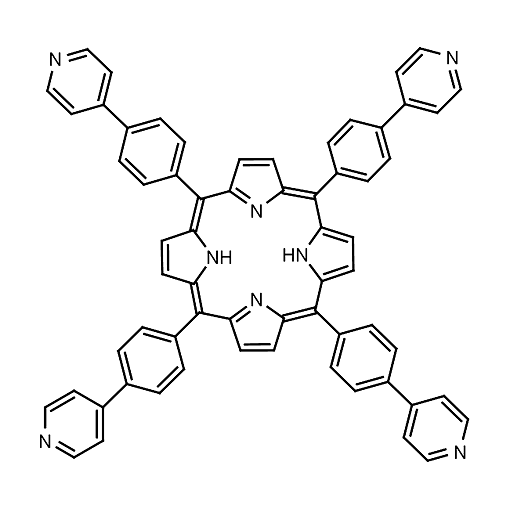
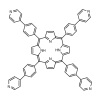
meso-Tetra(4-(4-pyridinium)phenyl)porphine
Molecular Formula: C64H42N8
CAS#: 1375257-01-4
SMILES:
C1(C2=CC=C(C3=CC=NC=C3)C=C2)=C4C=CC(C(C5=CC=C(C6=CC=NC=C6)C=C5)=C7C=CC(N7)=C(C8=CC=C(C9=CC=NC=C9)C=C8)C(C=C%10)=NC%10=C(C%11=CC=C(C%12=CC=NC=C%12)C=C%11)C%13=CC=C1N%13)=N4
MDL#: MFCD20261457
Catalog#: U34741
Molecular weight: 923.091 g/mol
Appearance: Purple solid
Purity: >95%
Storage: Store at room temperature
Solubility: meso-Tetra(4-(4-pyridinium)phenyl)porphine is of interest for the construction of metal-organic frameworks MOF’s and artificial photosynthesis
Other names:
- 5,10,15,20-Tetrakis[4-(4-pyridyl)phenyl]porphyrin
- 5,10,15,20-Tetrakis[4-(4-pyridinyl)phenyl]-21H,23H-porphyrin
- 5,10,15,20-Tetrakis(4-(pyridin-4-yl)phenyl)porphyrin
- Tetrakis(4-pyridylphenyl)porphyrin
- TPhPyP
- 4′-TPhPyP
- TPPP
Fields of Interest
porphyrin chemistry, metal-organic frameworks, coordination polymers, supramolecular chemistry, molecular cages, self-assembly, heavy metal adsorption, metal ion coordination, porous materials, photophysics, photocatalyst design, oxygen adsorption, oxygen reduction, hydrogen peroxide photosynthesis, molecular recognition, metalloporphyrins
Background
meso-Tetra[4-(4-pyridyl)phenyl] Porphine (CAS 1375257-01-4) is a free-base porphyrin bearing four extended 4-(pyridin-4-yl)phenyl substituents at the meso positions. Each arm terminates in a pyridyl nitrogen capable of coordinating metal ions, giving the molecule four peripheral nitrogen-donor sites in addition to the N₄ metal-binding cavity of the porphyrin macrocycle. This combination makes the compound a versatile tetratopic ligand for coordination chemistry, supramolecular self-assembly, and porous-material construction.
The extended phenyl–pyridyl substituents also influence interactions between the porphyrin and small molecules. Recent research has used this exact compound as a structural analogue in studies of molecular oxygen adsorption and porphyrin photocatalyst design. Its peripheral pyridyl nitrogen atoms interact with polarized O₂, making the compound useful for distinguishing the effects of specific nitrogen environments on oxygen binding. In that work, however, TPhPyP served as a mechanistic comparison compound rather than the optimized hydrogen-peroxide-producing photocatalyst. This distinction makes it particularly valuable for structure–property studies linking peripheral nitrogen functionality with oxygen adsorption, coordination, and photochemical behavior.
Applications
TPhPyP is primarily used as a multitopic porphyrin ligand for coordination assemblies, porous materials, and structure–property studies involving metal ions and molecular oxygen.
- Metal-organic framework construction: The four peripheral pyridyl donors provide directional coordination sites for metal ions. The exact compound has been combined with cobalt ions to form a porphyrin-based coordination framework, demonstrating its suitability as a tetratopic ligand for porous and networked materials.
- Heavy-metal adsorption: A cobalt framework constructed directly from TPhPyP has been investigated for removal of Pb(II) and Cu(II) from aqueous media. The porphyrin-based network provides accessible coordination environments capable of interacting with dissolved metal ions.
- Oxygen adsorption and photocatalyst design: The exact compound was synthesized as a structural analogue in research on porphyrin photocatalysts for H₂O₂ photosynthesis. Oxygen temperature-programmed desorption experiments demonstrated interaction between O₂ and its peripheral pyridyl nitrogen sites, helping researchers determine how nitrogen electronic structure affects oxygen adsorption. TPhPyP itself was used as a mechanistic control rather than as the study’s optimized H₂O₂ photocatalyst.
- Supramolecular molecular cages: TPhPyP has been used directly as a cruciform nitrogen-donor ligand in coordination-driven self-assembly. Its four pyridyl termini can connect preorganized metalloporphyrin units to produce large multiporphyrin cages and box-like architectures.
- Photophysical and molecular-recognition studies: The conjugated porphyrin core provides strong visible-light absorption while the peripheral pyridyl groups introduce coordination and molecular-interaction sites. This combination supports studies of ligand geometry, guest interactions, oxygen binding, light-driven processes, and the relationship between molecular structure and porphyrin photophysics.
Selected Literature
- Arceo-Ruiz, H.; Xochitiotzi-Flores, E.; García-Ortega, H.; Farfán, N.; Santillan, R.; Rincón, S.; Zepeda, A. “Synthesis of a New Co Metal–Organic Framework Assembled from 5,10,15,20-Tetrakis((pyridin-4-yl)phenyl)porphyrin ‘Co-MTPhPyP’ and Its Application to the Removal of Heavy Metal Ions.” Molecules 2023, 28, 1816. DOI: 10.3390/molecules28041816.
- This study synthesizes and characterizes the exact TPhPyP ligand and uses it to construct a cobalt coordination framework evaluated for Pb(II) and Cu(II) adsorption, demonstrating its direct utility as a tetratopic ligand for functional porous materials.
- Guo, Y.; Zhou, Q.; Wang, L.; Deng, Z.; Phillips, D. L.; Tang, C. Y.; Zhu, Y. “Enhanced Hydrogen Peroxide Photosynthesis via Charge-Complementary π-Electron Sites.” Nature Communications 2025, 16, 6297. DOI: 10.1038/s41467-025-61452-3.
- This study synthesizes the exact compound, abbreviated TPPP in the paper, as a structural analogue to probe oxygen adsorption at peripheral pyridyl nitrogen sites. O₂ desorption measurements helped establish how nitrogen-site electronic structure influences oxygen binding in porphyrin photocatalyst design; TPPP served as a mechanistic comparison rather than the optimized H₂O₂-producing photocatalyst.
- Alessio, E.; Casanova, M.; Zangrando, E.; Iengo, E. “Modular Self-Assembled Multiporphyrin Cages with Tunable Shape.” Chemical Communications 2012, 48, 5112–5114. DOI: 10.1039/C2CC31420G.
- This study uses 4′-TPhPyP directly as a tetratopic pyridyl ligand in coordination-driven self-assembly, producing large cubic multiporphyrin cages and demonstrating the compound’s utility as a supramolecular building block.