
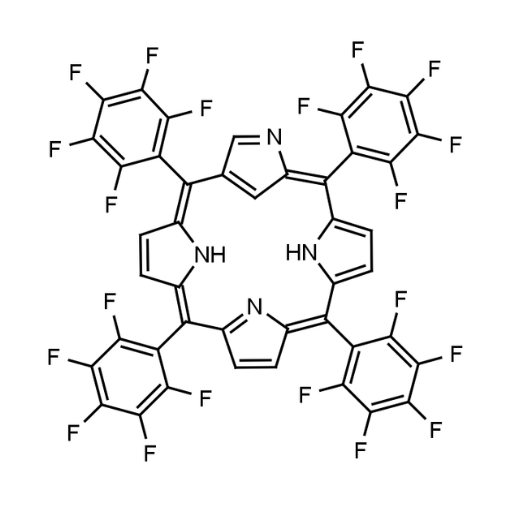
N-confused meso-Tetra (pentafluorophenyl) porphine
Molecular Formula: C44H10F20N4
CAS#: None
SMILES:
FC(C(F)=C(F)C(F)=C1F)=C1/C2=C3C=C(C=N/3)/C(C4=C(F)C(F)=C(F)C(F)=C4F)=C(N/5)/C=CC5=C(C6=C(F)C(F)=C(F)C(F)=C6F)\C7=N/C(C=C7)=C(C8=C(F)C(F)=C(F)C(F)=C8F)\C9=CC=C2N9
MDL#: None
Catalog#: N35005
Molecular weight: 974.54 g/mol
Appearance: Purple solid
Purity: >95%
Storage: store at room temperature
Solubility: Organic solvents
Other names:
- 5,10,15,20-Tetrakis(pentafluorophenyl)-2-aza-21-carbaporphyrin
- meso-Tetrakis(pentafluorophenyl)-N-confused porphyrin
- Tetrakis(pentafluorophenyl)-N-confused porphyrin
- Pentafluorophenyl-N-confused porphyrin
- PFNCP
- C₆F₅–NCP
- NCTPFPP
- N-Confused tetrakis(pentafluorophenyl)porphyrin
Fields of Interest
N-confused porphyrin chemistry, carbaporphyrinoids, coordination chemistry, organometallic chemistry, metalloporphyrins, anion recognition, molecular sensing, redox chemistry, catalysis, supramolecular chemistry, porphyrinoid synthesis, electronic structure
Background & Applications:
N-Confused meso-Tetra(pentafluorophenyl)porphine is an unusual porphyrin isomer in which one pyrrole ring is inverted relative to a conventional porphyrin. This structural rearrangement places a pyrrolic nitrogen on the exterior of the macrocycle and a carbon atom within the central coordination cavity. As a result, N-confused porphyrins exhibit distinctive coordination, acid–base, electronic, and tautomeric behavior compared with conventional tetraphenylporphyrins. The four strongly electron-withdrawing pentafluorophenyl groups further modify the electronic properties of the macrocycle.
The unusual N₃C coordination environment of this porphyrinoid makes it particularly valuable for studying metal binding and organometallic porphyrin chemistry. The compound has been used to prepare complexes with Cu, Ag, Ni, Pd, Pt, and Rh, with the internal carbon capable of participating directly in metal coordination. These complexes provide models for studying oxidation states, metal–carbon bonding, electronic structure, and reactivity that are difficult to access with conventional porphyrins.
The peripheral nitrogen of the confused pyrrole also creates an accessible recognition site. Metal complexes derived from this scaffold have demonstrated anion binding through hydrogen-bonding interactions, while Cu complexes exhibit protonation-dependent control of Cu(II)/Cu(III) redox states. Rhodium derivatives have additionally been investigated as highly effective catalysts for alkene cyclopropanation. Potential research applications therefore include coordination chemistry, anion recognition and sensing, molecular redox systems, organometallic chemistry, catalytic reaction development, and fundamental studies of nontraditional porphyrinoid electronic structure.
Literature:
- “N-Confused Porphyrin”: A New Isomer of Tetraphenylporphyrin, Hiroyuki Furuta; Tsutomu Asano; Takuji Ogawa Journal American Chemical Society (1994) 116 (2): 767–768. https://doi.org/10.1021/ja00081a047
- Fisher, J. M.; Kensy, V. K.; Geier, G. R., III. “Two-Step, One-Flask Synthesis of an N-Confused Porphyrin Bearing Pentafluorophenyl Substituents.” Journal of Organic Chemistry 2017, 82, 4429–4434. DOI: 10.1021/acs.joc.7b00195.
- This study focuses directly on N-confused tetrakis(pentafluorophenyl)porphyrin, developing a streamlined two-step, one-flask synthesis from pyrrole and pentafluorobenzaldehyde. The work also discusses the distinctive polarity, basicity, tautomerism, metal coordination, and chemical behavior that make this N-confused porphyrin an important research scaffold.
- Maeda, H.; Osuka, A.; Furuta, H. “N-Confused Porphyrin-Bearing meso-Perfluorophenyl Groups: A Potential Agent That Forms Stable Square-Planar Complexes with Cu(II) and Ag(III).” Organic Letters 2003, 5, 1293–1296. DOI: 10.1021/ol034227l.
- This foundational study reports the pentafluorophenyl-substituted N-confused porphyrin itself and demonstrates its coordination with Cu(II), Ag(III), Ni(II), and Pd(II). X-ray crystallography revealed unusual square-planar metal complexes, highlighting the distinctive coordination environment created by the inverted pyrrole ring.
- Maeda, H.; Ishikawa, Y.; Matsuda, T.; Osuka, A.; Furuta, H. “Control of Cu(II) and Cu(III) States in N-Confused Porphyrin by Protonation/Deprotonation at the Peripheral Nitrogen.” Journal of the American Chemical Society 2003, 125, 11822–11823. DOI: 10.1021/ja0356075.
- Using a tetrakis(pentafluorophenyl)-N-confused porphyrin copper complex, this study demonstrated reversible interconversion between Cu(II) and Cu(III). Interaction of anions with the unusual peripheral NH group influenced the redox potential, illustrating how N-confusion can couple molecular recognition with metal-centered redox chemistry.
- Niino, T.; Toganoh, M.; Andrioletti, B.; Furuta, H. “Rhodium N-Confused Porphyrin-Catalyzed Alkene Cyclopropanation.” Chemical Communications 2006, 4335–4337. DOI: 10.1039/B608154A.
- This work demonstrates the catalytic potential of rhodium N-confused porphyrins in alkene cyclopropanation. The catalysts produced cyclopropanes in high yields and with high trans selectivity, showing how the unusual coordination environment of N-confused porphyrins can be exploited in organometallic catalysis.