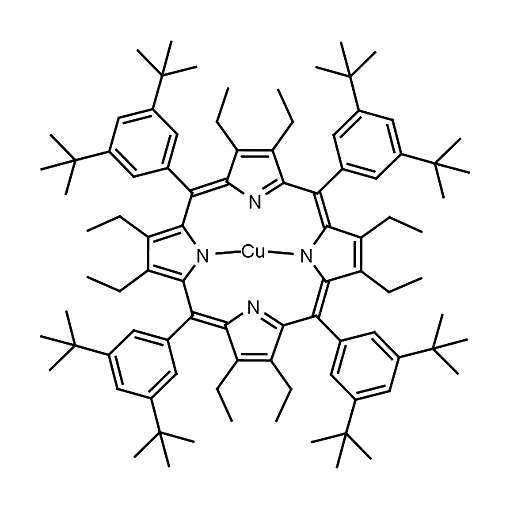
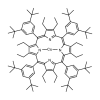
Cu(II) meso-Tetra (3,5-di-t-butylphenyl) octaethylporphine
Molecular Formula: C92H124CuN4
CAS#: None
SMILES: CCC1=C(CC)\C2=C(\C3=C(CC)C(CC)=C4N3[Cu]N3C(\C(CC)=C(CC)/C3=C(/C3=N/C(/C(CC)=C3CC)=C\4C3=CC(=CC(=C3)C(C)(C)C)C(C)(C)C)C3=CC(=CC(=C3)C(C)(C)C)C(C)(C)C)=C(/C1=N/2)C1=CC(=CC(=C1)C(C)(C)C)C(C)(C)C)C1=CC(=CC(=C1)C(C)(C)C)C(C)(C)C
MDL#: None
Catalog#: U34967
Molecular weight: 1349.54 g/mol
Appearance: purple solid
Purity: >95%
Storage: room temp
Solubility: Organic solvents
Other names:
- Copper(II) 2,3,7,8,12,13,17,18-octaethyl-5,10,15,20-tetrakis(3,5-di-tert-butylphenyl)porphyrin
- Cu(II) octaethyl meso-tetrakis(3,5-di-tert-butylphenyl)porphyrin
- Copper(II) octaethyl tetra(3,5-di-tert-butylphenyl)porphyrin
Fields of Interest
Distorted porphyrins, nonplanar porphyrins, copper porphyrins, dodeca-substituted porphyrins, conformational chemistry, macrocycle distortion, electrochemistry, Cu(II)/Cu(III) redox chemistry, porphyrin oxidation, sterically hindered porphyrins, photophysics, supramolecular chemistry, molecular recognition
Background
Cu(II) meso-Tetra(3,5-di-tert-butylphenyl) octaethylporphine is a highly substituted copper(II) porphyrin containing eight β-ethyl groups and four meso-3,5-di-tert-butylphenyl substituents. Copper(II) occupies the central N₄ coordination site, while the combination of β-octaethyl and meso-tetraaryl substitution produces a dodeca-substituted porphyrin framework closely related to copper(II) octaethyltetraphenylporphyrin, Cu(OETPP).
Octaethyl-tetraaryl porphyrins are important models for studying strongly nonplanar macrocycle conformations, particularly saddle distortion produced by steric interaction between β-alkyl and meso-aryl substituents. The 3,5-di-tert-butyl groups in U34967 add substantial peripheral steric bulk beyond the parent OETPP framework. Although direct structural studies of U34967 were not located, related Cu(OETPP) systems demonstrate that nonplanarity can substantially affect porphyrin electronic structure, oxidation potentials, metal–nitrogen bonding, spectroscopy, and the coupling between metal- and macrocycle-centered redox processes. U34967 therefore provides a particularly sterically encumbered copper porphyrin scaffold for investigating how peripheral bulk and macrocycle deformation influence metalloporphyrin properties.
Applications
Cu(II) meso-Tetra(3,5-di-tert-butylphenyl) octaethylporphine is most appropriately positioned as a sterically hindered, nonplanar copper porphyrin for structure–property and redox research. Applications below are supported primarily by the closely related Cu(OETPP) scaffold unless otherwise noted.
- Nonplanar porphyrin conformational studies: β-Octaethyl/meso-tetraaryl substitution is a well-established strategy for forcing porphyrin macrocycles away from planarity. The corresponding Cu(OETPP) system adopts a pronounced saddle conformation, making this more sterically bulky derivative relevant to investigations of macrocycle distortion and steric control.
- Copper redox and electrochemical research: Highly nonplanar Cu(OETPP) exhibits unusual oxidation chemistry involving sequential macrocycle-centered oxidation followed by an accessible Cu(II)/Cu(III) redox process. U34967 provides a closely related scaffold for examining how additional peripheral tert-butyl substitution influences these electronic processes.
- Porphyrin π-cation radical research: Oxidized Cu(OETPP) has been structurally characterized as a porphyrin π-cation radical, demonstrating that strongly distorted copper porphyrins provide useful models for separating metal-centered and ligand-centered oxidation chemistry.
- Sterically protected metalloporphyrin environments: The eight tert-butyl groups create a bulky hydrocarbon periphery around an already crowded octaethyl-tetraaryl macrocycle. This architecture is relevant to studies of steric shielding, intermolecular approach, aggregation control, and the design of spatially defined porphyrin environments, although these effects should be verified experimentally for U34967 itself.
- Photophysical and structure–property comparisons: Comparison with Cu(OEP), Cu(TPP), Cu(OETPP), and less substituted copper porphyrins can help identify how β-ethyl substitution, meso-aryl groups, peripheral tert-butyl groups, and macrocycle deformation influence absorption, electronic structure, and metalloporphyrin behavior.
Selected Literature
Peer-reviewed studies specifically using Cu(II) meso-Tetra(3,5-di-tert-butylphenyl) octaethylporphine were not located. The following publications provide the strongest support from the closely related Cu(OETPP) scaffold and functionalized nonplanar octaethyl-tetraaryl porphyrins.
- Fang, Y.; Senge, M. O.; Van Caemelbecke, E.; Smith, K. M.; Medforth, C. J.; Zhang, M.; Kadish, K. M. “Impact of Substituents and Nonplanarity on Nickel and Copper Porphyrin Electrochemistry: First Observation of a Cu(II)/Cu(III) Reaction in Nonaqueous Media.” Inorganic Chemistry 2014, 53, 10772–10778. DOI: 10.1021/ic502162p.
- This study examines the closely related Cu(OETPP) scaffold directly and shows sequential porphyrin-centered oxidations followed by a Cu(II)/Cu(III) process, demonstrating the major influence of nonplanarity on copper porphyrin electrochemistry.
- Renner, M. W.; Barkigia, K. M.; Zhang, Y.; Medforth, C. J.; Smith, K. M.; Fajer, J. “Consequences of Oxidation in Nonplanar Porphyrins: Molecular Structure and Diamagnetism of the π Cation Radical of Copper(II) Octaethyltetraphenylporphyrin.” Journal of the American Chemical Society 1994, 116, 8582–8592. DOI: 10.1021/ja00098a019.
- This foundational Cu(OETPP) study structurally characterizes both the neutral copper complex and its oxidized π-cation radical, directly linking the sterically crowded dodeca-substituted framework with saddle distortion and unusual electronic behavior.
- Sparks, L. D.; Medforth, C. J.; Park, M. S.; Chamberlain, J. R.; Ondrias, M. R.; Senge, M. O.; Smith, K. M.; Shelnutt, J. A. “Metal Dependence of the Nonplanar Distortion of Octaalkyltetraphenylporphyrins.” Journal of the American Chemical Society 1993, 115, 581–592. DOI: 10.1021/ja00055a030.
- This crystallographic and spectroscopic study includes Cu(OETPP) and establishes how β-octaethyl/meso-tetraaryl substitution produces pronounced nonplanarity while showing that the central metal further modulates macrocycle conformation and optical properties.
- Norvaiša, K.; Yeow, K.; Twamley, B.; Roucan, M.; Senge, M. O. “Strategic Synthesis of ‘Picket Fence’ Porphyrins Based on Nonplanar Macrocycles.” European Journal of Organic Chemistry 2021, 2021, 1871–1882. DOI: 10.1002/ejoc.202100154.
- This study investigates functionalized octaethyl-tetraaryl porphyrins with bulky meta-substitution, demonstrating how peripheral steric engineering can be combined with intrinsically nonplanar OETPP-type macrocycles to create spatially defined supramolecular environments.
- Ishizuka, T.; Grover, N.; Kingsbury, C. J.; Kotani, H.; Senge, M. O.; Kojima, T. “Nonplanar Porphyrins: Synthesis, Properties, and Unique Functionalities.” Chemical Society Reviews 2022, 51, 7560–7630. DOI: 10.1039/D2CS00391K.
- This review places highly substituted OETPP-type systems in the broader context of nonplanar porphyrin chemistry and summarizes how macrocycle deformation can alter electronic structure, redox behavior, recognition, catalysis, and photophysical properties.