
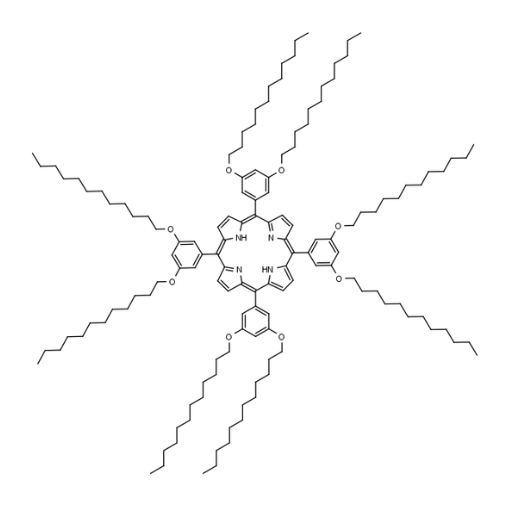
meso-Tetra(3,5-didodecyloxyphenyl) porphine
Molecular Formula: C140H222N4O8
CAS#: None
SMILES: CCCCCCCCCCCCOC1=CC(=CC(OCCCCCCCCCCCC)=C1)C1=C2NC(\C=C/2)=C(/C2=N/C(/C=C2)=C(\C2=CC=C(N2)/C(=C2/C=CC\1=N/2)C1=CC(OCCCCCCCCCCCC)=CC(OCCCCCCCCCCCC)=C1)C1=CC(OCCCCCCCCCCCC)=CC(OCCCCCCCCCCCC)=C1)C1=CC(OCCCCCCCCCCCC)=CC(OCCCCCCCCCCCC)=C1
MDL#: None
Catalog#: D34765
Molecular weight: 2089.32 g/mol
Appearance: Purple Solid
Purity: >95%
Storage: room temperature
Solubility: Organic solvents like dichloromethane, hexane
Other names:
- 5,10,15,20-tetrakis[3,5-bis(dodecyloxy)phenyl]porphyrin
- Octadodecyloxy-substituted tetraphenylporphyrin
- Free-base meso-tetra(3,5-didodecyloxyphenyl)porphine
Fields of Interest
porphyrin chemistry, supramolecular chemistry, self-assembly, liquid crystals, discotic materials, organic electronics, optoelectronics, thin films, nanomaterials, molecular electronics, photochemistry, light-harvesting materials, surface science
Background & Applications
meso-Tetra(3,5-didodecyloxyphenyl) Porphine is a highly lipophilic free-base porphyrin featuring eight long dodecyloxy chains distributed around the tetraphenylporphyrin macrocycle. The combination of a conjugated, photoactive porphyrin core with flexible hydrocarbon chains gives this molecule properties of interest for supramolecular organization, solution-processable materials, and self-assembled porphyrin systems.
Long-chain alkoxy substitution can enhance compatibility with nonpolar organic environments while promoting intermolecular van der Waals interactions between peripheral alkyl chains. In related dodecyloxy-substituted porphyrins, these interactions influence aggregation, thin-film morphology, surface organization, and liquid-crystalline behavior. The extended porphyrin π-system additionally provides characteristic visible-light absorption and the ability to coordinate metal ions at the macrocyclic core.
Potential research applications include discotic and liquid-crystalline materials, self-assembled nanostructures, organic and molecular electronics, optoelectronic materials, thin-film fabrication, light-harvesting systems, supramolecular assemblies, and porphyrin-based functional materials.
Literature:
- Microporous and Mesoporous Materials, 2009, vol. 120, # 3, p. 331 – 338, 10.1016/j.micromeso.2008.11.025
- Milic, T.; Garno, J. C.; Batteas, J. D.; Smeureanu, G.; Drain, C. M. “Self-Organization of Self-Assembled Tetrameric Porphyrin Arrays on Surfaces.” Langmuir 2004, 20, 3974–3983. DOI: 10.1021/la0359023.
- This study examines porphyrin assemblies containing long-chain dodecyloxyphenyl substituents and demonstrates how the peripheral hydrocarbon chains strongly influence surface organization. Dodecyloxy-functionalized porphyrin assemblies formed continuous films through interactions between the long alkyl chains, illustrating the importance of these substituents in controlling porphyrin self-assembly and thin-film morphology.
- Liu, W.; Shi, Y.; Shi, T.; Liu, G.; Liu, Y.; Wang, C.; Zhang, W. “Synthesis and Characterization of Liquid Crystalline 5,10,15,20-Tetrakis(4-n-alkanoyloxyphenyl)porphyrins.” Liquid Crystals 2003, 30, 1255–1257. DOI: 10.1080/0267829031000139559.
- This work investigates closely related long-chain-substituted tetraphenylporphyrins and their zinc complexes. The compounds exhibited hexagonal columnar liquid-crystalline phases, demonstrating how flexible hydrocarbon substituents attached to a porphyrin core can promote mesogenic behavior and organized supramolecular structures.