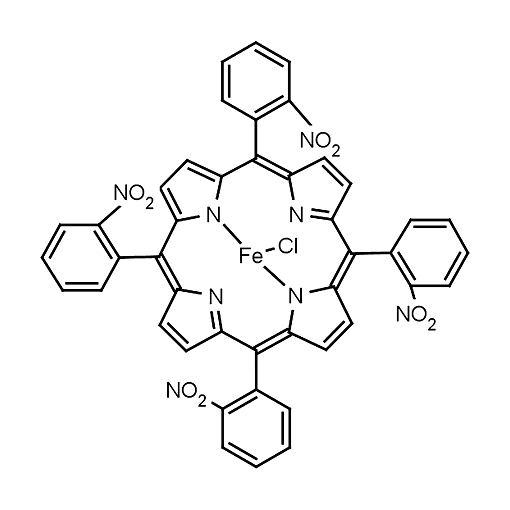
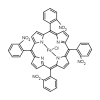
Fe(III) meso-Tetra(2-nitrophenyl) porphine chloride
Molecular Formula: C44H24ClFeN8O8
CAS#: 118115-08-5
SMILES: [O-][N+](=O)C1=C(C=CC=C1)C1=C2\C=CC(=N\2)/C(=C2/C=C\C3=C(\C4=N\C(\C=C4)=C(/C4=CC=C\1N4[Fe](Cl)N23)C1=C(C=CC=C1)[N+]([O-])=O)C1=C(C=CC=C1)[N+]([O-])=O)C1=C(C=CC=C1)[N+]([O-])=O
MDL#: None
Catalog#: U34690
Molecular weight: 884.023 g/mol
Appearance: Solid
Purity: >95%
Storage: Room temperature
Solubility: Organic solvents
Other names:
- 5,10,15,20-Tetra(2-nitrophenyl)porphyrin iron(III) chloride
- Tetrakis(2-nitrophenyl)porphyrin iron(III) chloride
- Tetra(2-nitrophenyl)porphyrin iron chloride
- Iron(III) tetrakis(ortho-nitrophenyl)porphyrin chloride
- Fe(TNO₂PP)Cl
- T(o-NO₂)PPFeCl
- TNPPFeCl
Fields of Interest
iron porphyrins, biomimetic catalysis, cytochrome P450 models, oxidative drug metabolism, hydrocarbon oxidation, alkane hydroxylation, alkene epoxidation, molecular oxygen oxidation, high-valent iron–oxo chemistry, redox catalysis, metalloporphyrin spectroscopy
Background
Fe(III) meso-Tetra(2-nitrophenyl) porphine chloride (CAS 118115-08-5) is an iron(III) tetraarylporphyrin containing four strongly electron-withdrawing ortho-nitro substituents and an axial chloride ligand. The iron center is coordinated within the porphyrin N₄ cavity, producing a redox-active metalloporphyrin that can access high-valent iron intermediates characteristic of biomimetic oxidation chemistry.
The location of the nitro substituents is particularly important. In addition to withdrawing electron density from the porphyrin system, the bulky ortho groups introduce steric effects around the macrocycle. These features influence the iron redox environment, molecular conformation, aggregation behavior, and resistance to catalyst self-oxidation. The resulting combination of electronic activation and steric protection makes Fe(TNO₂PP)Cl useful as a model for studying heme-like oxidation processes and the relationships among porphyrin substitution, iron–oxo reactivity, and catalytic selectivity.
Applications
Fe(TNO₂PP)Cl is primarily used as a biomimetic oxidation catalyst and model compound for cytochrome P450-type chemistry.
- Drug-metabolism modeling: The compound has been used directly to reproduce oxidative transformations associated with biological drug metabolism. Iron ortho-nitrophenylporphyrin chloride can generate major metabolites of pharmaceutical substrates using oxidants such as hydrogen peroxide, iodosobenzene, and organic hydroperoxides, providing a nonenzymatic model for oxidative metabolic pathways.
- Hydrocarbon oxidation: Nitro-substituted iron porphyrins including Fe(TNO₂PP)Cl catalyze alkane hydroxylation and alkene epoxidation through high-valent iron–oxo intermediates. The ortho-nitro groups provide both electron-withdrawing and steric effects that can influence catalyst activity and stability.
- Aerobic oxidation: The exact compound has been evaluated in metalloporphyrin-catalyzed oxidation using molecular oxygen. Electron-withdrawing nitro substitution enhances the oxidative activity of the iron porphyrin framework, supporting applications in mechanistic and synthetic oxidation research.
- High-valent iron–oxo chemistry: Fe(TNO₂PP)Cl is useful for studying reactive iron species analogous to intermediates proposed for heme enzymes. Research with this scaffold has helped clarify how porphyrin substitution affects formation and reactivity of Fe(IV)–oxo and related oxidizing species.
- Structure–activity and spectroscopic studies: Comparison with para-nitro, chloro, methyl, methoxy, and unsubstituted iron tetraphenylporphyrins allows researchers to examine how peripheral substituents alter UV-visible, infrared, Fe–Cl, and metal-centered properties.
Selected Literature
- Sun, Z.-C.; She, Y.-B.; Zhou, Y.; Song, X.-F.; Li, K. “Synthesis, Characterization and Spectral Properties of Substituted Tetraphenylporphyrin Iron Chloride Complexes.” Molecules 2011, 16 (4), 2960–2970. DOI: 10.3390/molecules16042960.
- This study synthesizes and characterizes the exact ortho-nitro Fe(III) porphyrin chloride as part of a systematic substituted-porphyrin series, comparing its UV-visible, IR, and far-IR properties with other iron tetraphenylporphyrins.
- Bazin, M. J.; Shi, H.; Delaney, J.; Kline, B.; Zhu, Z.; Kuhn, C.; Berlioz, F.; Farley, K. A.; Fate, G.; Lam, W.; Walker, G. S.; Yu, L.; Pollastri, M. P. “Efficient Use of the Iron Ortho-Nitrophenylporphyrin Chloride to Mimic Biological Oxidations of Dimethylaminoantipyrine.” Chemical Biology & Drug Design 2007, 70 (4), 354–359. DOI: 10.1111/j.1747-0285.2007.00568.x.
- The researchers use Fe(TNO₂PP)Cl directly as a biomimetic oxidation catalyst to generate major metabolites of dimethylaminoantipyrine, demonstrating its relevance to cytochrome P450-type drug-metabolism studies.
- Wang, L.; She, Y.; Zhong, R.; Ji, H.; Zhang, Y.; Song, X. “A Green Process for Oxidation of p-Nitrotoluene Catalyzed by Metalloporphyrins under Mild Conditions.” Organic Process Research & Development 2006, 10 (4), 757–761. DOI: 10.1021/op060056z.
- This study evaluates T(o-NO₂)PPFeCl directly in the molecular-oxygen oxidation of p-nitrotoluene and shows how strongly electron-withdrawing porphyrin substituents can enhance metalloporphyrin catalytic activity.
- Assis, M. D.; de Melo, A. J. B.; Serra, O. A.; Iamamoto, Y. “Study of Catalytic Activity of Nitro Substituted Ironporphyrins.” Journal of Molecular Catalysis A: Chemical 1995, 97, 41–47. DOI: 10.1016/1381-1169(94)00063-8.
- This foundational study investigates ortho-nitrophenyl-substituted iron porphyrins including FeTNPPCl in cyclohexane oxidation and relates their catalytic behavior to high-valent iron–oxo active species and the steric protection provided by ortho substitution.
- Schiavon, M. A.; Iamamoto, Y.; Nascimento, O. R.; Assis, M. D. “Catalytic Activity of Nitro- and Carboxy-Substituted Iron Porphyrins in Hydrocarbon Oxidation: Homogeneous Solution and Supported Systems.” Journal of Molecular Catalysis A: Chemical 2001, 174, 213–222. DOI: 10.1016/S1381-1169(01)00176-5.
- This study examines closely related ortho-nitro iron(III) porphyrins in alkene epoxidation and alkane hydroxylation, demonstrating how bulky electron-withdrawing nitro groups can enhance catalytic activity while helping protect the metalloporphyrin from self-oxidation.