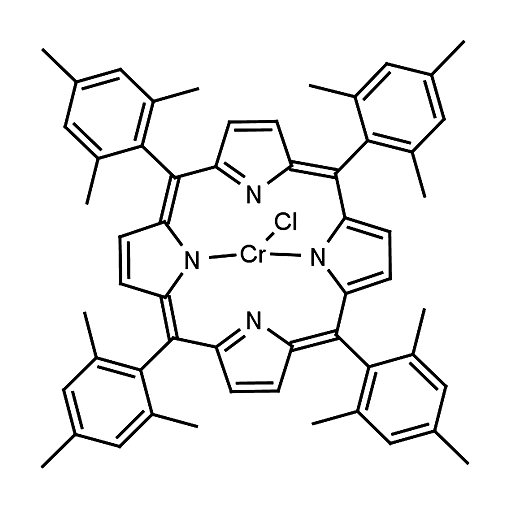
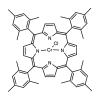
Cr(III) meso-Tetra (2,4,6-trimethylphenyl) porphine chloride
Molecular Formula: C56H52ClCrN4
CAS#: 80584-29-8
SMILES: CC1=CC(C)=C(C(C)=C1)C1=C2\C=CC(=N\2)/C(=C2/C=C\C3=C(\C4=N\C(\C=C4)=C(/C4=CC=C\1N4[Cr](Cl)N23)C1=C(C)C=C(C)C=C1C)C1=C(C)C=C(C)C=C1C)C1=C(C)C=C(C)C=C1C
MDL#: None
Catalog#: U34736
Molecular weight: 868.49 g/mol
Appearance: Purple crystalline solid
Purity: >95%
Storage: Room Temperature
Solubility: Organic solvents
Other names:
- Chromium(III) meso-tetramesitylporphyrin chloride
- Chloro(5,10,15,20-tetramesitylporphyrinato)chromium(III)
- Chloro[5,10,15,20-tetrakis(2,4,6-trimethylphenyl)porphyrinato]chromium(III)
- Chromium(III) tetramesitylporphyrin chloride
- Cr(III)TMPCl
- Cr(TMP)Cl
Fields of Interest
chromium porphyrins, cytochrome P450 models, high-valent metal–oxo chemistry, sulfoxidation, oxygen atom transfer, photochemistry, axial ligand coordination, redox chemistry, electron transfer, biomimetic oxidation, heterometallic complexes, metalloporphyrin catalysis
Background
Cr(III) meso-Tetra(2,4,6-trimethylphenyl) Porphine Chloride (CAS 80584-29-8) is a chromium(III) metalloporphyrin based on the sterically hindered tetramesitylporphyrin (TMP) ligand. Four 2,4,6-trimethylphenyl groups surround the porphyrin macrocycle, while chromium(III) occupies the central N₄ coordination site with chloride as an axial ligand. The ortho-methyl groups of the mesityl substituents create substantial steric shielding around the porphyrin core and influence both its molecular conformation and accessibility to axial ligands.
Cr(TMP)Cl is particularly valuable as a precursor to high-valent chromium–oxo porphyrins. Oxidation of the Cr(III) complex can generate Cr(IV)=O and Cr(V)=O species that provide well-defined systems for studying oxygen-atom transfer, electron transfer, and oxidation mechanisms. The sterically protected TMP ligand helps stabilize reactive chromium species sufficiently for spectroscopic, structural, and kinetic investigation. Its comparatively electron-rich mesityl substituents also provide a useful reference point when comparing chromium-oxo reactivity with more electron-deficient fluorinated porphyrin systems.
Applications
Cr(TMP)Cl is primarily used in high-valent chromium chemistry, mechanistic oxidation studies, and metalloporphyrin coordination research.
- Chromium–oxo generation and sulfoxidation: Cr(TMP)Cl can be oxidized to chromium(IV)-oxo and chromium(V)-oxo derivatives. These species have been used to investigate oxidation of thioanisoles and other sulfur-containing substrates, helping define how chromium oxidation state and porphyrin electronics affect oxygen-transfer rates.
- Oxygen-atom transfer chemistry: The Cr(TMP) framework is a well-established model for studying metal–oxo formation and reactivity. Its high-valent oxo derivatives can transfer oxygen to suitable substrates, providing mechanistic models for metalloporphyrin-mediated oxidation.
- Photochemistry and axial ligand exchange: Chromium(III) tetramesitylporphyrin complexes undergo photoinduced axial-ligand dissociation. Laser photolysis studies have used this system to examine formation of coordinatively unsaturated chromium intermediates and subsequent binding of water, pyridines, and other donor ligands.
- Redox and electron-transfer studies: Cr(TMP) complexes can undergo oxidation involving either the chromium center or the conjugated porphyrin π-system. This makes the scaffold useful for distinguishing metal-centered oxidation from porphyrin radical-cation formation and for examining coupling between ligand and metal redox states.
- Heterometallic coordination chemistry: Cr(TMP)Cl can act as an acceptor toward oxygen-donor metalloligands. Its axial coordination chemistry has been exploited to construct oxido-bridged chromium–titanium bi- and trimetallic complexes, providing model systems for studying metal–metal communication, ligand substitution, and multimetallic molecular architectures.
Selected Literature
- Skipworth, T.; Khashimov, M.; Ojo, I.; Zhang, R. “Kinetics of Chromium(V)-Oxo and Chromium(IV)-Oxo Porphyrins: Reactivity and Mechanism for Sulfoxidation Reactions.” Journal of Inorganic Biochemistry 2022, 237, 112006. DOI: 10.1016/j.jinorgbio.2022.112006.
- This study uses Cr(III) tetramesitylporphyrin chloride as the precursor to Cr(IV)- and Cr(V)-oxo TMP complexes and compares their kinetics in thioanisole sulfoxidation, demonstrating the role of oxidation state and porphyrin electronics in oxygen-transfer reactivity.
- Huang, T.; Wu, X.; Weare, W. W.; Sommer, R. D. “Mono-Oxido-Bridged Heterobimetallic and Heterotrimetallic Compounds Containing Titanium(IV) and Chromium(III).” European Journal of Inorganic Chemistry 2014, 2014 (33), 5662–5674. DOI: 10.1002/ejic.201402800.
- This work uses Cr(TMP)Cl directly and reports structural characterization of its hydrated form while employing the complex to construct oxido-bridged Ti–O–Cr assemblies, illustrating its axial coordination and heterometallic chemistry.
- Inamo, M.; Eba, K.; Nakano, K.; Itoh, N.; Hoshino, M. “Laser Photolysis Studies of the Photochemical Reactions of Chromium(III) Octaethylporphyrin and Tetramesitylporphyrin Complexes in Toluene Solution.” Inorganic Chemistry 2003, 42 (19), 6095–6105. DOI: 10.1021/ic0342696.
- This study investigates chromium(III) tetramesitylporphyrin chloride complexes directly, using laser photolysis to examine axial-ligand dissociation, coordinatively unsaturated intermediates, and subsequent ligand-binding reactions.
- Guldi, D. M.; Neta, P.; Hambright, P. “Oxidation of Chromium(III) Porphyrins to Their π-Radical Cations or to Oxochromium(IV) Porphyrins.” Journal of the Chemical Society, Faraday Transactions 1992, 88, 2013–2019. DOI: 10.1039/FT9928802013.
- This work examines Cr(III) tetramesitylporphyrin directly and demonstrates that oxidation can occur initially at the porphyrin π-system or evolve toward higher chromium oxidation states depending on reaction conditions, providing insight into coupled metal–ligand redox chemistry.
- Groves, J. T.; Kruper, W. J., Jr.; Haushalter, R. C.; Butler, W. M. “Synthesis, Characterization, and Molecular Structure of Oxo(porphyrinato)chromium(IV) Complexes.” Inorganic Chemistry 1982, 21 (4), 1363–1368. DOI: 10.1021/ic00134a018.
- This foundational study reports the preparation and characterization of Cr(TMP)Cl itself and its conversion to oxo(chromium(IV)) tetramesitylporphyrin, establishing the compound as a precursor for high-valent chromium–oxo chemistry.