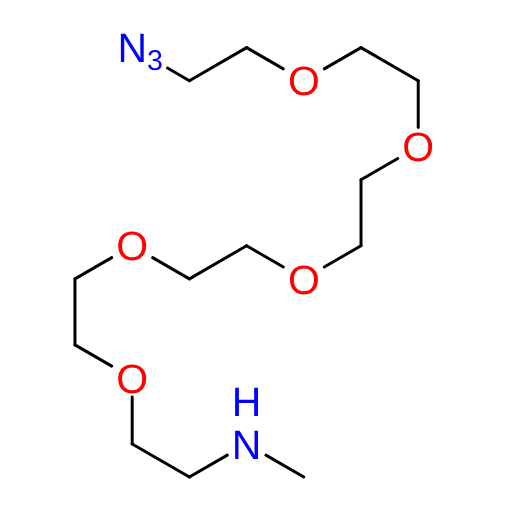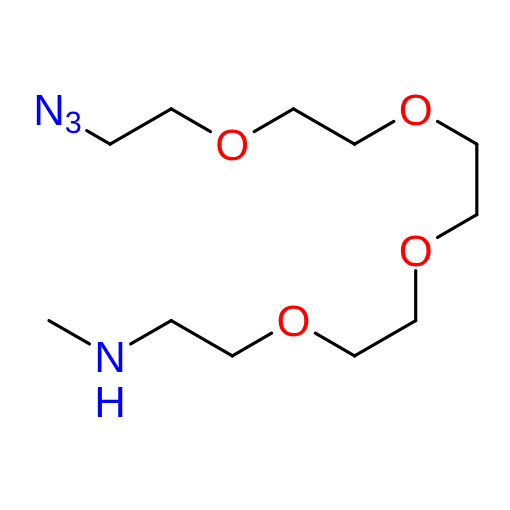
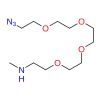
14-Azido-N-methyl-3,6,9,12-tetraoxatetradecan-1-amine (98%)
Molecular Formula: C11H24N4O4
CAS#: 2922968-17-8
SMILES: CNCCOCCOCCOCCOCCN=[N+]=[N-]
MDL#: MFCD36477619
Catalog#: AMTGC1186-AT23
Molecular weight: 276.33 g/mol
Appearance: Yellow liquid
Purity: 98%
Storage: Long-term storage in a freezer at -20°C
Solubility: Dichloromethane, Chloroform, Methanol
Other names:
- N3-PEG4-CH2CH2NHMe
- N-Methyl-14-azido-3,6,9,12-tetraoxatetradecan-1-amine
- Methylamino-PEG4-azide
Fields of Interest:
Bioconjugation, click chemistry, chemical biology, medicinal chemistry, molecular probe development, PEG linker synthesis, surface functionalization
Background
14-Azido-N-methyl-3,6,9,12-tetraoxatetradecan-1-amine (CAS 2922968-17-8) is a heterobifunctional polyethylene glycol (PEG) linker containing a terminal azide and an N-methyl secondary amine. These two functional groups provide complementary attachment sites for designing molecular conjugates through click chemistry and amide coupling. The defined PEG4 chain contains four ether oxygen atoms, creating a flexible, polar spacer between the reactive termini.
The secondary amine retains an N–H bond that can undergo acylation with an appropriately activated carboxylic acid to form a tertiary amide. Under compatible conditions, this attachment leaves the azide available for subsequent conjugation with an alkyne-bearing partner. The resulting amide incorporates the N-methyl group and has no amide N–H hydrogen-bond donor, providing a distinct structural feature for linker design. Together, the defined spacer and chemically different termini make this compound a useful building block for exploring modular probes, ligand conjugates, and functional materials.
Applications
The compound’s azide and secondary amine groups support several potential research applications through established conjugation chemistry.
Click chemistry and molecular labeling: The azide can participate in copper(I)-catalyzed azide–alkyne cycloaddition (CuAAC) with terminal alkynes, forming a triazole linkage. This provides a route for attaching suitably functionalized fluorescent reporters, affinity tags, or other molecular components. The secondary amine supplies an additional site for incorporating the linker into a larger construct.
Copper-free bioconjugation: Reaction with a strained cyclooctyne partner offers a route to strain-promoted azide–alkyne cycloaddition (SPAAC). This approach is relevant to conjugation workflows involving components sensitive to copper exposure. Selection of the reaction partner and conditions depends on the intended biomolecule or probe.
Probe development and medicinal chemistry: Amide coupling at the N-methylamino terminus can connect a carboxyl-containing ligand or molecular fragment to the PEG spacer. The retained azide then allows a second component to be introduced through click chemistry. This sequential approach offers flexibility when constructing and comparing ligand–reporter conjugates or other bifunctional research molecules.
Surface and polymer functionalization: The same complementary reactions suggest a route for installing an azide-bearing spacer on appropriately activated carboxyl-containing polymers or surfaces. Subsequent coupling with an alkyne-functionalized component could introduce a label or recognition group, with the PEG segment providing separation from the attachment surface.
Literature:
These publications support the conjugation methods described above; they do not report studies of this exact compound.
- Hong, V.; Presolski, S. I.; Ma, C.; Finn, M. G. “Analysis and Optimization of Copper-Catalyzed Azide–Alkyne Cycloaddition for Bioconjugation.” Angewandte Chemie International Edition 2009, 48, 9879–9883. DOI: 10.1002/anie.200905087
- Examines catalyst systems and reaction conditions for CuAAC bioconjugation, offering practical context for coupling azide-functionalized linkers with biomolecular partners.
- Baskin, J. M.; et al. “Copper-free click chemistry for dynamic in vivo imaging.” Proceedings of the National Academy of Sciences 2007, 104, 16793–16797. DOI: 10.1073/pnas.0707090104
- Demonstrates labeling of azide-bearing biomolecules using a strained cyclooctyne, illustrating the chemistry underlying copper-free conjugation.
- Montalbetti, C. A. G. N.; Falque, V. “Amide bond formation and peptide coupling.” Tetrahedron 2005, 61, 10827–10852. DOI: 10.1016/j.tet.2005.08.031
- Reviews carboxylic acid activation and amide-forming reactions relevant to attaching amine-functionalized linkers to molecular building blocks.