
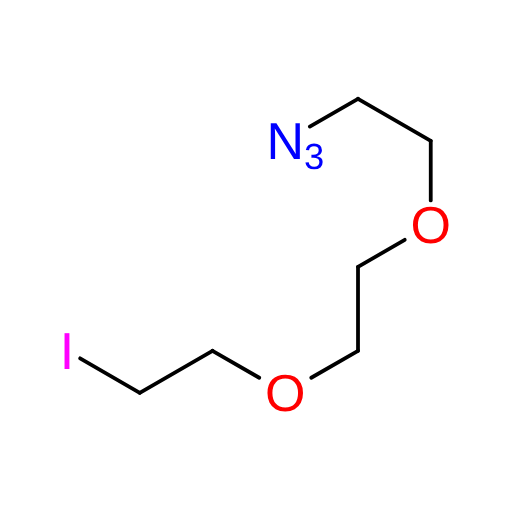
1-Azido-2-(2-(2-iodoethoxy)ethoxy)ethane (96%)
Molecular Formula: C6H12lO2
CAS#: 1309457-01-9
SMILES: ICCOCCOCCN=[N+]=[N-]
MDL#: None
Catalog#: AMTGC348-AI17
Molecular weight: 285.08 g/mol
Appearance: Dark Liquid
Purity: 96%
Storage: Room Temperature
Solubility: Dichloromethane, Chloroform, Methanol
Other names:
- N3-PEG2-CH2CH2I
- Azido-PEG2-iodide
- Azide-PEG3-iodide
- Iodo-PEG3-azide
Fields of Interest:
Functionalized PEGs, click chemistry, organic synthesis, bioconjugation, chemical biology, medicinal chemistry, drug discovery, PEG linker synthesis, molecular probe development, materials science, surface functionalization, specialty chemical synthesis
Background
1-Azido-2-(2-(2-iodoethoxy)ethoxy)ethane (CAS 1309457-01-9) is a compact heterobifunctional oligoethylene glycol linker containing two chemically distinct terminal functionalities: an azide and a primary alkyl iodide. These groups provide complementary reaction pathways, allowing the molecule to function as a versatile intermediate for sequential molecular modification. Frontier’s AMT catalog identifies the structure as N3-PEG2-CH₂CH₂I, while other commercial sources use the shorthand Azide-PEG3-iodide.
The azide terminus provides a bioorthogonal handle for copper-catalyzed azide–alkyne cycloaddition (CuAAC) and strain-promoted azide–alkyne cycloaddition (SPAAC). This allows attachment to terminal alkynes or strained cyclooctynes such as DBCO and BCN. The azide can also be chemically reduced to a primary amine, providing an additional route to downstream functionalization.
At the opposite terminus, the primary alkyl iodide provides an effective electrophile for nucleophilic substitution. It can be used to alkylate suitable oxygen-, nitrogen-, sulfur-, carbon-, and other nucleophiles. The strong leaving-group ability of iodide makes this terminus particularly useful when rapid or efficient SN2 substitution is desired.
Together, these functionalities create an orthogonal azide/iodide linker: the iodide can be used to install the linker onto an appropriate nucleophile while retaining the azide for subsequent click conjugation. The defined oligoethylene glycol segment provides molecular flexibility and hydrophilic character without the size or dispersity of polymeric PEG.
Applications
One of the most useful applications of CAS 1309457-01-9 is as a two-stage linker for modular molecular assembly. The alkyl iodide terminus can first undergo nucleophilic substitution with an appropriate substrate, installing a short azide-terminated oligoethylene glycol chain. The remaining azide can then participate in CuAAC or SPAAC to introduce a second molecular component. This provides a straightforward route for converting nucleophilic molecules into click-reactive intermediates.
This chemistry makes the compound useful in chemical biology and bioconjugation reagent synthesis. Rather than directly reacting the iodide indiscriminately with complex biomolecules, it can be used during synthetic preparation of a ligand, probe, surface modifier, or other intermediate. The resulting azide-functionalized product can subsequently be coupled under more selective click-chemistry conditions.
In medicinal chemistry and drug discovery, the reagent can be used to introduce a short, defined oligoethylene glycol spacer together with a latent conjugation handle. Such architectures can be useful in constructing molecular probes, ligand conjugates, multifunctional small molecules, and other compounds where a short hydrophilic spacer separates two molecular components.
The iodide functionality also makes the compound useful for polymer and materials modification, surface functionalization, and specialty linker synthesis. Reaction with suitable thiols, amines, alcohols/alkoxides, phenoxides, or other nucleophiles can install the azido-OEG unit onto an existing scaffold. Subsequent click chemistry can then introduce dyes, affinity tags, ligands, polymers, or other functional components.
The combination of an electrophilic alkyl iodide with a terminal azide is particularly useful because the molecule serves as more than a conventional PEG spacer: it acts as a functional-group conversion and linker-building reagent, providing a route from nucleophilic substrates to click-compatible products.
Literature:
- Beilstein Journal of Organic Chemistry, 2018, vol. 14, p. 1281 – 1286
- Organic and Biomolecular Chemistry, 2011, vol. 9, # 9, p. 3188 – 3198
- Molecules, 2019, vol. 24, # 1, art. no. 157
- Kolb, H. C.; Finn, M. G.; Sharpless, K. B. “Click Chemistry: Diverse Chemical Function from a Few Good Reactions.” Angewandte Chemie International Edition 2001, 40, 2004–2021. DOI: 10.1002/1521-3773(20010601)40:11<2004::AID-ANIE2004>3.0.CO;2-5.
- A foundational paper defining click chemistry and its emphasis on reliable, modular bond-forming reactions. It provides general context for the azide functionality of this linker and its role in modular molecular construction.
- Agard, N. J.; Prescher, J. A.; Bertozzi, C. R. “A Strain-Promoted [3+2] Azide–Alkyne Cycloaddition for Covalent Modification of Biomolecules in Living Systems.” Journal of the American Chemical Society 2004, 126, 15046–15047. DOI: 10.1021/ja044996f.
- This landmark study demonstrated copper-free strain-promoted azide–alkyne cycloaddition for biomolecular modification. It provides strong class-level support for the terminal azide as a handle for SPAAC-based bioconjugation.
- Prescher, J. A.; Bertozzi, C. R. “Chemistry in Living Systems.” Nature Chemical Biology 2005, 1, 13–21. DOI: 10.1038/nchembio0605-13.
- This review discusses bioorthogonal chemical reactions and their use in biological systems, providing broader context for why terminal azides are valuable functional groups in chemical biology and molecular probe design.