
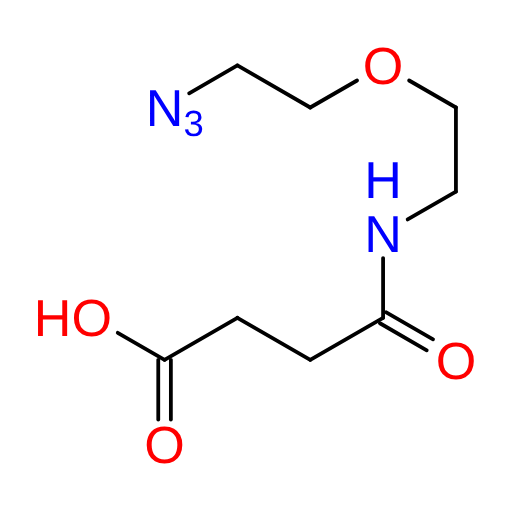
4-((2-(2-Azidoethoxy)ethyl)amino)-4-oxobutanoic acid (96%)
Molecular Formula: C8H14N4O4
CAS#: None
SMILES: O=C(CCC(O)=O)NCCOCCN=[N+]=[N-]
MDL#: None
Catalog#: AMTGC1267-OB24
Molecular weight: 230.22 g/mol
Appearance: Yellow Liquid
Purity: 96%
Storage: No special consideration
Solubility: Dichloromethane, Chloroform, Methanol
Other names:
- 3-((2-(2-Azidoethoxy)ethyl)carbamoyl)propanoic acid
- Azidoethoxyethyl succinamic acid
- N3-EOE-Suc-OH
- N3-PEG1-Suc-OH
- Azido-PEG1-succinamic acid
- Azido-PEG1-Suc-OH
Fields of Interest
Functionalized PEGs, azido linkers, acid linkers, click chemistry, bioconjugation, peptide chemistry, medicinal chemistry, chemical biology, drug discovery, PROTAC linker synthesis, targeted protein degradation, molecular probe development, custom linker synthesis
Background
4-((2-(2-Azidoethoxy)ethyl)amino)-4-oxobutanoic acid is a compact heterobifunctional linker containing a terminal azide and carboxylic acid, together with an internal ether and amide. The supplied structure, O=C(CCC(O)=O)NCCOCCN=[N+]=[N-], corresponds to molecular formula C8H14N4O4 and molecular weight approximately 230.22 g/mol.
Structurally, the compound consists of a 2-(2-azidoethoxy)ethylamine-derived segment connected to succinic acid through an amide bond. Succinylation converts the original primary amine into a stable internal amide while introducing a terminal carboxylic acid. The resulting molecule therefore provides two chemically distinct terminal functionalities while maintaining a short and precisely defined spacer.
The terminal azide provides a bioorthogonal reaction handle for copper-catalyzed azide–alkyne cycloaddition (CuAAC) and strain-promoted azide–alkyne cycloaddition (SPAAC). The terminal carboxylic acid can independently be activated using common amide-coupling reagents and reacted with amine-containing compounds. Together, these groups enable sequential and orthogonal molecular assembly.
Compared with longer azido-PEG-succinamic acid linkers, this compound provides a particularly compact spacer. It contains only one ether oxygen between its ethylene segments, reducing linker length while retaining some of the flexibility and polarity associated with ether-containing linkers. This makes it useful when researchers require azide and acid functionality but want to minimize the physical footprint of the linker.
Applications
4-((2-(2-Azidoethoxy)ethyl)amino)-4-oxobutanoic acid can serve as a modular building block for bioconjugation, medicinal chemistry, and chemical biology. Its carboxylic acid can be activated and coupled to an amine-containing drug, peptide, ligand, fluorophore, or other molecular component while leaving the distal azide available for subsequent click chemistry.
This two-stage reactivity is particularly useful for molecular probe and conjugate synthesis. After incorporation of the linker through amide formation, the remaining azide can be reacted with an alkyne- or cyclooctyne-functionalized reporter, affinity tag, targeting ligand, biomolecule, or other functional component. Azides are especially useful as latent conjugation handles because of their small size and compatibility with highly selective bioorthogonal reactions.
The compound may also be useful in PROTAC and targeted protein degradation research, where linker composition and length are routinely varied during structure–activity optimization. The combination of a coupling-ready acid and click-reactive azide enables modular assembly of different ligand combinations, while the relatively short spacer provides an alternative to longer PEG-based linkers.
For peptide chemistry, the terminal acid can be incorporated using standard amide-forming chemistry, providing a route to azide-functionalized peptide constructs. The distal azide can then enable subsequent installation of labels or other molecular components without requiring a second conventional coupling reaction.
The compound is especially useful as part of a linker-length series. Researchers can compare this short ether-containing linker with longer analogues such as N3-PEG2-Suc-OH and other azido-PEG-succinamic acids to evaluate how molecular spacing, flexibility, and hydrophilicity affect the properties of a final conjugate.
Literature:
Peer-reviewed literature specifically identifying this exact discrete compound was not located in the sources reviewed. The literature below therefore supports its azide–alkyne conjugation chemistry and the use of related functionalized linkers, rather than being presented as exact-compound precedent.
- Kolb, H. C.; Finn, M. G.; Sharpless, K. B. “Click Chemistry: Diverse Chemical Function from a Few Good Reactions.” Angew. Chem. Int. Ed. 2001, 40, 2004–2021. DOI: 10.1002/1521-3773(20010601)40:11<2004::AID-ANIE2004>3.0.CO;2-5.
- This foundational publication established the click-chemistry concept and identified azide–alkyne cycloaddition as a particularly effective reaction for modular molecular construction. The chemistry provides the basis for using the terminal azide of this linker to connect alkyne-functionalized molecular components.
- Agard, N. J.; Prescher, J. A.; Bertozzi, C. R. “A Strain-Promoted [3+2] Azide–Alkyne Cycloaddition for Covalent Modification of Biomolecules in Living Systems.” J. Am. Chem. Soc. 2004, 126, 15046–15047. DOI: 10.1021/ja044996f.
- This landmark study introduced strain-promoted azide–alkyne cycloaddition (SPAAC) for copper-free modification of biomolecules. The reaction provides a direct route for conjugating the azide terminus of this linker with appropriately functionalized strained cyclooctynes.
- Sletten, E. M.; Bertozzi, C. R. “Bioorthogonal Chemistry: Fishing for Selectivity in a Sea of Functionality.” Angew. Chem. Int. Ed. 2009, 48, 6974–6998. DOI: 10.1002/anie.200900942.
- This review describes the development of bioorthogonal reactions capable of operating selectively in chemically complex environments. It provides broader support for azide-functionalized linkers as versatile tools for chemical biology, biomolecular labeling, and multicomponent conjugation.
- An, S.; Fu, L. “Small-Molecule PROTACs: An Emerging and Promising Approach for the Development of Targeted Therapy Drugs.” EBioMedicine 2018, 36, 553–562. DOI: 10.1016/j.ebiom.2018.09.005.
- This review discusses the design and synthesis of PROTACs and highlights the role of linker composition and length in targeted protein degradation. The work provides application-level context for using defined functionalized linkers in modular degrader synthesis.