
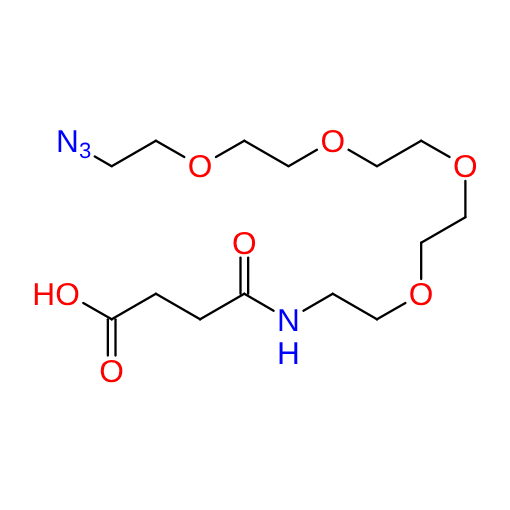
1-Azido-16-oxo-3,6,9,12-tetraoxa-15-azanonadecan-19-oic acid (99%)
Molecular Formula: C14H26N4O7
CAS#: 2250064-24-3
SMILES: O=C(CCC(O)=O)NCCOCCOCCOCCOCCN=[N+]=[N-]
MDL#: MFCD35646957
Catalog#: AMTGC1254-AA24
Molecular weight: 362.38 g/mol
Appearance: Yellow Liquid
Purity: 99%
Storage: No special consideration
Solubility: Dichloromethane, Chloroform, Methanol
Other names:
- Azido-PEG4-succinamic acid
- Azido-PEG4-Suc-OH
- N3-PEG4-Suc-OH
- Azido-PEG acid linker
Fields of Interest
Functionalized PEGs, azido PEGs, acid PEGs, click chemistry, bioconjugation, medicinal chemistry, peptide chemistry, chemical biology, drug discovery, PROTAC linker synthesis, targeted protein degradation, antibody-drug conjugates, molecular probe development, custom linker synthesis
Background
1-Azido-16-oxo-3,6,9,12-tetraoxa-15-azanonadecan-19-oic acid (CAS 2250064-24-3) is a heterobifunctional PEG-based linker containing a terminal azide and carboxylic acid separated by a defined, ether-rich spacer and an internal amide. Chemical registry sources associate CAS 2250064-24-3 with this systematic structure.
The compound combines two complementary reactive termini. The azide provides a compact bioorthogonal handle for copper-catalyzed azide–alkyne cycloaddition (CuAAC) with terminal alkynes or strain-promoted azide–alkyne cycloaddition (SPAAC) with strained cyclooctynes such as DBCO and BCN. The carboxylic acid can independently be activated for coupling to primary amines, enabling formation of stable amide bonds.
Structurally, the molecule can be viewed as an azido-PEG amine that has been succinylated, producing an internal amide and terminal carboxylic acid. This architecture distinguishes CAS 2250064-24-3 from simpler azido-PEG acids in which the carboxyl group is connected directly through the ether-containing chain. The internal amide introduces an additional hydrogen-bond donor and acceptor while retaining the flexible, hydrophilic character associated with the oligoethylene glycol segment.
As a discrete PEG linker, CAS 2250064-24-3 provides a precisely defined spacer rather than the range of molecular weights associated with polydisperse PEG materials. This can be valuable when linker length and molecular composition need to remain consistent across synthesized conjugates.
Applications
CAS 2250064-24-3 is well suited to sequential and orthogonal conjugation strategies. The terminal carboxylic acid can be activated using standard amide-coupling chemistry and reacted with an amine-containing drug, peptide, ligand, fluorophore, or other molecular component while retaining the distal azide for subsequent click chemistry.
In bioconjugation and chemical biology, this architecture provides a practical method for installing a latent click handle onto amine-containing molecules. Following attachment through the carboxylic acid, the remaining azide can be reacted with an alkyne- or cyclooctyne-functionalized reporter, affinity tag, targeting group, biomolecule, or other component.
The defined PEG spacer may also be useful in medicinal chemistry and drug-conjugate development, where linker length, flexibility, polarity, and attachment chemistry can influence the properties of the complete molecule. The combination of ether oxygens and an internal amide provides a relatively polar spacer while maintaining a precisely defined molecular structure.
Azido-PEG acid linkers are particularly relevant to PROTAC and targeted protein degradation research, where modular synthetic routes are commonly used to connect target-binding ligands and E3-ligase-recruiting groups. A carboxylic acid can provide an attachment point for amine-containing ligands, while the azide enables subsequent incorporation of an alkyne-functionalized component through click chemistry.
Similar strategies can be applied to antibody-drug conjugates, peptide conjugates, molecular probes, surface modification, and functional materials. CAS 2250064-24-3 is especially useful when a researcher requires both a coupling-ready carboxylic acid and a bioorthogonal azide separated by a longer, defined PEG spacer.
Literature:
Peer-reviewed publications explicitly identifying CAS 2250064-24-3 were not located in the scientific literature reviewed. Because this is a relatively recently registered linker, the references below support the reaction chemistry and applications of its azido-PEG linker architecture, rather than being presented as exact-compound precedent.
- Kolb, H. C.; Finn, M. G.; Sharpless, K. B. “Click Chemistry: Diverse Chemical Function from a Few Good Reactions.” Angew. Chem. Int. Ed. 2001, 40, 2004–2021. DOI: 10.1002/1521-3773(20010601)40:11<2004::AID-ANIE2004>3.0.CO;2-5.
- This foundational publication introduced the click-chemistry concept and established azide–alkyne cycloaddition as an effective strategy for modular molecular construction. The chemistry provides the basis for using the terminal azide of CAS 2250064-24-3 to attach alkyne-functionalized molecular components.
- Agard, N. J.; Prescher, J. A.; Bertozzi, C. R. “A Strain-Promoted [3+2] Azide–Alkyne Cycloaddition for Covalent Modification of Biomolecules in Living Systems.” J. Am. Chem. Soc. 2004, 126, 15046–15047. DOI: 10.1021/ja044996f.
- This landmark study established strain-promoted azide–alkyne cycloaddition (SPAAC), enabling azides to react with strained cyclooctynes without a copper catalyst. The chemistry supports the use of azido-PEG linkers such as CAS 2250064-24-3 in bioorthogonal conjugation and chemical biology.
- Sletten, E. M.; Bertozzi, C. R. “Bioorthogonal Chemistry: Fishing for Selectivity in a Sea of Functionality.” Angew. Chem. Int. Ed. 2009, 48, 6974–6998. DOI: 10.1002/anie.200900942.
- This review examines bioorthogonal reaction strategies for selectively modifying molecules in chemically complex environments. Azide-containing linkers are particularly useful in these applications because the azide is compact, relatively stable, and compatible with highly selective click reactions.
- Burslem, G. M.; Crews, C. M. “Proteolysis-Targeting Chimeras as Therapeutics and Tools for Biological Discovery.” Cell 2020, 181, 102–114. DOI: 10.1016/j.cell.2019.11.031.
- This review discusses PROTAC design and highlights the importance of linker composition and length in connecting target-binding and E3-ligase-binding components. Defined PEG linkers provide a modular means of adjusting molecular spacing, flexibility, and polarity during degrader optimization.
- An, S.; Fu, L. “Small-Molecule PROTACs: An Emerging and Promising Approach for the Development of Targeted Therapy Drugs.” EBioMedicine 2018, 36, 553–562. DOI: 10.1016/j.ebiom.2018.09.005.
- This review describes the design and synthesis of small-molecule PROTACs and the importance of linker selection in targeted protein degradation. The work provides class-level context for using functionalized PEG building blocks containing complementary reactive groups in modular PROTAC synthesis.

![Molecular structure for PEG Biotin-PEG4-azide (CAS 1309649-57-7), also known as N-[2-[2-[2-[2-(2-Azidoethoxy)ethoxy]ethoxy]ethoxy]ethyl]biotinamide, from Frontier Specialty Chemicals.](https://frontierspecialtychemicals.com/wp-content/uploads/2026/06/AMTGC893-BT21-Square-510x510-1.png)