
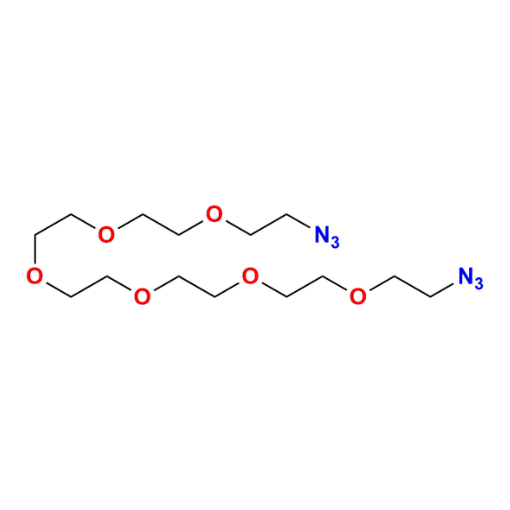
Name: 1,20-Diazido-3,6,9,12,15,18-hexaoxaeicosane
Molecular Formula: C14H28N6O6
CAS#: 1243536-56-2
SMILES: [N-]=[N+]=NCCOCCOCCOCCOCCOCCOCCN=[N+]=[N-]
MDL#: MFCD29049373
Catalog#: AMTGC1601-DA26
Molecular weight: 376.41 g/mol
Other names:
- 1,20-Diazido-3,6,9,12,15,18-hexaoxaicosane
- Azido-PEG6-azide
- PEG6 diazide
- Diazido-PEG6
- Bis-PEG6-azide
Fields of Interest: click chemistry, crosslinking, bioconjugation, drug delivery, and materials science
Background & Applications:
Background
Azido-PEG6-azide is a symmetrical, bifunctional diazide-functionalized PEG derivative based on a PEG6 backbone, featuring azide groups at both termini. The polyethylene glycol spacer provides hydrophilicity, flexibility, and compatibility with aqueous and biological environments while offering extended linker length for increased spatial separation and conformational freedom. The terminal azide functionalities enable highly efficient bioorthogonal click chemistry, including copper-catalyzed azide–alkyne cycloaddition (CuAAC) and strain-promoted azide–alkyne cycloaddition, allowing simultaneous or stepwise conjugation at both ends of the molecule. This bifunctional PEG linker serves as a versatile building block within a comprehensive portfolio of functionalized PEGs designed for modular molecular assembly, crosslinking, and advanced conjugation strategies. The compound is commonly referred to as Azido-PEG6-azide and is widely recognized as a PEG-based click chemistry linker.
Applications
Azido-PEG6-azide is commonly used in crosslinking, bioconjugation, drug delivery, and materials science applications where dual click reactivity and extended PEG spacing are required. Typical uses include construction of PEG-based polymer networks, preparation of multifunctional intermediates, surface and nanoparticle modification, and assembly of advanced biomaterials through click chemistry. The longer PEG6 spacer provides enhanced flexibility, improved solubility, and reduced steric hindrance relative to shorter diazide linkers, making it particularly useful when greater molecular reach is desired. The compound has also been marketed and utilized as a PEG-based PROTAC linker, reflecting its utility in modern targeted protein degradation and linker design workflows.
Appearance: colorless liquid
Purity: 98%
Storage: Room Temperature
Solubility: Dichloromethane, Chloroform, Methanol
Literature:
- Bioorganic and Medicinal Chemistry, 2010, vol. 18, # 15, p. 5732 – 5737
- Journal of the American Chemical Society, 2023, vol. 145, # 48, p. 26238 – 26248