
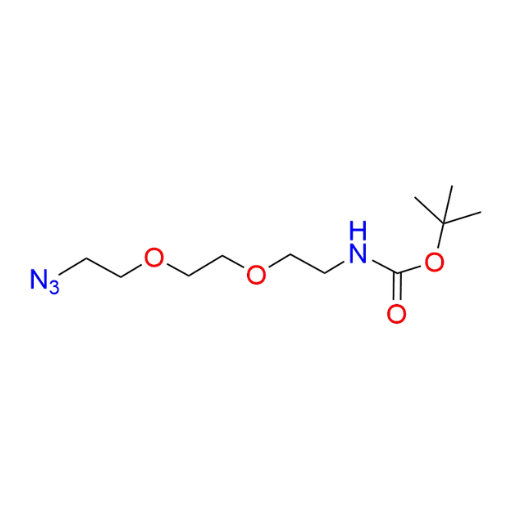
Name: tert-Butyl (2-(2-(2-azidoethoxy)ethoxy)ethyl)carbamate
Molecular Formula: C11H22N4O4
CAS#: 950683-55-3
SMILES: O=C(OC(C)(C)C)NCCOCCOCCN=[N+]=[N-]
MDL#: MFCD23380094
Catalog#: AMTGC279-TB17
Molecular weight: 274.32 g/mol
Other names:
- Azido-PEG3-NHBoc
- Boc-N-Amido-PEG2-C2-azide
- N-Boc-PEG3-azide
- tert-Butyl N-[2-[2-(2-azidoethoxy)ethoxy]ethyl]carbamate
Fields of Interest: bioconjugation, drug delivery, chemical biology, and materials science
Background & Applications:
Background
Azido-PEG3-NHBoc (CAS 950683-55-3) is a heterobifunctional azide-functionalized PEG derivative based on a PEG3 backbone, featuring a terminal azide group and a Boc-protected primary amine. The polyethylene glycol spacer provides hydrophilicity, flexibility, and compatibility with aqueous and organic environments while offering defined linker length for controlled molecular spacing. The azide functionality enables highly efficient bioorthogonal click chemistry, including copper-catalyzed azide–alkyne cycloaddition (CuAAC) and strain-promoted azide–alkyne cycloaddition, while the tert-butoxycarbonyl (Boc) group temporarily masks the amine, allowing selective, stepwise synthetic transformations. Following deprotection, the resulting azido-amine linker can be readily coupled to activated carboxylic acids, NHS esters, isocyanates, and related electrophiles. This compound serves as a versatile building block within a comprehensive portfolio of functionalized PEGs designed for orthogonal and modular molecular assembly.
Applications
tert-Butyl (2-(2-(2-azidoethoxy)ethoxy)ethyl)carbamate is commonly used in bioconjugation, drug delivery, chemical biology, and materials science applications where orthogonal reactivity and controlled functional group exposure are required. Typical uses include click-based attachment of PEG linkers to alkynyl-functionalized molecules, followed by Boc deprotection and subsequent amine coupling to prepare multifunctional conjugates, PEGylated biomolecules, fluorescent probes, and advanced materials. The combination of a click-reactive azide and a protected amine enables highly selective, sequential conjugation strategies while minimizing undesired side reactions during intermediate synthetic steps. As part of a robust functionalized PEG product line, this compound supports modular design strategies in pharmaceutical research, diagnostics, biomaterials development, and specialty chemical synthesis.
Appearance: Orange liquid
Purity: 96%
Storage: Room Temperature
Solubility: Dichloromethane, Chloroform, Methanol
Literature:
While this specific compound is most commonly cited as a synthetic linker intermediate rather than a final research reagent, Boc-protected azido PEG linkers of this type are widely used in the synthesis of PROTACs, antibody-drug conjugates (ADCs), targeted imaging agents, and bioconjugates. The combination of a protected amine and terminal azide allows orthogonal assembly strategies that are central to modern click chemistry workflows. References discussing the use of Boc-protected amino PEG azides in linker design and bioconjugation include the broader PEG linker literature and click chemistry methodologies.
- Tetrahedron, 2011, vol. 67, # 49, p. 9588 – 9594
- Molecules, 2025, vol. 30, # 12, art. no. 2655