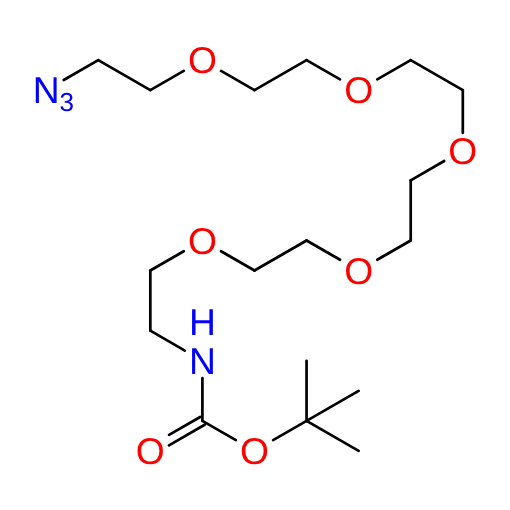
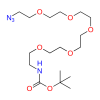
tert-Butyl (17-azido-3,6,9,12,15-pentaoxaheptadecyl)carbamate (97%)
Molecular Formula: C17H34N4O7
CAS#: 911209-07-9
SMILES: O=C(OC(C)(C)C)NCCOCCOCCOCCOCCOCCN=[N+]=[N-]
MDL#: MFCD22056314
Catalog#: AMTGC282-BO17
Molecular weight: 406.47 g/mol
Appearance: Pale yellow liquid
Purity: 97%
Storage: Room Temperature
Solubility: Dichloromethane, Chloroform, Methanol
Other names:
- BocNH-PEG5-CH2CH2N3
- Boc-NH-PEG5-azide
- N3-PEG5-CH2CH2NtBoc
- t-Boc-N-amido-PEG5-azide
Fields of Interest:
Click chemistry, Bioconjugation, Functionalized PEGs, Protected amine linkers, Chemical biology, Molecular probe synthesis, Surface functionalization
Background
Boc-NH-PEG5-azide (CAS 911209-07-9) is a heterobifunctional polyethylene glycol (PEG) linker containing a terminal azide and a Boc-protected primary amine. It provides two complementary sites for sequential molecular assembly: the azide participates in click chemistry, while the tert-butoxycarbonyl (Boc) group temporarily masks the amine until a later coupling step. The defined PEG5 spacer contains five ether oxygen atoms and supplies a flexible, polar connection between attached components.
The protected amine is particularly useful when researchers want to perform azide–alkyne coupling before exposing an additional nucleophilic group. Appropriate acidic deprotection releases the primary amine, which can subsequently form an amide with an activated carboxylic acid. Alternatively, deprotection and amine coupling can precede the click reaction when that sequence better suits the molecular partners. This flexibility supports the preparation of conjugates with a defined spacer and controlled attachment chemistry.
Applications
Boc-NH-PEG5-azide supports several conjugation strategies through its azide functionality and selectively accessible amine.
Copper-catalyzed click conjugation: The azide can react with a terminal alkyne through copper-catalyzed azide–alkyne cycloaddition (CuAAC), forming a triazole linkage. This provides a route to connect the PEG5 building block to alkyne-functionalized labels, small molecules, or synthetic scaffolds while retaining the protected amine for subsequent modification.
Copper-free conjugation: Reaction with a suitable strained cyclooctyne enables strain-promoted azide–alkyne cycloaddition (SPAAC). This offers an alternative attachment strategy when avoiding copper is important to the experimental design. The suitability of the complete linker and reaction conditions still depends on the intended molecular partner.
Sequential probe and conjugate synthesis: Following Boc removal, the exposed amine can react with activated carboxylic acids or N-hydroxysuccinimide (NHS) esters. Researchers can use this sequence to connect two different components through amide and triazole bonds. For acid-sensitive partners, completing deprotection before their introduction can help guide the synthetic sequence.
Surface functionalization: The same complementary reactions offer routes to attach the linker to appropriately functionalized surfaces and subsequently introduce a second component. These are structure-supported applications of azide/amine linker chemistry; performance on a particular surface requires evaluation.
Literature:
- Bioorganic and Medicinal Chemistry Letters, 2012, vol. 22, # 1, p. 586 – 590
- Synlett, 2015, vol. 26, # 19, art. no. ST-2015-S0639-L, p. 2707 – 2713
- Organic and Biomolecular Chemistry, 2009, vol. 7, # 15, p. 3049 – 3060
- Hong, V.; Presolski, S. I.; Ma, C.; Finn, M. G. “Analysis and Optimization of Copper-Catalyzed Azide–Alkyne Cycloaddition for Bioconjugation.” Angewandte Chemie International Edition 2009, 48, 9879–9883.
- Examines CuAAC conditions for bioconjugation, providing methodological guidance for coupling azide-bearing linkers with terminal alkynes.
- Baskin, J. M.; et al. “Copper-free click chemistry for dynamic in vivo imaging.” Proceedings of the National Academy of Sciences 2007, 104, 16793–16797.
- Demonstrates copper-free azide labeling with strained cyclooctynes, supporting the broader SPAAC strategy rather than testing this specific PEG linker.
- Isidro-Llobet, A.; Álvarez, M.; Albericio, F. “Amino Acid-Protecting Groups.” Chemical Reviews 2009, 109, 2455–2504.
- Explains Boc protection and acid-mediated removal, helping inform the sequence used to expose and functionalize the terminal amine.
- Montalbetti, C. A. G. N.; Falque, V. “Amide bond formation and peptide coupling.” Tetrahedron 2005, 61, 10827–10852.
- Reviews activation and coupling methods relevant to attaching the deprotected amine to carboxylic-acid-containing partners.