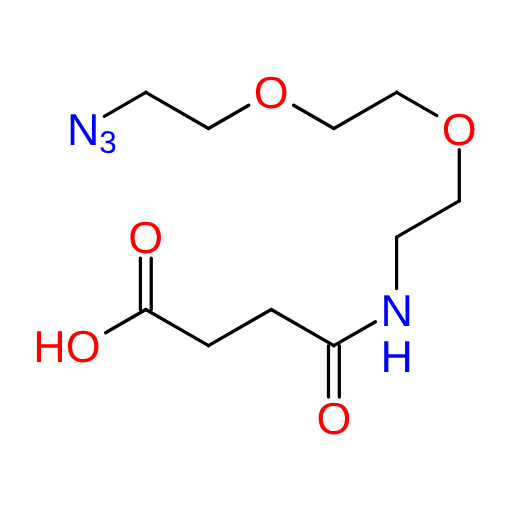
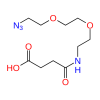
4-((2-(2-(2-Azidoethoxy)ethoxy)ethyl)amino)-4-oxobutanoic acid (99%)
Molecular Formula: C10H18N4O5
CAS#: 1189096-56-7
SMILES: O=C(CCC(O)=O)NCCOCCOCCN=[N+]=[N-]
MDL#: MFCD20134137
Catalog#: AMTGC1239-EB24
Molecular weight: 274.28 g/mol
Appearance: Orange Liquid
Purity: 99%
Storage: No special consideration
Solubility: Dichloromethane, Chloroform, Methanol
Other names:
- N3-DOOA-Suc-OH
- N3-EDOEA-Suc-OH
- N3-PEG2-Suc-OH
- 3-({2-[2-(2-Azidoethoxy)ethoxy]ethyl}carbamoyl)propanoic acid
Fields of Interest
Functionalized PEGs, azido PEGs, acid PEGs, click chemistry, bioconjugation, peptide chemistry, medicinal chemistry, drug discovery, antibody-drug conjugates, PROTAC linker synthesis, chemical biology, molecular probe development, custom linker synthesis
Background
4-(2-(2-(2-Azidoethoxy)ethoxy)ethylamino)-4-oxobutanoic acid (CAS 1189096-56-7) is a heterobifunctional azido-oligoethylene glycol linker containing a terminal azide and carboxylic acid, connected through a short ether-rich spacer and an internal amide. It has the molecular formula C10H18N4O5 and molecular weight 274.27 g/mol. The compound is commonly abbreviated N3-DOOA-Suc-OH, while N3-PEG2-Suc-OH is another useful structural shorthand.
Structurally, the molecule can be viewed as an azido-PEG2-ethylamine that has been succinylated at the amine. This gives it a terminal succinamic acid group rather than the simpler ether-linked carboxylic acid found in many azido-PEG-acid reagents. The internal amide adds hydrogen-bonding capability and provides a stable connection between the PEG-like segment and terminal carboxylic acid.
The two termini support complementary conjugation strategies. The azide provides a bioorthogonal handle for copper-catalyzed azide–alkyne cycloaddition (CuAAC) or strain-promoted azide–alkyne cycloaddition (SPAAC), while the carboxylic acid can be activated for coupling with amines to form an additional amide bond. This makes the compound particularly suitable for sequential molecular assembly in which one component is attached through conventional coupling chemistry and another through click chemistry.
Compared with polydisperse PEG materials, CAS 1189096-56-7 is a defined molecular linker with a specific spacer length and composition. This can be advantageous in medicinal chemistry, chemical biology, and conjugate development where reproducibility and precise control of molecular architecture are important.
Applications
N3-DOOA-Suc-OH is useful as a modular building block for bioconjugation and linker synthesis. Activation of the terminal carboxylic acid with common peptide-coupling reagents can enable attachment to amine-containing peptides, ligands, drugs, fluorophores, or other molecules while retaining the terminal azide for a subsequent click reaction.
The compound is particularly relevant to peptide and protein modification. Its succinamic acid terminus can be incorporated using familiar amide-forming chemistry, while the distal azide provides a compact chemical handle for attaching additional components after the initial conjugation. This architecture can facilitate installation of reporter groups, affinity tags, targeting ligands, fluorophores, or other functional molecules through CuAAC or SPAAC.
In medicinal chemistry and targeted conjugate development, the defined ether-rich spacer provides molecular separation between attached components without introducing a long PEG chain. The combination of a carboxylic acid, internal amide, and terminal azide can therefore be useful for constructing multicomponent molecules in which linker length, polarity, and attachment chemistry need to be controlled.
Related azido-PEG linkers are also widely used in antibody-drug conjugate and PROTAC research, where modular linker construction is important for connecting targeting elements, payloads, or recruiting ligands. CAS 1189096-56-7 provides both an amide-coupling site and a click-reactive terminus, making it a useful candidate for building and screening defined linker architectures.
The terminal azide also makes N3-DOOA-Suc-OH useful in chemical biology and molecular probe development. After incorporation through its carboxylic acid, the remaining azide can provide a relatively small latent tag that can subsequently be reacted with an alkyne- or cyclooctyne-functionalized reporter.
Literature:
- Peer-reviewed literature explicitly identifying CAS 1189096-56-7 / N3-DOOA-Suc-OH is limited in readily indexed scientific databases. The compound is, however, well documented as a defined commercial click-chemistry building block, and PubChem records it as N3-DOOA-Suc-OH.
- The following references support the principal chemistry and applications of its azide functionality and closely related PEG/amide linker architecture.
- Kolb, H. C.; Finn, M. G.; Sharpless, K. B. “Click Chemistry: Diverse Chemical Function from a Few Good Reactions.” Angew. Chem. Int. Ed. 2001, 40, 2004–2021. DOI: 10.1002/1521-3773(20010601)40:11<2004::AID-ANIE2004>3.0.CO;2-5.
- This foundational paper introduced the click-chemistry concept and established azide–alkyne cycloaddition as a particularly useful strategy for modular molecular construction. It provides the broader chemical basis for using the terminal azide of N3-DOOA-Suc-OH to attach alkyne-functionalized molecular components.
- Agard, N. J.; Prescher, J. A.; Bertozzi, C. R. “A Strain-Promoted [3+2] Azide–Alkyne Cycloaddition for Covalent Modification of Biomolecules in Living Systems.” J. Am. Chem. Soc. 2004, 126, 15046–15047. DOI: 10.1021/ja044996f.
- This landmark study established strain-promoted azide–alkyne cycloaddition (SPAAC) as a copper-free approach to bioorthogonal conjugation. The chemistry directly supports use of the terminal azide in N3-DOOA-Suc-OH with strained cyclooctyne-functionalized biomolecules, probes, and other conjugation partners.
- Sletten, E. M.; Bertozzi, C. R. “Bioorthogonal Chemistry: Fishing for Selectivity in a Sea of Functionality.” Angew. Chem. Int. Ed. 2009, 48, 6974–6998. DOI: 10.1002/anie.200900942.
- This review discusses the development and application of bioorthogonal reactions, including azide-based conjugation chemistry. It provides broader support for the use of azido-functionalized PEG linkers as chemically selective handles in complex biological and biomolecular environments.
- Fishman, J. M.; Kiessling, L. L. “Synthesis of Functionalizable and Degradable Polymers by Ring-Opening Metathesis Polymerization.” Angew. Chem. Int. Ed. 2013, 52, 5061–5064. DOI: 10.1002/anie.201300754.
- This work illustrates the broader value of azide-containing molecular building blocks for post-synthetic functionalization. Such modular strategies support the use of azido-PEG linkers for attaching additional functionality after construction of a parent molecular or materials framework.