
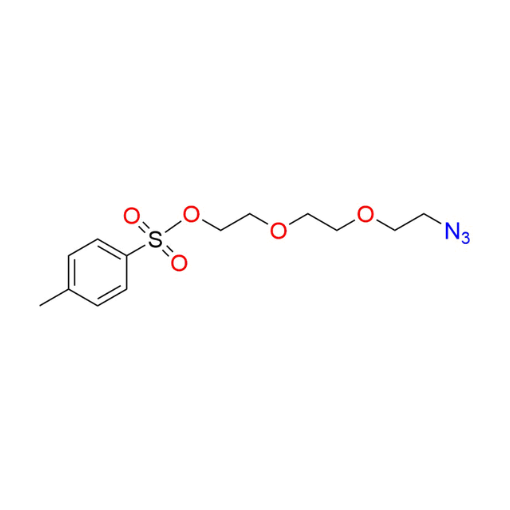
2-(2-(2-Azidoethoxy)ethoxy)ethyl 4-methylbenzenesulfonate
Molecular Formula: C13H19N3O5S
CAS#: 178685-33-1
SMILES: O=S(OCCOCCOCCN=[N+]=[N-])(C1=CC=C(C)C=C1)=O
MDL#: MFCD18433411
Catalog#: AMTGC1090-BS22
Molecular weight: 329.37 g/mol
Appearance: Colorless liquid
Purity: 98.8%
Storage: Long-term storage in a fridge at 2-8°C
Solubility: Dichloromethane, Chloroform, Methanol
Other names:
- Azide-PEG3-Tos
- Azido-PEG3-tosylate
- Azido-PEG3-OTs
- N3-PEG3-Tos
Fields of Interest: Click chemistry, Bioconjugation, Medicinal chemistry, PROTAC research, ADC linker development, Chemical biology, Polymer chemistry, Materials science, PEG linker synthesis
Background
2-[2-(2-Azidoethoxy)ethoxy]ethyl 4-methylbenzenesulfonate (CAS 178685-33-1) is a heterobifunctional azide-functionalized PEG linker, commonly known as Azide-PEG3-Tos. The molecule combines a flexible, hydrophilic PEG3 spacer with a terminal azide group and a tosylate (OTs) leaving group. The azide provides a bioorthogonal handle for copper-catalyzed azide–alkyne cycloaddition (CuAAC) and strain-promoted azide–alkyne cycloaddition (SPAAC), while the tosylate can undergo nucleophilic substitution to introduce additional functional groups. This combination makes Azide-PEG3-Tos a useful intermediate for stepwise linker synthesis and controlled molecular modification.
Applications
Azide-PEG3-Tos is used in bioconjugation, click chemistry, medicinal chemistry, linker synthesis, and materials research where two complementary reaction pathways are advantageous. The terminal azide can react with alkynes through CuAAC or with strained cyclooctynes such as DBCO and BCN through SPAAC, producing stable triazole linkages. Meanwhile, the tosylate functions as an effective leaving group for nucleophilic substitution, allowing conversion to amine-, thiol-, halide-, or other functionalized PEG derivatives depending on the chosen nucleophile and reaction conditions. This makes the compound particularly useful as a precursor for preparing more complex heterobifunctional PEG linkers. Commercial references also identify Azide-PEG3-Tos as a linker building block relevant to PROTAC and ADC synthesis.
Literature:
- ACS Combinatorial Science, 2020, vol. 22, # 3, p. 109 – 113
- Chemical Biology and Drug Design, 2017, vol. 89, # 4, p. 559 – 565
- ACS Combinatorial Science, 2020, vol. 22, # 3, p. 109 – 113