
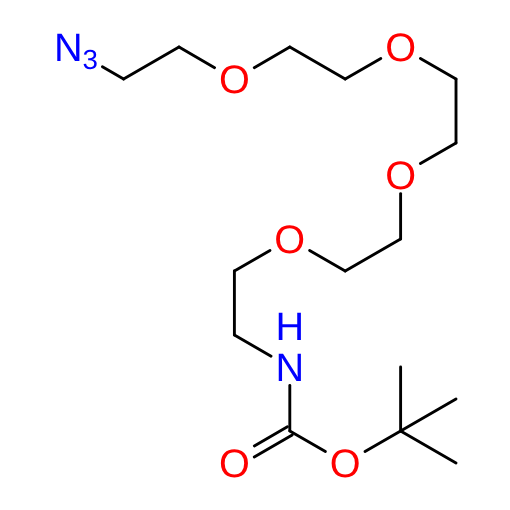
tert-Butyl (14-azido-3,6,9,12-tetraoxatetradecyl)carbamate (98%)
Molecular Formula: C15H30N4O6
CAS#: 940951-99-5
SMILES: O=C(OC(C)(C)C)NCCOCCOCCOCCOCCN=[N+]=[N-]
MDL#: MFCD28015765
Catalog#: AMTGC338-AC17-98
Molecular weight: 362.42 g/mol
Appearance: Pale yellow liquid
Purity: 98%
Storage: Room Temperature
Solubility: Dichloromethane, Chloroform, Methanol
Other names:
- BocNH-PEG4-CH2CH2N3
- Boc-NH-PEG4-azide
- t-Boc-N-Amido-PEG4-Azide
- Boc-N-Amido-PEG4-Azide
- Azido-PEG4-Boc amine
- N3-PEG4-NH-Boc
- Boc-NH-PEG4-N3
Fields of Interest:
Click chemistry, bioconjugation, medicinal chemistry, chemical biology, PROTAC development, targeted protein degradation, drug discovery, linker synthesis, biomolecule modification, molecular probe development, functionalized PEG synthesis, specialty chemical synthesis
Background
tert-Butyl (14-azido-3,6,9,12-tetraoxatetradecyl)carbamate (CAS 940951-99-5) is a heterobifunctional, discrete PEG linker containing a terminal azide and a Boc-protected primary amine separated by a PEG4 spacer. The Boc protecting group masks the amine during reactions involving the azide terminus and can subsequently be removed under acidic conditions to expose a primary amine for additional functionalization.
This combination makes the compound particularly useful for stepwise and orthogonal molecular assembly. The azide provides a bioorthogonal reaction handle compatible with copper-catalyzed azide–alkyne cycloaddition (CuAAC) and strain-promoted azide–alkyne cycloaddition (SPAAC). The protected amine remains unavailable for competing amine reactions until deprotection is desired, giving researchers greater control over the sequence in which molecular components are assembled.
The defined PEG4 spacer provides a flexible and relatively hydrophilic connection between the two termini. Unlike polydisperse PEG materials, this compound has a discrete molecular structure and defined spacer length, which is useful when reproducible molecular architecture and controlled separation between conjugated components are important.
Applications
Boc-NH-PEG4-azide is particularly useful as an intermediate in multistep bioconjugation and linker synthesis. The terminal azide can first be coupled to an alkyne-functionalized molecule through CuAAC or to a strained alkyne such as DBCO or BCN through SPAAC. Following click conjugation, removal of the Boc group reveals the primary amine, which can then participate in reactions such as amide formation, NHS-ester coupling, reductive amination, or other amine-selective derivatization strategies.
This orthogonal design makes the compound useful for constructing multifunctional molecular probes, biomolecule conjugates, drug-linker systems, and other modular chemical architectures. The PEG4 spacer provides physical separation between attached components while avoiding the substantially greater size and heterogeneity associated with polymeric PEG.
Boc-protected amino-PEG-azides are also useful in medicinal chemistry and targeted protein degradation research, where defined PEG segments can be incorporated into larger linker architectures connecting functional molecular components. PEG-based linkers are commonly employed in PROTAC design because linker composition and length can influence ternary-complex geometry, physicochemical properties, and degradation behavior. CAS 940951-99-5 is consequently marketed as a PEG-based PROTAC linker building block, although its utility is broader than PROTAC development alone.
The protected-amine/azide combination also provides a convenient route to additional functionalized PEG derivatives. After deprotection, the resulting Azido-PEG4-amine can be coupled with carboxylic acids, activated esters, fluorophores, affinity tags, ligands, peptides, or other molecular components while retaining—or after first consuming—the azide functionality. This makes CAS 940951-99-5 a useful intermediate for researchers building customized heterobifunctional PEG linkers rather than relying solely on a predetermined end-product linker.
Literature:
- Nguyen, T. T. T.; et al. “Assembly of Detergents with Highly Branched Dicarboxylate Clamps for Membrane Protein Studies.” ChemistryOpen 2025. DOI: 10.1002/open.202500122.
- This is particularly relevant because the experimental work specifically prepares tert-butyl (14-azido-3,6,9,12-tetraoxatetradecyl)carbamate (B2) from 14-azido-3,6,9,12-tetraoxatetradecan-1-amine and Boc₂O. The Boc-protected PEG4 azide is subsequently used as a synthetic building block in assembling more complex amphiphilic structures for membrane-protein research.
- An, S.; Fu, L. “Small-Molecule PROTACs: An Emerging and Promising Approach for the Development of Targeted Therapy Drugs.” EBioMedicine 2018, 36, 553–562. DOI: 10.1016/j.ebiom.2018.09.005.
- This review discusses the design and development of small-molecule PROTACs, in which a target-binding ligand and E3-ligase ligand are joined through a linker. It provides class-level support for the use of functionalized PEG building blocks in targeted-protein-degradation linker design.

![Molecular structure for PEG Biotin-PEG4-azide (CAS 1309649-57-7), also known as N-[2-[2-[2-[2-(2-Azidoethoxy)ethoxy]ethoxy]ethoxy]ethyl]biotinamide, from Frontier Specialty Chemicals.](https://frontierspecialtychemicals.com/wp-content/uploads/2026/06/AMTGC893-BT21-Square-510x510-1.png)