
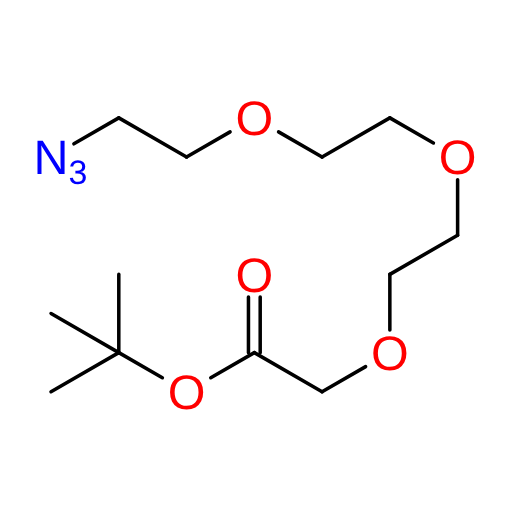
1,1-Dimethylethyl 11-azido-3,6,9-trioxaundecanoate (98%)
Molecular Formula: C12H23N3O5
CAS#: 172531-36-1
SMILES: O=C(OC(C)(C)C)COCCOCCOCCN=[N+]=[N-]
MDL#: MFCD20134124
Catalog#: AMTGC501-AB19
Molecular weight: 289.33
Appearance: colorless liquid
Purity: 98%
Storage: No special considerations
Solubility: Dichloromethane, Chloroform, Methanol
Other names:
- Azido-PEG3-CH2CO2-t-Bu
- N3-PEG3-CH2COOtBu
- Azido-PEG3-C-Boc
- Azido-PEG3-CH2COOH tert-butyl ester
- tert-Butyl 2-[2-[2-(2-azidoethoxy)ethoxy]ethoxy]acetate
- Azidotriethylene glycol-Boc
Fields of Interest:
Functionalized PEGs, azido PEGs, click chemistry, bioconjugation, medicinal chemistry, drug discovery, PROTAC linker synthesis, chemical biology, molecular probe development, protected carboxylic acid linkers, custom linker synthesis
Background
tert-Butyl 11-azido-3,6,9-trioxaundecanoate (CAS 172531-36-1) is a heterobifunctional, discrete PEG linker containing a terminal azide and a tert-butyl-protected carboxylic acid separated by a triethylene glycol-derived spacer. PubChem identifies the compound as tert-butyl 2-[2-[2-(2-azidoethoxy)ethoxy]ethoxy]acetate, with molecular formula C12H23N3O5 and molecular weight 289.33 g/mol.
The two termini provide complementary functionality for stepwise and orthogonal molecular assembly. The azide can participate in copper-catalyzed azide–alkyne cycloaddition (CuAAC) with terminal alkynes or strain-promoted azide–alkyne cycloaddition (SPAAC) with strained cyclooctynes such as DBCO and BCN. The carboxylic acid is protected as a tert-butyl ester, allowing reactions involving the azide or other portions of a molecular scaffold to be performed while the acid functionality remains masked.
Removal of the tert-butyl protecting group under appropriate acidic conditions generates the corresponding 11-azido-3,6,9-trioxaundecanoic acid (CAS 172531-37-2). Frontier’s AMT catalog lists these compounds consecutively, making the protected ester a useful precursor when the free acid needs to be revealed later in a multistep synthesis.
Once deprotected, the carboxylic acid can be activated for coupling to amines to form amide bonds. This combination of a protected acid, a click-reactive azide, and a defined hydrophilic PEG spacer makes CAS 172531-36-1 useful for constructing more complex heterobifunctional linkers while maintaining control over reaction sequence.
Applications
Azido-PEG3-CH2CO2-t-Bu is particularly useful in multistep linker synthesis where independent control of azide and carboxylic-acid chemistry is required. The terminal azide can be reacted with an alkyne-containing molecular component through CuAAC or SPAAC while the carboxyl group remains protected. Alternatively, the tert-butyl ester can be removed first to expose the acid for amide coupling, leaving the azide available for subsequent click conjugation.
This orthogonal functionality makes the compound useful in medicinal chemistry, chemical biology, and bioconjugation. It can serve as an intermediate for connecting small molecules, targeting ligands, peptides, fluorophores, affinity groups, or other molecular components while introducing a defined PEG3 spacer between them.
There is direct literature precedent for this exact compound in the construction of multifunctional bioactive molecules. In research on bivalent curcumin–diosgenin compounds for Alzheimer’s disease, tert-butyl 11-azido-3,6,9-trioxaundecanoate was prepared as a linker intermediate. Its azide was subsequently reduced to an amine, enabling further linker elaboration before the tert-butyl ester was removed. The resulting linkers were used to assemble bivalent molecules through amide and click chemistry.
The compound is also useful as a precursor to amino-functionalized PEG linkers. Reduction of the terminal azide gives tert-butyl 2-[2-[2-(2-aminoethoxy)ethoxy]ethoxy]acetate, providing a primary amine while retaining the protected carboxyl terminus. This transformation has direct synthetic precedent in medicinal-chemistry patent literature.
In PROTAC and targeted protein degradation research, the same combination of a defined PEG spacer, orthogonal terminal groups, and removable protecting group makes this type of reagent useful for constructing linkers between target-binding and E3-ligase-binding components. CAS 172531-36-1 is consequently cataloged as a PEG-based PROTAC linker, although its chemistry is broadly applicable beyond targeted protein degradation.
Literature:
- “Bivalent Ligands Incorporating Curcumin and Diosgenin as Multifunctional Compounds Against Alzheimer’s Disease.”
- This study provides exact-compound synthetic precedent for tert-butyl 11-azido-3,6,9-trioxaundecanoate. The compound was prepared as part of a triethylene glycol-based spacer strategy and subsequently transformed through azide reduction and further coupling chemistry. The resulting linkers were incorporated into bivalent curcumin–diosgenin molecules, demonstrating the value of this protected azido-PEG intermediate for assembling complex medicinal-chemistry constructs.
- Kolb, H. C.; Finn, M. G.; Sharpless, K. B. “Click Chemistry: Diverse Chemical Function from a Few Good Reactions.” Angewandte Chemie International Edition 2001, 40, 2004–2021. DOI: 10.1002/1521-3773(20010601)40:11<2004::AID-ANIE2004>3.0.CO;2-5.
- This publication established the click-chemistry concept and provides the broader chemical basis for using azide-functionalized PEG building blocks in modular molecular assembly.
- Agard, N. J.; Prescher, J. A.; Bertozzi, C. R. “A Strain-Promoted [3+2] Azide–Alkyne Cycloaddition for Covalent Modification of Biomolecules in Living Systems.” Journal of the American Chemical Society 2004, 126, 15046–15047. DOI: 10.1021/ja044996f.
- This study demonstrated copper-free strain-promoted azide–alkyne cycloaddition, supporting the use of azido-PEG building blocks in SPAAC-based bioconjugation and chemical-biology applications.
- An, S.; Fu, L. “Small-Molecule PROTACs: An Emerging and Promising Approach for the Development of Targeted Therapy Drugs.” EBioMedicine 2018, 36, 553–562. DOI: 10.1016/j.ebiom.2018.09.005.
- This class-level review discusses the architecture of small-molecule PROTACs and the role of linkers in connecting target-binding and E3-ligase-binding components. It provides broader context for the use of discrete PEG linker building blocks such as Azido-PEG3-CH2CO2-t-Bu in targeted protein degradation research.