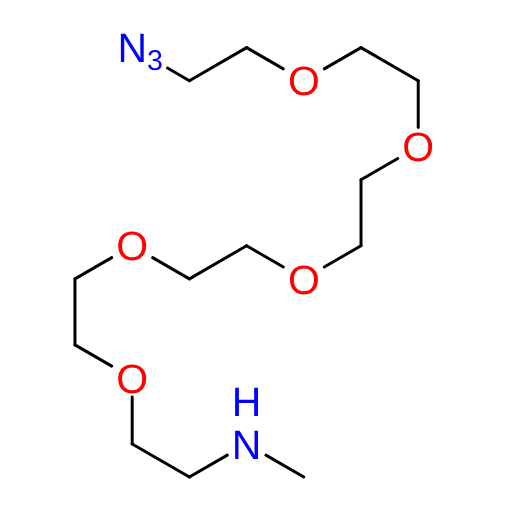
17-Azido-N-methyl-3,6,9,12,15-pentaoxaheptadecan-1-amine (97%)
Molecular Formula: C13H28N4O5
CAS#: 2055046-24-5
SMILES: CNCCOCCOCCOCCOCCOCCN=[N+]=[N-]
MDL#: MFCD29042361
Catalog#: AMTGC1187-AP23
Molecular weight: 320.39 g/mol
Appearance: colorless liquid
Purity: 97%
Storage: Long-term storage in a freezer at -20°C
Solubility: Dichloromethane, Chloroform, Methanol
Other names:
- N3-PEG5-CH2CH2NHMe
- Methylamino-PEG5-azide
Fields of Interest:
Bioconjugation, click chemistry, chemical biology, medicinal chemistry, molecular probe development, PEG linker synthesis, surface functionalization
Background
Methylamino-PEG5-azide (CAS 2055046-24-5) is a heterobifunctional polyethylene glycol (PEG) linker combining a terminal azide with an N-methyl secondary amine. These complementary functional groups provide attachment sites for click chemistry and amide coupling, supporting the design of molecular probes and other research conjugates. Its defined PEG5 segment contains five ether oxygen atoms and provides a flexible, polar spacer between the two reactive termini.
The secondary amine can react with appropriately activated carboxylic acids to form a tertiary amide, while the azide remains available for subsequent conjugation under compatible conditions. This enables staged assembly, with one molecular component attached through the amine and a second introduced through azide–alkyne chemistry. The defined chain length also makes the linker useful for exploring how spacer length influences a conjugate’s geometry and accessibility. Compared with the corresponding PEG4 linker, the PEG5 structure introduces one additional oxyethylene unit while retaining the same terminal functional groups.
Applications
The combination of a secondary amine, an azide, and a defined PEG spacer supports several potential applications based on established conjugation chemistry.
Click chemistry and bioconjugation: The azide can react with terminal alkynes through copper(I)-catalyzed azide–alkyne cycloaddition (CuAAC), forming a triazole linkage. This provides a route for connecting suitably functionalized fluorescent labels, affinity tags, small molecules, or biomolecular components through the PEG5 spacer.
Copper-free labeling strategies: The azide also enables strain-promoted azide–alkyne cycloaddition (SPAAC) with strained cyclooctyne reagents. This reaction is relevant when designing conjugation workflows for components sensitive to copper exposure, with reaction conditions selected to suit the intended probe or biomolecule.
Amide-linked probes and ligand conjugates: Acylation of the N-methyl secondary amine can attach the linker to a carboxyl-containing molecular fragment, producing a tertiary amide. The remaining azide provides a second attachment site for subsequent assembly, offering flexibility when developing ligand–reporter conjugates and comparing molecular probe designs.
Surface and polymer functionalization: Coupling the amine to an appropriately activated carboxyl-containing surface or polymer offers a potential route for installing a PEG-spaced azide. Subsequent click conjugation could introduce a recognition group or reporter. The defined spacer allows researchers to vary the separation between the supporting material and the attached component.
Literature:
These references support the reaction methods and application concepts described above; they do not report studies of this exact compound.
- Hong, V.; Presolski, S. I.; Ma, C.; Finn, M. G. “Analysis and Optimization of Copper-Catalyzed Azide–Alkyne Cycloaddition for Bioconjugation.” Angewandte Chemie International Edition 2009, 48, 9879–9883. DOI: 10.1002/anie.200905087
Examines CuAAC conditions for biomolecular conjugation, providing practical guidance relevant to coupling azide-functionalized linkers with alkyne-bearing partners. - Baskin, J. M.; et al. “Copper-free click chemistry for dynamic in vivo imaging.” Proceedings of the National Academy of Sciences 2007, 104, 16793–16797. DOI: 10.1073/pnas.0707090104
Demonstrates cyclooctyne-mediated labeling of azide-bearing biomolecules, illustrating the chemistry underlying copper-free conjugation strategies. - Montalbetti, C. A. G. N.; Falque, V. “Amide bond formation and peptide coupling.” Tetrahedron 2005, 61, 10827–10852. DOI: 10.1016/j.tet.2005.08.031
Reviews carboxylic acid activation and amide-forming reactions relevant to incorporating amine-functionalized PEG linkers into larger molecular constructs.