
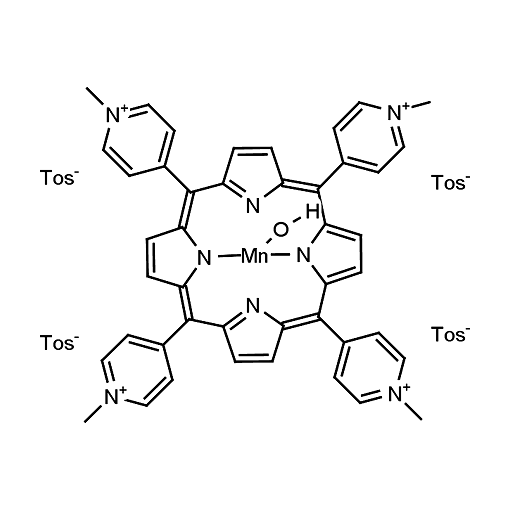
Mn(III) meso-Tetra(N-methyl-4-pyridyl) porphine tetra tosylate hydroxide
Molecular Formula: C72H65MnN8O9S4
CAS#: None
SMILES: CC1=CC=C(C=C1)[S-](=O)=O.CC1=CC=C(C=C1)[S-](=O)=O.CC1=CC=C(C=C1)[S-](=O)=O.CC1=CC=C(C=C1)[S-](=O)=O.[H]O[Mn]1N2C3=CC=C2\C(=C2\C=CC(=N\2)/C(=C2/C=C\C(N12)=C(\C1=N\C(\C=C1)=C/3C1=CC=[N+](C)C=C1)C1=CC=[N+](C)C=C1)C1=CC=[N+](C)C=C1)C1=CC=[N+](C)C=C1
MDL#: None
Catalog#: T40671
Molecular weight: 1369.53 g/mol
Appearance: Black solid
Purity: >95%
Storage: at room temperature
Solubility: aqueous solvents
Other Names
- Manganese(III) meso-tetra(N-methyl-4-pyridyl)porphine tetratosylate hydroxide
- Manganese(III) tetrakis(1-methyl-4-pyridyl)porphyrin tetratosylate hydroxide
- Mn(III) tetrakis(N-methyl-4-pyridyl)porphyrin tetratosylate hydroxide
- MnTMPyP tetratosylate hydroxide
- MnTMPyP
- MnTM-4-PyP
Fields of Interest
manganese porphyrins, redox chemistry, superoxide dismutation, peroxynitrite reduction, reactive oxygen species, reactive nitrogen species, oxidative stress research, bioinorganic chemistry, mitochondrial redox biology, metalloporphyrin catalysis, catalytic antioxidant research
Background
Mn(III) meso-Tetra(N-methyl-4-pyridyl) Porphine Tetratosylate Hydroxide is a water-soluble cationic manganese porphyrin widely known as MnTMPyP. The complex contains a Mn(III) ion coordinated by a tetrapyrrolic porphyrin macrocycle bearing four N-methyl-4-pyridinium substituents. An axial hydroxide ligand and four p-toluenesulfonate (tosylate) counterions complete the isolated salt represented by the supplied structure.
The positively charged pyridinium groups strongly influence the porphyrin’s aqueous behavior and manganese-centered redox potential. MnTMPyP can cycle between multiple manganese oxidation states and react with reactive oxygen and nitrogen species, including superoxide and peroxynitrite. It has therefore become a widely studied model compound for examining superoxide dismutase-like activity, high-valent manganese-oxo chemistry, electron transfer, and redox-active metalloporphyrins. Importantly, its behavior depends on the surrounding redox environment: in biological systems, MnTMPyP can participate in reductant-coupled redox cycles rather than functioning solely as a simple stoichiometric radical scavenger.
Applications
MnTMPyP is primarily used in redox chemistry and oxidative-stress research, particularly where a water-compatible manganese porphyrin is needed to investigate reactive oxygen and nitrogen species.
- Superoxide and SOD-mimetic research: MnTMPyP catalyzes reactions involving superoxide and has been widely used as a synthetic model for superoxide dismutase activity. Early mechanistic studies showed that cellular reductants such as NADPH and glutathione can participate in its redox cycling, making it useful for investigating how metalloporphyrins interact with superoxide under biologically relevant conditions.
- Peroxynitrite reduction and reactive nitrogen species: MnTMPyP reacts rapidly with peroxynitrite to produce higher-valent oxomanganese intermediates. Biological reductants such as ascorbate and glutathione can return these intermediates to lower oxidation states, enabling catalytic redox cycles relevant to peroxynitrite and oxidative-nitrosative stress research.
- Cellular oxidative-stress models: The tetratosylate hydroxide form has been used directly in cellular studies of mitochondrial superoxide and peroxynitrite generation. These studies make the compound useful as a research tool for probing relationships among reactive oxygen species, mitochondrial dysfunction, ATP depletion, and cellular injury.
- In vivo oxidative-stress research: MnTMPyP tetratosylate hydroxide has also been used in animal models to investigate the contribution of superoxide and peroxynitrite to microvascular and tissue injury. These applications are experimental research uses and should not be interpreted as established therapeutic indications.
- Mechanistic bioinorganic chemistry: The accessible Mn(III), Mn(II), and higher-valent manganese-oxo states make MnTMPyP useful for studying electron transfer, metalloporphyrin oxidation chemistry, reductant coupling, and structure–reactivity relationships in water-soluble manganese porphyrins.
Selected Literature
- Wang, Z.; Holthoff, J. H.; Seely, K. A.; Pathak, E.; Spencer, H. J., III; Gokden, N.; Mayeux, P. R. “Development of Oxidative Stress in the Peritubular Capillary Microenvironment Mediates Sepsis-Induced Renal Microcirculatory Failure and Acute Kidney Injury.” The American Journal of Pathology 2012, 180 (2), 505–516. DOI: 10.1016/j.ajpath.2011.10.011.
- This study uses MnTMPyP tetratosylate hydroxide directly, demonstrating its utility for investigating superoxide and peroxynitrite generation and their relationship to renal microcirculatory and oxidative-stress changes in an experimental sepsis model.
- Pathak, E.; MacMillan-Crow, L. A.; Mayeux, P. R. “Role of Mitochondrial Oxidants in an In Vitro Model of Sepsis-Induced Renal Injury.” Journal of Pharmacology and Experimental Therapeutics 2012, 340 (1), 192–201. DOI: 10.1124/jpet.111.183756.
- The researchers use the tetratosylate hydroxide form of MnTMPyP directly to examine mitochondrial oxidative stress, showing effects on superoxide and peroxynitrite generation, cellular ATP, and mitochondrial function in cultured renal epithelial cells.
- Lee, J.; Hunt, J. A.; Groves, J. T. “Manganese Porphyrins as Redox-Coupled Peroxynitrite Reductases.” Journal of the American Chemical Society 1998, 120 (24), 6053–6061. DOI: 10.1021/ja9801036.
- This mechanistic study examines Mn(III)TMPyP directly and shows rapid reaction with peroxynitrite followed by formation of an oxomanganese(IV) intermediate; biological antioxidants can reduce this intermediate and complete a catalytic peroxynitrite-reduction cycle.
- Gardner, P. R.; Nguyen, D. D.; White, C. W. “Superoxide Scavenging by Mn(II/III) Tetrakis(1-methyl-4-pyridyl) Porphyrin in Mammalian Cells.” Archives of Biochemistry and Biophysics 1996, 325 (1), 20–28. DOI: 10.1006/abbi.1996.0003.
- This work investigates MnTMPyP in mammalian cells and demonstrates that its interaction with superoxide depends strongly on the cellular redox environment, supporting its use for studying reductant-coupled manganese porphyrin chemistry and oxidative stress.
- Faulkner, K. M.; Liochev, S. I.; Fridovich, I. “Stable Mn(III) Porphyrins Mimic Superoxide Dismutase in Vitro and Substitute for It in Vivo.” Journal of Biological Chemistry 1994, 269 (38), 23471–23476.
- This foundational study examines Mn(III) tetrakis(1-methyl-4-pyridyl)porphyrin directly, establishing its superoxide-related redox activity and showing that NADPH and glutathione can maintain the reduced manganese state in biological systems.