
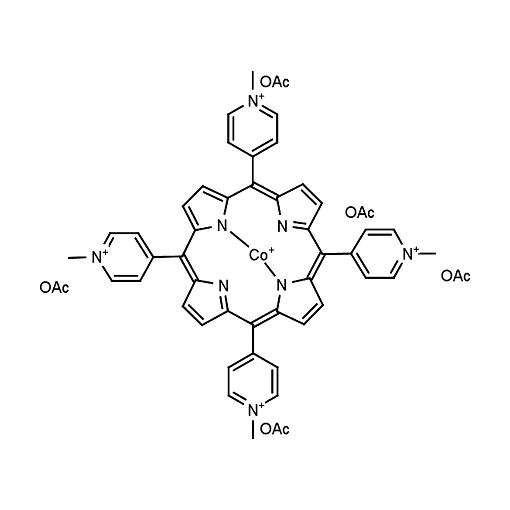
Co(III) meso-Tetra (N-Methyl-4-Pyridyl) Porphine Pentaacetate
Molecular Formula: C54H51CoN8O10
CAS#: None
SMILES: CC([O-])=O.CC([O-])=O.CC([O-])=O.CC([O-])=O.CC([O-])=O.C[N+]1=CC=C(C=C1)C1=C2\C=CC(=N\2)/C(=C2/C=C\C3=C(\C4=N\C(\C=C4)=C(/C4=CC=C\1N4[Co+]N23)C1=CC=[N+](C)C=C1)C1=CC=[N+](C)C=C1)C1=CC=[N+](C)C=C1
MDL#: None
Catalog#: T10355
Molecular weight: 1030.96 g/mol
Appearance: Purple to dark-purple solid/powder
Purity: >95%
Storage: Room temperature
Solubility: soluble in water and alcohols
Other Names
- Cobalt(III) meso-Tetrakis(N-methyl-4-pyridyl)porphyrin pentaacetate
- Cobalt(III) meso-Tetrakis(N-methyl-4-pyridiniumyl)porphyrin pentaacetate
- Co(III)TMPyP pentaacetate
- CoTMPyP pentaacetate
Fields of Interest
water-soluble porphyrins, cobalt porphyrins, electrocatalysis, electrochemistry, carbon dioxide reduction, hydrogen evolution, oxygen reduction, oxidation catalysis, redox chemistry, ligand binding, molecular sensing, porphyrin nanocomposites, biomimetic chemistry
Background
Co(III) meso-Tetra(N-Methyl-4-Pyridyl) Porphine Pentaacetate is a water-soluble, cationic cobalt metalloporphyrin based on the meso-tetrakis(N-methyl-4-pyridyl)porphyrin, or TMPyP, framework. Four N-methylpyridinium substituents give the porphyrin a strongly cationic periphery, while cobalt(III) occupies the central N₄ coordination cavity. Together, the four pyridinium groups and the Co(III)-porphyrin center produce a +5 ionic species balanced in this material by five acetate counterions.
The cationic structure gives Co(III)TMPyP strong compatibility with aqueous environments and enables electrostatic interactions with negatively charged molecules, surfaces, and layered inorganic materials. The cobalt center can also access multiple oxidation states, making the complex useful for studying Co(III)/Co(II)/Co(I) redox chemistry, axial ligand coordination, electron transfer, and catalytic reaction mechanisms. In solution, the acetate ions primarily serve as counterions; coordination and catalytic behavior are largely associated with the CoTMPyP cation, although pH, axial ligands, electrolyte composition, and counterion identity can influence speciation and electrochemical behavior.
Applications
Co(III)TMPyP is primarily used in electrochemical, catalytic, coordination, and hybrid-material research.
- Electrochemistry and redox studies: The cobalt center and conjugated porphyrin system undergo multiple reduction processes involving both metal-centered and ligand-centered states. CoTMPyP is therefore useful for investigating electron-transfer mechanisms, metalloporphyrin redox behavior, and the influence of peripheral pyridinium groups on charge accumulation.
- Electrocatalytic CO₂ and proton reduction: Related redox forms of CoTMPyP have been studied as water-compatible molecular catalysts for carbon dioxide reduction and hydrogen evolution. Formation of cobalt hydride and low-valent cobalt intermediates can support pathways leading to CO, formate, or H₂, making the scaffold useful for mechanistic studies of molecular energy-conversion catalysis.
- Oxygen reduction and supported catalysts: The positively charged CoTMPyP framework can be incorporated into negatively charged layered materials and electrode assemblies through electrostatic interactions. Immobilized Co(III)TMPyP systems have demonstrated electrocatalytic oxygen reduction and provide a route to combining molecular cobalt catalysis with inorganic or carbon-based supports.
- Oxidation and epoxidation research: Co(III)TMPyP incorporated into layered niobate materials has been investigated for cyclohexene epoxidation using molecular oxygen. This illustrates the potential of the cationic porphyrin for heterogeneous and biomimetic oxidation-catalyst design.
- Axial ligand and anion-binding studies: Co(III)TMPyP readily participates in axial coordination chemistry. The same Co(III)TMPyP cation, isolated with other counterions, has been studied for cyanide binding and scavenging, providing insight into cobalt oxidation-state changes, ligand substitution, and strong anionic ligand coordination.
Selected Literature
- Benz, O. S.; Yuan, Q.; Cronican, A. A.; Peterson, J.; Pearce, L. L. “Effect of Ascorbate on the Cyanide-Scavenging Capability of Cobalt(III) meso-Tetra(4-N-methylpyridyl)porphine Pentaiodide: Deactivation by Reduction?” Chemical Research in Toxicology 2016, 29 (3), 270–278. DOI: 10.1021/acs.chemrestox.5b00447.
- This study examines the same Co(III)TMPyP cation with iodide counterions, showing how reduction to Co(II), subsequent cyanide coordination, and reoxidation influence its ligand-binding chemistry and potential as a cyanide-scavenging metalloporphyrin.
- Liu, L.; Ma, J.; Shao, F.; Zhang, D.; Gong, J.; Tong, Z. “A Nanostructured Hybrid Synthesized by the Intercalation of CoTMPyP into Layered Titanate: Direct Electrochemistry and Electrocatalysis.” Electrochemistry Communications 2012, 24, 74–77. DOI: 10.1016/j.elecom.2012.08.021.
- The researchers incorporated Co(III)TMPyP directly into layered titanate, producing a hybrid electrode material that exhibited Co-centered redox behavior and electrocatalytic activity toward oxygen reduction.
- Ma, J.; Wu, J.; Gu, J.; Liu, L.; et al. “Fabrication and Spectroscopic, Electrochemical, and Catalytic Properties of a New Intercalation Compound of K₄Nb₆O₁₇ with Cationic Cobalt Porphyrin.” Journal of Molecular Catalysis A: Chemical 2012, 357, 95–100. DOI: 10.1016/j.molcata.2012.01.025.
- This study uses Co(III)TMPyP as the cationic porphyrin component of a layered niobate nanocomposite, examining its electrochemistry and demonstrating catalytic activity and recyclability in cyclohexene epoxidation.
- Van Caemelbecke, E.; Derbin, A.; Hambright, P.; Garcia, R.; Doukkali, A.; Saoiabi, A.; Ohkubo, K.; Fukuzumi, S.; Kadish, K. M. “Electrochemistry of [(TMpyP)MII]⁴⁺(X⁻)₄ (X⁻ = Cl⁻ or BPh₄⁻) and [(TMpyP)MIIICl]⁴⁺(Cl⁻)₄ in N,N-Dimethylformamide Where M Is One of 15 Different Metal Ions.” Inorganic Chemistry 2005, 44 (11), 3789–3798. DOI: 10.1021/ic048820q.
- This systematic electrochemical study includes Co(III)TMPyP and shows that the cobalt complex undergoes a reversible Co(III)/Co(II) reduction before additional reductions involving the porphyrin π-system and N-methylpyridyl substituents.
- Bochlin, Y.; Ben-Eliyahu, Y.; Kadosh, Y.; Kozuch, S.; Zilbermann, I.; Korin, E.; Bettelheim, A. “DFT and Empirical Considerations on Electrocatalytic Water/Carbon Dioxide Reduction by CoTMPyP in Neutral Aqueous Solutions.” ChemPhysChem 2020, 21 (24), 2644–2650. DOI: 10.1002/cphc.202000715.
- This study investigates the closely related redox-active CoTMPyP catalyst in aqueous CO₂ and water reduction, identifying cobalt-hydride chemistry as an important pathway toward H₂, formate, and CO formation. It supports the broader use of the CoTMPyP framework in molecular electrocatalysis.