
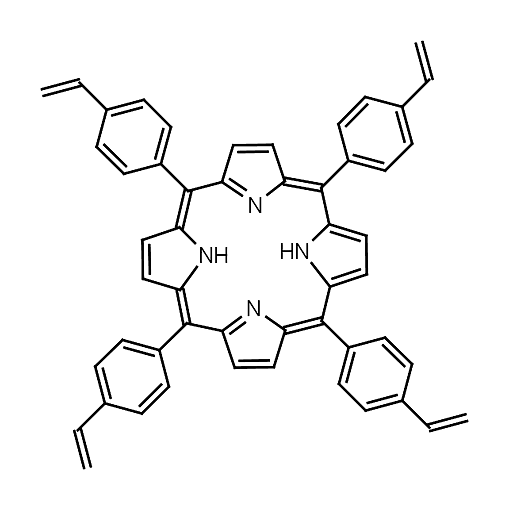
meso-Tetra(4-ethenylphenyl)porphine
Molecular Formula: C52H38N4
CAS#: 113477-21-7
SMILES: C=CC1=CC=C(C2=C3C=CC(=N3)C(C3=CC=C(C=C)C=C3)=C3C=CC(=N3)C(C3=CC=C(C=C)C=C3)=C3C=CC(=C(C4=CC=C(C=C)C=C4)C4=CC=C2N4)N3)C=C1
MDL#: MFCD35093288
Catalog#: T14928
Molecular weight: 718.9039917 g/mol
Appearance: Purple solid
Purity: >98%
Storage: store at -20 C
Solubility: Organic solvents
Other Names
- 5,10,15,20-Tetrakis(4-ethenylphenyl)-21H,23H-porphine
- 5,10,15,20-Tetrakis(4-vinylphenyl)porphyrin
- Tetra(4′-vinylphenyl)porphyrin
- meso-Tetra(4-vinylphenyl)porphine
- TVPP
Fields of Interest
porphyrin chemistry, polymerizable porphyrins, porous organic polymers, radical polymerization, photocatalysis, heterogeneous catalysis, CO₂ conversion, functional polymers, fluorescent sensing, mercury ion detection, lithium-ion battery materials, single-atom materials
Background
meso-Tetra(4-ethenylphenyl)porphine (CAS 113477-21-7) is a free-base tetraphenylporphyrin bearing four para-vinyl groups, one on each meso-phenyl substituent. Also known as 5,10,15,20-tetrakis(4-vinylphenyl)porphyrin (TVPP), it combines the visible-light absorption and coordination chemistry of the porphyrin macrocycle with four independently polymerizable alkene functionalities.
The four vinyl groups make TVPP particularly useful as a multifunctional porphyrin monomer. Unlike unsubstituted tetraphenylporphyrin, which generally must be physically incorporated into a polymer or attached through additional functionalization, TVPP can participate directly in radical polymerization and crosslinking reactions. This allows the porphyrin chromophore to become covalently integrated into porous polymers and other network materials while leaving the central porphyrin cavity available for subsequent metal coordination. These characteristics make TVPP a useful starting material for photoactive polymers, heterogeneous catalysts, sensing materials, and carbon-based functional materials.
Applications
TVPP is primarily used as a polymerizable porphyrin building block for functional and porous materials.
- Porphyrin-based porous organic polymers: The four peripheral vinyl groups can undergo free-radical polymerization to form highly crosslinked porphyrin-containing networks. This approach has been used to prepare porous organic polymers in which the porphyrin is an integral structural and photoactive component rather than a physically adsorbed additive.
- Visible-light photocatalysis: TVPP-derived porous polymers have been investigated as metal-free visible-light photocatalysts. Their porphyrin chromophores absorb visible light and can promote oxygen activation, enabling reactions such as the oxidative coupling of primary amines to imines.
- Heterogeneous catalyst development: After polymerization, the free-base porphyrin centers can be metalated with ions such as Co, Zn, and Mg. Metalated TVPP-derived porous polymers have been studied as recyclable heterogeneous catalysts, including for the cycloaddition of CO₂ with epoxides to produce cyclic carbonates.
- Fluorescent sensing and environmental materials: TVPP itself has been investigated as a fluorescence-based probe for Hg²⁺, while copolymers incorporating the vinyl-functionalized porphyrin have been used for mercury-ion recognition and adsorption. The polymerizable groups therefore provide a route from molecular sensing to recoverable functional materials.
- Energy-storage and single-atom materials: TVPP can also serve as a porphyrin-derived precursor for polymer-pyrolysis strategies. Recent research has used the scaffold in the preparation of metal- and nitrogen-co-doped porous carbon materials containing atomically dispersed transition-metal sites for lithium-ion battery research.
Selected Literature
- Zhang, J.; Chen, B.; Lu, W.; Li, L.; Wang, P. “Single Crystal Structure of 5,10,15,20-Tetrakis(4-vinylphenyl)porphyrin and Its Visual Recognition and Adsorption Properties for Mercury Ions.” Journal of Shandong University of Science and Technology (Natural Science) 2026, 45 (4), 84–93. DOI: 10.16452/j.cnki.sdkjzk.2026.04.008.
- This study investigates TVPP itself, reports its single-crystal structure, and demonstrates fluorescence quenching in response to Hg²⁺; TVPP-containing copolymers were additionally evaluated for mercury-ion recognition and adsorption.
- Huang, J.-Y.; Guo, X.-X.; Chen, P.-X.; Liu, X.-H.; Zhou, X.-T.; Yu, H.-Y.; Ji, H.-B. “Metal-Free Coordination of Porphyrin-Based Porous Organic Polymers for Efficient Photocatalytic Oxidative Coupling of Amines under Visible Light.” Molecular Catalysis 2023, 546, 113248. DOI: 10.1016/j.mcat.2023.113248.
- This work uses 5,10,15,20-tetra(4-vinylphenyl)porphyrin directly as the monomer for a porous organic polymer, demonstrating how the vinyl-functionalized porphyrin can form a stable, metal-free visible-light photocatalyst for oxidative coupling of amines.
- Dai, Z.; Sun, Q.; Liu, X.; Bian, C.; Wu, Q.; Pan, S.; Wang, L.; Meng, X.; Deng, F.; Xiao, F.-S. “Metalated Porous Porphyrin Polymers as Efficient Heterogeneous Catalysts for Cycloaddition of Epoxides with CO₂ under Ambient Conditions.” Journal of Catalysis 2016, 338, 202–209. DOI: 10.1016/j.jcat.2016.03.005.
- TVPP was polymerized into a high-surface-area porous porphyrin network and subsequently metalated with Co, Zn, or Mg; the resulting materials functioned as recyclable heterogeneous catalysts for CO₂/epoxide cycloaddition to cyclic carbonates.
- He, Q.; Sun, J.; Pang, S.; Tao, H.; Xu, W.; Xia, X.; Guo, M.; Shi, C.; Lv, Y. “Single Atom Metal and N Co-Doped Porous Carbons for High-Performance Lithium-Ion Batteries.” RSC Advances 2026, 16 (36), 37527–37532. DOI: 10.1039/D6RA02451C.
- This study uses tetra(4′-vinylphenyl)porphyrin as a precursor in a polymer-pyrolysis strategy to produce Fe-, Co-, Ni-, and Mn/N co-doped porous carbons, illustrating a newer application of the scaffold in lithium-ion battery materials.
- Liu, X.-H.; Guo, X.-X.; Zheng, S.-Y.; Zhou, X.-T. “Efficient Photocatalytic Oxidative Coupling of Amines under Visible Light Using a Trioporphyrins-Based Covalent Triazine Framework.” ChemPlusChem 2025, 90 (1), e202400460. DOI: 10.1002/cplu.202400460.
- This work uses tetra(4-vinylphenyl)porphyrin directly to prepare the POP-TSP comparison material, demonstrating that the TVPP-derived porous polymer itself functions as a visible-light-active photocatalyst for oxidative amine coupling.