
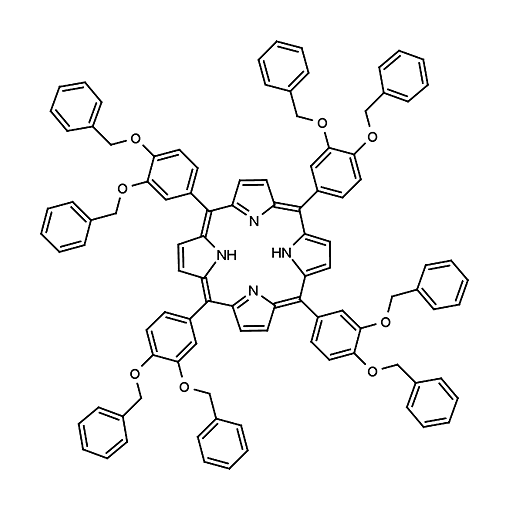

meso-Tetra (3,4-dibenzyloxyphenyl) porphine (TCBOPP)
Molecular Formula: C100H78N4O8
CAS#: 2097782-84-6
SMILES: C(OC1=CC=C(C=C1OCC1=CC=CC=C1)C1=C2C=CC(=N2)C(=C2NC(C=C2)=C(C2=NC(C=C2)=C(C2=CC=C1N2)C1=CC=C(OCC2=CC=CC=C2)C(OCC2=CC=CC=C2)=C1)C1=CC=C(OCC2=CC=CC=C2)C(OCC2=CC=CC=C2)=C1)C1=CC=C(OCC2=CC=CC=C2)C(OCC2=CC=CC=C2)=C1)C1=CC=CC=C1
MDL#: None
Catalog#: U34560
Molecular weight: 1463.74 g/mol
Appearance: Purple solid
Purity: >95%
Storage: Store at room temperature
Solubility: Organic solvents
Other names:
- 5,10,15,20-Tetrakis(3,4-dibenzyloxyphenyl)porphyrin
- 5,10,15,20-Tetrakis(3,4-bis(benzyloxy)phenyl)porphyrin
- Tetra(3,4-dibenzyloxyphenyl)porphyrin
- TDBOPP
Fields of Interest
porphyrin chemistry, photophysics, fluorescence spectroscopy, electron transfer, light harvesting, dye-sensitized solar cells, metalloporphyrins, porphyrin synthesis, optical materials, molecular electronics
Background
meso-Tetra(3,4-dibenzyloxyphenyl) Porphine, commonly abbreviated TDBOPP, is a free-base tetraarylporphyrin bearing eight peripheral benzyloxy groups distributed across four 3,4-disubstituted phenyl rings. The extended porphyrin macrocycle provides the characteristic strongly absorbing and fluorescent chromophore, while the benzyloxy-substituted aryl groups modify the steric and electronic environment surrounding the porphyrin core.
The compound is particularly useful as a photoactive porphyrin scaffold and metalloporphyrin precursor. Its free-base N₄ cavity can coordinate metal ions while retaining the highly substituted aryl periphery, allowing researchers to compare how metal insertion changes the absorption, emission, and electron-transfer properties of the same ligand framework. The benzyl ether substituents also provide a protected oxygenated aryl architecture that can be useful in multistep porphyrin synthesis where peripheral functionality must be retained during manipulation of the macrocycle.
Applications
TDBOPP is primarily relevant to porphyrin photophysics, metallation, and light-harvesting materials research.
- Photophysical and spectroscopic studies: TDBOPP has been characterized directly by UV-visible absorption, fluorescence spectroscopy, NMR, and high-resolution mass spectrometry. Its strong visible absorption and red-region fluorescence make it useful for examining structure–property relationships in highly substituted tetraarylporphyrins.
- Electron-transfer and photoactive materials research: The conjugated porphyrin macrocycle provides a platform for studying light absorption, excited states, and electron-transfer processes. The compound was originally developed in part to investigate applications in which these porphyrin photophysical properties are important.
- Metalloporphyrin synthesis: The free-base macrocycle can serve as a precursor to metal complexes while preserving the dibenzyloxyphenyl substitution pattern. Copper insertion has been demonstrated directly, providing a route to compare free-base and metal-centered optical behavior.
- Dye-sensitized solar-cell research: The copper complex derived directly from TDBOPP has been incorporated into Grätzel-type dye-sensitized solar cells. This supports use of the TDBOPP framework as a starting point for developing and comparing porphyrin-based light-harvesting dyes.
- Functional porphyrin development: The combination of a metal-binding porphyrin center with eight benzyloxy substituents provides a versatile scaffold for investigating how peripheral aryl substitution influences solubility, steric environment, spectroscopy, and subsequent porphyrin functionalization.
Selected Literature
- Tidwell, C. P.; Bharara, P.; Belmore, K. A.; Liang, Q.; Dye, G. W.; Jarrett, K.; McKinney, W.; Su, T. Y.; Tidwell, T. “Synthesis and Spectral Evaluation of 5,10,15,20-Tetrakis(3,4-dibenzyloxyphenyl)porphyrin.” Heterocyclic Communications 2017, 23 (2), 79–83. DOI: 10.1515/hc-2016-0188.
- This is the direct synthesis and characterization study of TDBOPP, confirming its structure by NMR and high-resolution mass spectrometry and examining its UV-visible absorption and fluorescence properties for photoactive and electron-transfer research.
- Mathews, L. D.; Tidwell, C. P.; Bharara, P.; Stephens, G.; Su, T. Y.; Carter, A. “Copper 5,10,15,20-Tetrakis-(3,4-dibenzyloxyphenyl)porphyrin.” Molbank 2017, 2017 (1), M931. DOI: 10.3390/M931.
- This study uses TDBOPP directly as the precursor to its Cu(II) complex, documenting the spectral changes associated with metal insertion and evaluating CuTDBOPP in a Grätzel-type dye-sensitized solar cell.