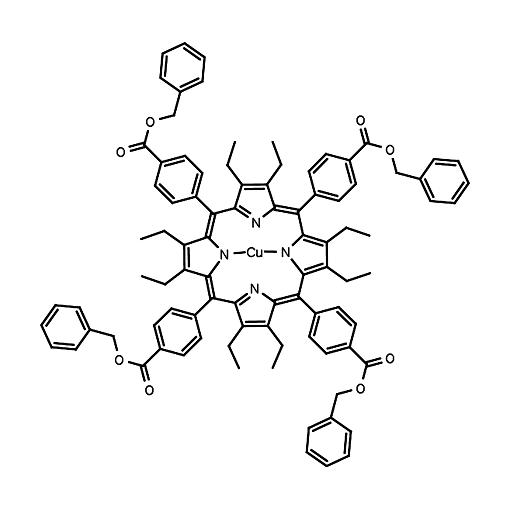
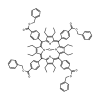
Cu(II) meso-Tetra (4-Carboxyphenyl)octaethylporphine tetrabenzyl ester
Molecular Formula: C92H84CuN4O8
CAS#: None
SMILES: CCC1=C(CC)/C2=C(/C3=C(CC)C(CC)=C4N3[Cu]N3C(/C(CC)=C(CC)\C3=C(\C3=N\C(\C(CC)=C3CC)=C/4C3=CC=C(C=C3)C(=O)OCC3=CC=CC=C3)C3=CC=C(C=C3)C(=O)OCC3=CC=CC=C3)=C(\C1=N\2)C1=CC=C(C=C1)C(=O)OCC1=CC=CC=C1)C1=CC=C(C=C1)C(=O)OCC1=CC=CC=C1
MDL#: None
Catalog#: U34966
Molecular weight: 1437.22 g/mol
Appearance: Purple solid
Purity: >95%
Storage: room temp
Solubility: organic solvents
Other names:
- Copper(II) meso-tetra(4-carboxyphenyl)octaethylporphyrin tetrabenzyl ester
- Copper(II) 2,3,7,8,12,13,17,18-octaethyl-5,10,15,20-tetrakis[4-(benzyloxycarbonyl)phenyl]porphyrin
- Cu(II) octaethyl-tetra(4-carboxyphenyl)porphyrin tetrabenzyl ester
- Tetrabenzyl-protected Cu(II) octaethyl tetracarboxyphenylporphyrin
Fields of Interest
copper porphyrins, distorted porphyrins, nonplanar porphyrins, dodeca-substituted porphyrins, conformational chemistry, redox chemistry, protected carboxy porphyrins, porphyrin building blocks, surface functionalization, coordination materials, porous materials, photochemistry, molecular electronics
Background
Cu(II) meso-Tetra(4-carboxyphenyl)octaethylporphine tetrabenzyl ester is a highly substituted copper(II) porphyrin containing eight β-ethyl groups and four meso-4-carboxyphenyl substituents protected as benzyl esters. Copper(II) occupies the central N₄ coordination site, while the combined β-octaethyl and meso-tetraaryl substitution produces a sterically congested, dodeca-substituted porphyrin framework.
This substitution pattern is significant because octaethyl-tetraphenylporphyrins are strongly nonplanar, typically adopting pronounced saddle-like macrocycle distortions. Studies of the parent Cu(II) octaethyltetraphenylporphyrin, Cu(OETPP), demonstrate that this distortion influences metal coordination, redox behavior, electronic structure, and access to the regions above and below the macrocycle. In U34966, the additional para-benzyloxycarbonyl functionality adds four protected peripheral carboxyl groups without removing the steric features responsible for the nonplanar porphyrin core. The benzyl esters therefore provide synthetically protected handles that may be converted to carboxylic-acid functionality under suitable deprotection conditions for subsequent attachment or materials chemistry.
Applications
This compound is most appropriately viewed as a protected, functionalized nonplanar copper porphyrin building block for synthetic and structure–property research.
- Nonplanar porphyrin studies: The β-octaethyl/meso-tetraaryl substitution pattern is closely related to Cu(OETPP), a benchmark system for studying saddle distortion in copper porphyrins. U34966 provides the same sterically crowded porphyrin architecture while adding peripheral protected carboxyl functionality.
- Redox and electronic-structure research: Cu(OETPP) studies show that oxidation can involve the porphyrin π-system and that nonplanarity affects electronic coupling between the copper center and macrocycle. The related U34966 scaffold may therefore be useful for comparative studies of substituent effects on redox and spectroscopic properties.
- Protected precursor to carboxyl-functionalized porphyrins: The four benzyl esters mask para-carboxyl groups during synthetic manipulation. After suitable debenzylation, the resulting carboxyl-functionalized porphyrin would provide sites for coordination, covalent attachment, surface modification, or further derivatization.
- Hybrid and surface-bound materials: Closely related copper tetrakis(4-carboxyphenyl)porphyrins use their peripheral carboxyl groups to associate with inorganic and functional materials. The tetrabenzyl ester form provides a protected route toward analogous carboxyl-functionalized systems while retaining the unusual steric environment of the octaethylporphyrin core.
- Structure–property comparisons: Comparison with planar Cu tetraphenylporphyrins, Cu octaethylporphyrin, and nonplanar Cu(OETPP) derivatives can help distinguish the effects of β-alkyl substitution, macrocycle distortion, peripheral ester functionality, and metal coordination on porphyrin behavior.
Selected Literature
Peer-reviewed studies specifically using U34966 or the exact tetrabenzyl ester were not located. The following literature concerns the closest directly relevant copper octaethyltetraphenylporphyrin and copper tetracarboxyphenylporphyrin scaffolds.
- Renner, M. W.; Barkigia, K. M.; Zhang, Y.; Medforth, C. J.; Smith, K. M.; Fajer, J. “Consequences of Oxidation in Nonplanar Porphyrins: Molecular Structure and Diamagnetism of the π Cation Radical of Copper(II) Octaethyltetraphenylporphyrin.” Journal of the American Chemical Society 1994, 116, 8582–8592. DOI: 10.1021/ja00098a019.
- This study examines Cu(OETPP), the closest unsubstituted parent of the U34966 porphyrin core, and demonstrates its strongly saddle-distorted structure and unusual redox behavior associated with the nonplanar macrocycle.
- Sparks, L. D.; Medforth, C. J.; Park, M. S.; Chamberlain, J. R.; Ondrias, M. R.; Senge, M. O.; Smith, K. M.; Shelnutt, J. A. “Metal Dependence of the Nonplanar Distortion of Octaalkyltetraphenylporphyrins.” Journal of the American Chemical Society 1993, 115, 581–592. DOI: 10.1021/ja00055a030.
- This foundational crystallographic and spectroscopic study includes Cu(II) octaethyltetraphenylporphyrin directly and establishes how severe steric crowding and metal identity control porphyrin nonplanarity and optical properties.
- Renner, M. W.; Barkigia, K. M.; Fajer, J. “Conformational Landscapes of Nonplanar Porphyrins: Superstructure, Ligation, Binding Pockets and Oxidation Effects in Cu(II) Porphyrins.” Inorganica Chimica Acta 1997, 263, 181–187. DOI: 10.1016/S0020-1693(97)05570-9.
- This study of oxidized Cu(OETPP) shows how its saddle-shaped macrocycle and bulky peripheral groups create defined axial-ligand orientations and supramolecular binding pockets, illustrating the structural consequences of the same highly substituted copper-porphyrin core.
- Zhang, Z.; Liu, H.; Xu, J.; Zhang, N. “Enhancing the Visible Light Absorption and Charge Separation of Bi₂WO₆ by Hybridizing a CuTCPP Sensitizer.” Photochemical & Photobiological Sciences 2017, 16, 1194–1200. DOI: 10.1039/C7PP00118E.
- This related Cu(II) tetrakis(4-carboxyphenyl)porphyrin study demonstrates how exposed peripheral carboxyl groups can integrate a copper porphyrin with an inorganic semiconductor for visible-light harvesting and charge-transfer research; U34966 would require deprotection before analogous carboxyl-group chemistry.
- Wang, H.; Zhou, D.; Shen, S.; Wan, J.; Zheng, X.; Yu, L.; Phillips, D. L. “The Photocatalytic Activity and Degradation Mechanism of Methylene Blue over Copper(II) Tetra(4-carboxyphenyl) Porphyrin Sensitized TiO₂ under Visible Light Irradiation.” RSC Advances 2014, 4, 28978–28986. DOI: 10.1039/C4RA03979C.
- This related CuTCPP study shows the utility of deprotected carboxyphenyl copper porphyrins in surface-associated photoactive materials, supporting materials applications for derivatives obtained after conversion of protected carboxyl groups to their free-acid form.