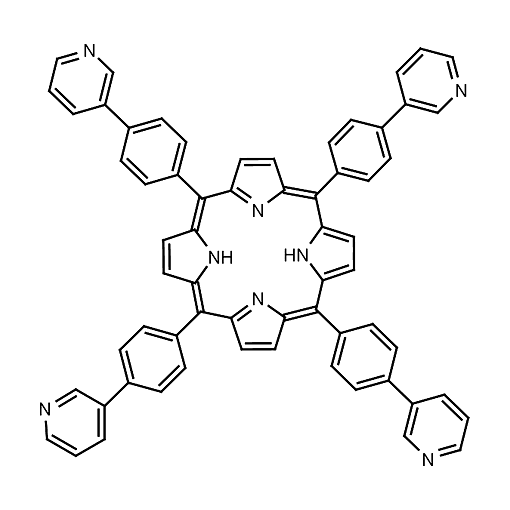
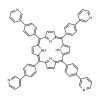
meso-Tetra(4-(3-pyridyl)phenyl) porphine
Molecular Formula: C64H42N8
CAS#: None
SMILES: N1C2=CC=C1\C(=C1\C=CC(=N\1)/C(=C1NC(/C=C\1)=C(\C1=N\C(\C=C1)=C/2C1=CC=C(C=C1)C1=CN=CC=C1)C1=CC=C(C=C1)C1=CC=CN=C1)C1=CC=C(C=C1)C1=CN=CC=C1)C1=CC=C(C=C1)C1=CN=CC=C1
MDL#: None
Catalog#: U34744
Molecular weight: 923.07 g/mol
Appearance: Purple solid
Purity: >95%
Storage: Store at room temperature
Solubility: organic solvents
Other names:
- 5,10,15,20-Tetrakis[4-(pyridin-3-yl)phenyl]porphyrin
- 5,10,15,20-Tetrakis[4-(3-pyridyl)phenyl]porphyrin
- meso-Tetrakis[4-(3-pyridyl)phenyl]porphyrin
- Tetra(3-pyridylphenyl)porphyrin
- 3′-pyridylphenyl porphyrin
Fields of Interest
porphyrin chemistry, supramolecular chemistry, coordination chemistry, metal-organic frameworks, coordination polymers, molecular cages, crystal engineering, molecular recognition, host–guest chemistry, porphyrin arrays, photophysics, energy transfer, metal-directed self-assembly
Background
meso-Tetra[4-(3-pyridyl)phenyl] Porphine is a free-base porphyrin bearing four extended 4-(pyridin-3-yl)phenyl substituents at the meso positions. Each arm contains a phenyl spacer terminated by a neutral 3-pyridyl nitrogen donor, providing four peripheral metal-coordination sites in addition to the N₄ cavity at the center of the porphyrin macrocycle. This combination makes the compound a potentially useful tetratopic building block for metal-directed supramolecular chemistry while preserving the strong visible-light absorption characteristic of a free-base porphyrin.
The meta relationship of the pyridyl nitrogen is an important structural feature. Compared with the corresponding 4-pyridylphenyl isomer, the 3-pyridyl donor geometry changes the direction in which coordinated metal centers project from the porphyrin. Studies of related 3-pyridyl porphyrins show that this geometry can produce canted, curved, or otherwise three-dimensional assemblies rather than the more perpendicular architectures often associated with 4-pyridyl donors. The additional phenyl spacer in this compound further extends the coordination sites away from the porphyrin core, making it particularly relevant to research on larger coordination networks, molecular cages, and spatially defined multiporphyrin assemblies.
Applications
The principal research value of this compound is as an extended tetratopic porphyrin ligand for metal-directed assembly and functional supramolecular materials.
- Coordination-driven self-assembly: Four peripheral 3-pyridyl nitrogen atoms can act as coordination donors toward Pd(II), Pt(II), Ru(II), transition-metal ions, and other suitable metal centers. Related 3-pyridyl systems demonstrate that meta-oriented donors can generate nonplanar and three-dimensional supramolecular architectures.
- Molecular cages and host–guest systems: The extended 4-(3-pyridyl)phenyl arms provide both separation from the porphyrin core and directional nitrogen donors. Closely related ligands containing the same 4-(3-pyridyl)phenyl motif have formed discrete Pd(II) cages capable of encapsulating multiple anionic and aromatic guests, supporting investigation of this porphyrin as a larger photoactive cage-building scaffold.
- Metal-organic frameworks and coordination polymers: The combination of four coordination sites and a rigid porphyrin center makes the compound structurally suited to extended metal-linked networks. Related tetra(3-pyridyl)porphyrins form three-dimensional coordination polymers and other crystalline architectures through transition- and lanthanide-metal interactions.
- Porphyrin arrays and photophysical research: Metal coordination can organize multiple porphyrin chromophores at defined distances and orientations. Studies of 3-pyridyl porphyrin arrays show that donor geometry strongly influences assembly shape while allowing investigation of energy-transfer and excited-state processes between neighboring porphyrins.
- Molecular recognition and crystal engineering: The pyridyl groups can participate in metal coordination and, when protonated or incorporated into suitable assemblies, additional noncovalent interactions. This enables investigation of how ligand geometry controls crystal packing, guest recognition, and the balance between discrete and extended supramolecular structures.
Selected Literature
Suitable peer-reviewed literature specifically using the exact extended 4-(3-pyridyl)phenyl porphyrin appears to be limited. The following studies provide the closest experimental support for its 3-pyridyl coordination geometry, extended pyridylphenyl arms, and proposed supramolecular applications.
- Vidal, A.; Rossato, D.; Iengo, E.; Balducci, G.; Alessio, E. “Modulating the Shape of Short Metal-Mediated Heteroleptic Tapes of Porphyrins.” Chemistry – A European Journal 2023, 29, e202300893. DOI: 10.1002/chem.202300893.
- This study uses meso-tetra(3-pyridyl)porphyrin directly in Ru-mediated multiporphyrin tapes and shows that 3-pyridyl donor geometry generates well-defined nonplanar three-dimensional structures, supporting the use of meta-pyridyl porphyrins in shape-controlled self-assembly.
- Kim, T. Y.; Digal, L.; Gardiner, M. G.; Lucas, N. T.; Crowley, J. D. “Octahedral [Pd₆L₈]¹²⁺ Metallosupramolecular Cages: Synthesis, Structures and Guest-Encapsulation Studies.” Chemistry – A European Journal 2017, 23, 15089–15097. DOI: 10.1002/chem.201702518.
- This closely related study uses ligands containing the same 4-(3-pyridyl)phenyl donor motif to construct Pd₆L₈ cages and demonstrates size-selective encapsulation of anionic and aromatic guests, directly supporting the relevance of this peripheral group to molecular-cage and host–guest chemistry.
- Lipstman, S.; Goldberg, I. “Versatile Molecular Recognition Features of Tetra(3-pyridyl)porphyrin in Crystal Engineering.” Crystal Growth & Design 2010, 10, 4596–4606. DOI: 10.1021/cg1008973.
- This study demonstrates the coordination and molecular-recognition versatility of tetra(3-pyridyl)porphyrin, including formation of three-dimensional coordination polymers and diverse supramolecular crystalline architectures with transition and lanthanide metal ions.
- Alessio, E.; Geremia, S.; Mestroni, S.; Srnova, I.; Slouf, M.; Gianferrara, T.; Prodi, A. “Porphyrin ‘Flying-Saucers’: Solid State and Solution Structure of a Novel Pentameric Array of Axially-Ligated Canted Porphyrins.” Inorganic Chemistry 1999, 38, 2527–2529. DOI: 10.1021/ic990084g.
- This work shows directly that four peripheral 3-pyridyl groups can coordinate four metalloporphyrin units, producing a pentameric canted array and establishing the characteristic three-dimensional coordination geometry of meta-pyridyl porphyrins.
- Prodi, A.; Indelli, M. T.; Kleverlaan, C. J.; Scandola, F.; Alessio, E.; Gianferrara, T.; Marzilli, L. G. “Side-to-Face Ruthenium Porphyrin Arrays: Photophysical Behavior of Dimeric and Pentameric Systems.” Chemistry – A European Journal 1999, 5, 2668–2679. DOI: 10.1002/(SICI)1521-3765(19990903)5:9<2668::AID-CHEM2668>3.0.CO;2-M.
- This study compares 3- and 4-pyridyl porphyrin assemblies and examines their photophysical behavior, showing how pyridyl orientation controls porphyrin-array geometry while supporting energy-transfer processes within coordinated multiporphyrin systems.