
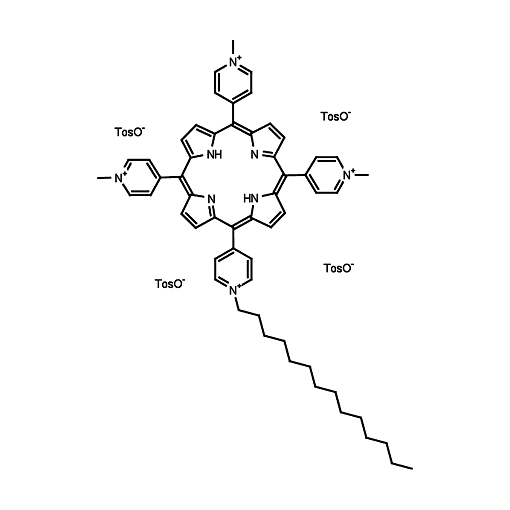
5-(4-N-tetradecylpyridyl) 10,15,20-tris (4-N-methylpyridyl)-21H, 23H-porphine tetratosylate
Molecular Formula: C85H92N8O12S4
CAS#: None
SMILES: CC1=CC=C(C=C1)S([O-])(=O)=O.CC1=CC=C(C=C1)S([O-])(=O)=O.CC1=CC=C(C=C1)S([O-])(=O)=O.CC1=CC=C(C=C1)S([O-])(=O)=O.CCCCCCCCCCCCCC[N+]1=CC=C(C=C1)C1=C2NC(\C=C/2)=C(/C2=N/C(/C=C2)=C(\C2=CC=C(N2)/C(=C2/C=CC\1=N/2)C1=CC=[N+](C)C=C1)C1=CC=[N+](C)C=C1)C1=CC=[N+](C)C=C1
MDL#: None
Catalog#: T41124
Molecular weight: 1545.94 g/mol
Appearance: Purple solid
Purity: >95%
Storage: at room temperature
Solubility: water, alcohols
Other names:
- meso-Tri(N-methylpyridyl)-meso-mono(N-tetradecylpyridyl)porphine tetratosylate
- meso-Tri(N-methylpyridyl)-meso-mono(N-tetradecylpyridyl)porphine tetrasulfonate
- 5-(4-N-Tetradecylpyridyl)-10,15,20-tris(4-N-methylpyridyl)porphyrin tetratosylate
- C14 porphyrin
- TMPyP4-C14
- C14-TMPyP
Fields of Interest
amphiphilic porphyrins, cationic porphyrins, photodynamic inactivation, antimicrobial photodynamic therapy, photosensitizers, biofilm research, virus inactivation, water photodisinfection, singlet oxygen generation, membrane interactions, photochemistry, microbial control
Background
5-(4-N-Tetradecylpyridyl)-10,15,20-tris(4-N-methylpyridyl)-21H,23H-porphine tetratosylate is an amphiphilic, tetracationic porphyrin designed to combine the aqueous compatibility and electrostatic binding properties of N-methylpyridinium porphyrins with the membrane affinity of a long C14 tetradecyl chain. Three peripheral pyridyl groups are N-methylated, while the fourth carries the tetradecyl substituent; four p-toluenesulfonate counterions balance the four positive charges.
This asymmetric combination of cationic and hydrophobic functionality distinguishes C14 from conventional meso-tetra(N-methylpyridyl)porphyrin (TMPyP). The positively charged pyridinium groups promote interaction with negatively charged biological surfaces, while the tetradecyl chain increases hydrophobic association with lipid-rich membranes and other nonpolar domains. Upon visible-light excitation, the porphyrin macrocycle can transfer energy to molecular oxygen and generate reactive oxygen species, including singlet oxygen. These characteristics make C14 particularly useful for research into photodynamic microbial inactivation, membrane-associated photosensitization, biofilms, viruses, and light-activated environmental disinfection.
Applications
C14 is primarily studied as an amphiphilic photosensitizer for photodynamic inactivation where both electrostatic binding and hydrophobic membrane interaction are advantageous.
- Antimicrobial photodynamic inactivation: C14 has been studied directly against both Gram-positive and Gram-negative bacteria. Increasing the alkyl-chain length within related TMPyP derivatives increases association with microbial cells, and the C14 derivative showed particularly favorable photosensitizing activity by balancing membrane affinity with limited aggregation.
- Biofilm photoinactivation: C14 has been used against Staphylococcus epidermidis biofilms grown on titanium alloy surfaces. Its long alkyl chain promoted greater association and deeper interaction with bacterial membranes than the parent N-methylpyridyl porphyrin, supporting research into light-mediated control of surface-associated microbial communities.
- Virus and bacteriophage inactivation: The exact Frontier-supplied C14 porphyrin has been evaluated for blue-light photodynamic inactivation of bacteriophages used as viral surrogates. Hydrophobic C14 functionalization improved the performance of the parent TMPyP framework, demonstrating the importance of porphyrin–virus association in photodynamic disinfection.
- Photoactivated larval control: C14 has been investigated directly as a visible-light-activated photosensitizer against Aedes aegypti larvae. Its amphiphilic structure enables association with biological material and efficient photooxidative activity, supporting research into light-activated approaches for vector control.
- Photophysical and membrane-interaction studies: C14 is useful for investigating the effects of amphiphilicity on porphyrin aggregation, singlet-oxygen generation, cellular binding, and membrane penetration. The C14 scaffold provides a useful comparison with shorter- and longer-chain pyridinium porphyrins for structure–activity studies.
Selected Literature
- Heffron, J.; Bork, M.; Mayer, B. K.; Skwor, T. “A Comparison of Porphyrin Photosensitizers in Photodynamic Inactivation of RNA and DNA Bacteriophages.” Viruses 2021, 13 (3), 530. DOI: 10.3390/v13030530.
- This study uses the exact Frontier-supplied C14 porphyrin and demonstrates its binding to bacteriophages and its use in blue-light photodynamic virus inactivation; addition of the C14 chain improved activity relative to the parent TMPyP photosensitizer.
- Lucantoni, L.; Magaraggia, M.; Lupidi, G.; Ouedraogo, R. K.; Coppellotti, O.; Esposito, F.; Fabris, C.; Jori, G.; Habluetzel, A. “Novel, Meso-Substituted Cationic Porphyrin Molecule for Photo-Mediated Larval Control of the Dengue Vector Aedes aegypti.” PLoS Neglected Tropical Diseases 2011, 5 (12), e1434. DOI: 10.1371/journal.pntd.0001434.
- The authors use meso-tri(N-methylpyridyl)-meso-mono(N-tetradecylpyridyl)porphine tetrasulfonate (C14), MW 1545.96, directly and demonstrate efficient visible-light-mediated photosensitization of A. aegypti larvae.
- Saino, E.; Sbarra, M. S.; Arciola, C. R.; Scavone, M.; Bloise, N.; Nikolov, P.; Ricchelli, F.; Visai, L. “Photodynamic Action of Tri-meso (N-methyl-pyridyl), meso (N-tetradecyl-pyridyl) Porphine on Staphylococcus epidermidis Biofilms Grown on Ti6Al4V Alloy.” The International Journal of Artificial Organs 2010, 33 (9), 636–645. DOI: 10.1177/039139881003300909.
- This direct study of C14 shows enhanced binding to and penetration into S. epidermidis biofilms compared with the parent methylpyridyl porphyrin, resulting in improved light-dependent bacterial inactivation.
- Reddi, E.; Ceccon, M.; Valduga, G.; Jori, G.; Bommer, J. C.; Elisei, F.; Latterini, L.; Mazzucato, U. “Photophysical Properties and Antibacterial Activity of meso-Substituted Cationic Porphyrins.” Photochemistry and Photobiology 2002, 75 (5), 462–470. DOI: 10.1562/0031-8655(2002)075<0462>2.0.CO;2.
- This study compares TMPyP derivatives bearing C6–C22 hydrocarbon chains and identifies the C14 porphyrin as a particularly effective balance of bacterial association, photophysical behavior, and photosensitizing activity against S. aureus and E. coli.
- Kassab, K.; Ben Amor, T.; Jori, G.; Coppellotti, O. “Photosensitization of Colpoda inflata Cysts by meso-Substituted Cationic Porphyrins.” Photochemical & Photobiological Sciences 2002, 1 (8), 560–564. DOI: 10.1039/B201267G.
- This work evaluates the C14 tetradecyl porphyrin directly and reports that introduction of the long hydrocarbon chain substantially increased phototoxic activity compared with the parent N-methylpyridyl porphyrin.