
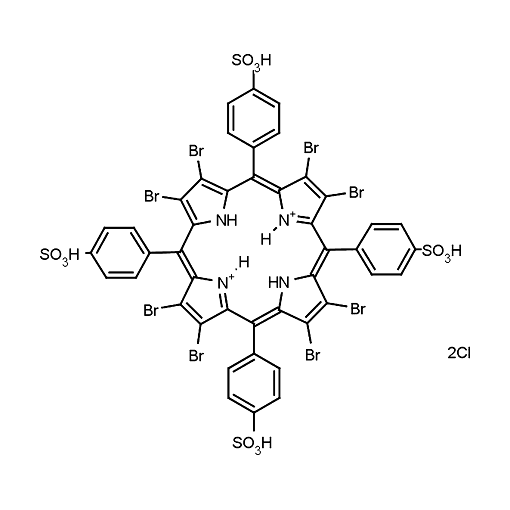
2,3,7,8,12,13,17,18-octabromo-5,10,15,20-tetrakis(4-sulfonatophenyl) Porphyrin
Molecular Formula: C44H22Br8N4O12S4
CAS#: 154783-99-0
SMILES:
O=S(=O)(O)C=1C=CC(=CC1)C=2C3=NC(C(Br)=C3Br)=C(C4=CC=C(C=C4)S(=O)(=O)O)C=5NC(=C(Br)C5Br)C(C=6C=CC(=CC6)S(=O)(=O)O)=C7N=C(C(Br)=C7Br)C(C8=CC=C(C=C8)S(=O)(=O)O)=C9NC2C(Br)=C9Br
MDL#: None
Catalog#: T41101
Molecular weight: 1566.15 g/mol
Appearance: Green Solid
Purity: >95%
Storage: Store at room temperature, protected from light
Solubility: water, alcohols
Other names:
- octabromo-meso-tetra(4-sulfonatophenyl)porphine
- 2,3,7,8,12,13,17,18-Octabromo-5,10,15,20-tetrakis(4-sulfonatophenyl)-21H,23H-porphyrin
- 4,4′,4″,4‴-(2,3,7,8,12,13,17,18-Octabromo-21H,23H-porphine-5,10,15,20-tetrayl)tetrakis[benzenesulfonic acid]
- Br₈TPPS₄
Fields of Interest
porphyrin chemistry, lithium ion sensing, spectrophotometric analysis, optical sensors, ion recognition, lithium separation, membrane transport, aqueous porphyrin chemistry, J-aggregates, supramolecular chemistry, self-assembly, photophysics
Background
2,3,7,8,12,13,17,18-Octabromo-5,10,15,20-tetrakis(4-sulfonatophenyl)porphyrin (CAS 154783-99-0) is a highly brominated, water-soluble free-base porphyrin developed for ion-recognition, spectrophotometric, and supramolecular studies. Four para-sulfonated phenyl groups provide compatibility with aqueous media, while eight bromine atoms occupy the β-pyrrolic positions of the porphyrin macrocycle.
The extensive β-bromination gives this compound markedly different acid–base and structural behavior from non-brominated tetraphenylporphyrin sulfonates. The electron-withdrawing bromine substituents lower the basicity of the macrocycle and promote a strongly nonplanar, distorted porphyrin conformation. These properties enable unusual interactions with lithium ions under alkaline conditions and also influence the compound’s protonation and aggregation behavior in acidic aqueous solutions. As a result, Br₈TPPS₄ is useful both as an analytical ion-recognition reagent and as a model system for studying how peripheral substitution controls porphyrin conformation, protonation, spectroscopy, and self-assembly.
Applications
This octabrominated sulfonated porphyrin is particularly relevant to lithium sensing, selective ion chemistry, and aqueous porphyrin aggregation research.
- Lithium ion detection: In alkaline aqueous solution, the porphyrin forms a lithium complex accompanied by a pronounced change in its visible absorption spectrum. This response has been used for spectrophotometric determination of Li⁺, while sodium and potassium show substantially different behavior under the reported conditions.
- Lithium monitoring in biological samples: More recent work has used this exact porphyrinoid reagent in a portable optical system for quantitative lithium measurement in blood plasma, illustrating continued interest in its selective lithium-dependent absorbance response.
- Lithium separation and membrane transport: The lithium–porphyrin complex can form ion pairs with appropriate counterions, enabling extraction into organic media and transport across liquid membranes. This chemistry has been investigated for separating trace lithium in the presence of much higher sodium concentrations.
- J-aggregate and self-assembly research: Under acidic conditions, Br₈TPPS₄ undergoes sequential protonation and can form J-aggregates with distinctive red-shifted optical features. Its strongly distorted macrocycle makes it a useful comparison with conventional sulfonated tetraphenylporphyrins in studies of nucleation, aggregate growth, morphology, and supramolecular organization.
- Acid–base and porphyrin coordination studies: The compound’s unusual protonation and deprotonation equilibria provide a useful system for investigating how electron-withdrawing β-substitution changes porphyrin basicity, metal-ion interaction, and optical response in aqueous environments.
Selected Literature
- Ye, Z.; Huang, Z.; Zhou, J.; Li, H.; Zhang, M.; He, Q.; Chen, H.; Zhong, J.; Zhang, H.; Han, Z.; Chu, L. T.; Guo, W. “A Portable Optical Device for Quantitative Detection of Lithium in Blood Plasma.” Analytical Methods 2025, 17, 5355–5361. DOI: 10.1039/D5AY00469A.
- This study uses the exact octabrominated sulfonatophenyl porphyrin as the lithium-responsive reagent in a portable optical platform for rapid quantitative measurement of Li⁺ in blood plasma.
- Abdelaziz, B.; Sarà, M.; Ayachi, S.; Zagami, R.; Patanè, S.; Romeo, A.; Castriciano, M. A.; Scolaro, L. M. “Investigation of J-Aggregates of 2,3,7,8,12,13,17,18-Octabromo-5,10,15,20-tetrakis(4-sulfonatophenyl) Porphyrin in Aqueous Solutions.” Nanomaterials 2023, 13, 2832. DOI: 10.3390/nano13212832.
- This work studies the exact compound directly, examining its pH-dependent protonation, J-aggregate formation, aggregation kinetics, morphology, and strongly distorted porphyrin conformation in aqueous solution.
- Sun, H.; Tabata, M. “Separation and Transport of Lithium of 10⁻⁵ M in the Presence of Sodium Chloride Higher than 0.1 M by 2,3,7,8,12,13,17,18-Octabromo-5,10,15,20-tetrakis(4-sulfonatophenyl)porphyrin.” Talanta 1999, 49 (3), 603–610. DOI: 10.1016/S0039-9140(99)00053-3.
- The researchers use the exact porphyrin for selective lithium extraction and liquid-membrane transport, demonstrating separation of low lithium concentrations even in the presence of substantially higher sodium chloride levels.
- Tabata, M.; Nishimoto, J.; Kusano, T. “Spectrophotometric Determination of Lithium Ion Using a Water-Soluble Octabromoporphyrin in Aqueous Solution.” Talanta 1998, 46 (4), 703–709. DOI: 10.1016/S0039-9140(97)00327-5.
- This foundational study develops the exact compound as a spectrophotometric lithium reagent, showing that β-bromination lowers porphyrin basicity sufficiently to permit Li⁺ complexation and a measurable absorption shift in alkaline solution.
- Tabata, M.; Kusano, T.; Nishimoto, J. “Lithium(I) Porphyrin Complex for the Spectrophotometric Determination of Lithium Ion in Aqueous Solution.” Analytical Sciences 1997, 13, Supplement, 157–160. DOI: 10.2116/analsci.13.Supplement_157.
- This early study reports the synthesis and lithium-binding behavior of the same water-soluble octabromoporphyrin, establishing its distinctive acid–base properties and selective spectroscopic response to Li⁺ over sodium and potassium.