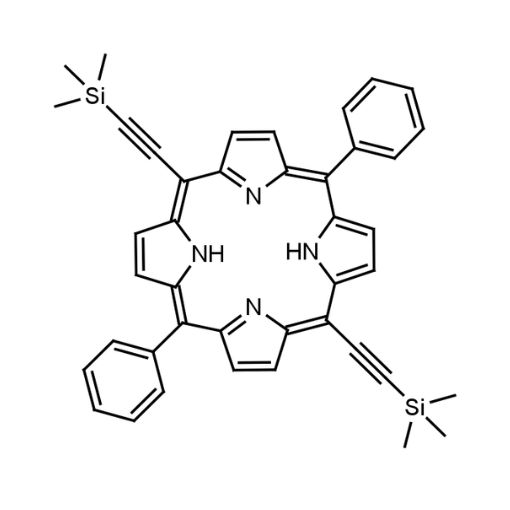
5,15-(di-trimethylsilylethynyl)-10,20-(diphenyl) porphyrin
Molecular Formula: C42H38N4Si2
CAS#: 186382-65-0
SMILES: C[Si](C)(C)C#CC1=C2N=C(C(C3=CC=CC=C3)=C4C=CC(N4)=C(C5=NC(C=C5)=C(C6=CC=C1N6)C7=CC=CC=C7)C#C[Si](C)(C)C)C=C2
MDL#: None
Catalog#: D34983
Molecular weight: 654.95 g/mol
Appearance: Purple solid
Purity: >95%
Storage: store at room temperature
Solubility: organic solvents
Other names:
- 5,15-Diphenyl-10,20-bis[(trimethylsilyl)ethynyl]porphine
- 5,15-Diphenyl-10,20-bis(trimethylsilylethynyl)porphyrin
- TMS-protected 5,15-diethynyl-10,20-diphenylporphyrin
Fields of Interest
Porphyrin arrays, High performance Energy storage, ethynyl porphyrins, organic synthesis, metalloporphyrins, conjugated materials, molecular electronics, electrochemical energy storage, organic electrodes, supramolecular chemistry, photophysics, optoelectronics
Background & Applications:
5,15-(di-trimethylsilylethynyl)-10,20-(diphenyl) porphyrin is of interest for the construction of porphyrin arrays and the corresponding copper(II) complex has demonstrated utility for high performance energy storage.
5,15-Bis(trimethylsilylethynyl)-10,20-diphenylporphyrin is a free-base trans-A₂B₂ porphyrin containing two phenyl groups and two trimethylsilyl-protected ethynyl substituents at opposing meso positions. The ethynyl groups are directly conjugated with the porphyrin π-system, making this scaffold useful for constructing extended conjugated porphyrin structures and studying electronic communication within functional molecular materials.
The trimethylsilyl groups serve as protecting groups for terminal alkynes and can be removed to generate 5,15-bis(ethynyl)-10,20-diphenylporphyrin (DEPP). The resulting terminal ethynyl groups provide versatile sites for further coupling, polymerization, and incorporation into larger molecular architectures. The free-base porphyrin can also be metalated to prepare Co, Ni, Cu, Zn, and other metalloporphyrin derivatives.
This compound is therefore useful as a synthetic intermediate and porphyrin building block for research involving conjugated porphyrin systems, metalloporphyrins, molecular electronics, photophysical materials, and electrochemical energy-storage materials. Ethynyl-functionalized derivatives of this scaffold have received particular interest as redox-active organic electrode materials for lithium- and sodium-based batteries.
Literature:
- European Journal of Organic Chemistry, 2011, # 29, p. 5817 – 5844, 10.1002/ejoc.201100642
- Journal of the American Chemical Society, 2000, vol. 122, # 29, p. 7017 – 7033, 10.1021/ja9939587
- Angewandte Chemie – International Edition, 2017, vol. 56, # 35, p. 10341 – 10346, 10.1002/anie.201702805
- Shakouri, S.; Abouzari-Lotf, E.; Chen, J.; Diemant, T.; Klyatskaya, S.; Pammer, F. D.; Mizuno, A.; Fichtner, M.; Ruben, M. “Molecular Engineering of Metalloporphyrins for High-Performance Energy Storage: Central Metal Matters.” ChemSusChem 2023, 16, e202202090. DOI: 10.1002/cssc.202202090.
- This study uses the 5,15-bis(trimethylsilylethynyl)-10,20-diphenylporphyrin scaffold directly in the synthesis of a series of metalloporphyrins. After conversion to ethynyl-functionalized derivatives, the researchers compared free-base and Co, Ni, Cu, and Zn porphyrins as redox-active materials for electrochemical energy storage. The work demonstrates how metal coordination, molecular packing, crystallinity, and porphyrin structure influence charge-storage performance.
- Chen, X.; Feng, X.; Ren, B.; et al. “High Rate and Long Lifespan Sodium-Organic Batteries Using Pseudocapacitive Porphyrin Complexes-Based Cathode.” Nano-Micro Letters 2021, 13, 71. DOI: 10.1007/s40820-021-00593-8.
- The synthesis described for this study uses 5,15-bis(trimethylsilylethynyl)-10,20-diphenylporphyrin as a precursor to ethynyl-functionalized porphyrins. The resulting DEPP and CuDEPP compounds were evaluated as cathode materials in sodium-organic batteries, where ethynyl functionality contributed to electrochemical stabilization and favorable cycling behavior.
- Arnold, D. P.; Bott, R. C.; Eldridge, H.; Elms, F. M.; Smith, G.; Zojaji, M. “Functionalization of 5,15-Diphenylporphyrin: Preparation and X-Ray Crystal Structures of meso Nitro, Bromo, and Trimethylsilylethynyl Derivatives.” Australian Journal of Chemistry 1997, 50, 495–504. DOI: 10.1071/C96193.
- This work investigates closely related trimethylsilylethynyl-substituted 5,15-diphenylporphyrins, including mono- and bis(trimethylsilylethynyl) nickel complexes. It demonstrates the use of TMS-protected ethynyl groups in porphyrin functionalization and provides structural characterization of this important class of meso-substituted porphyrins.