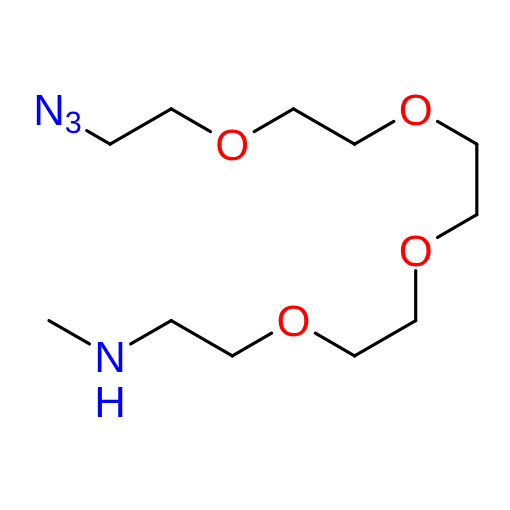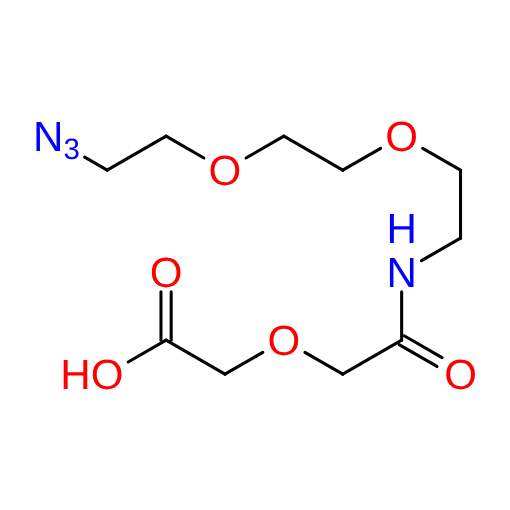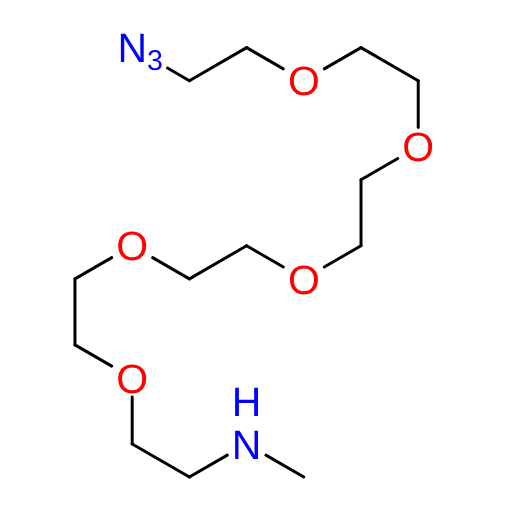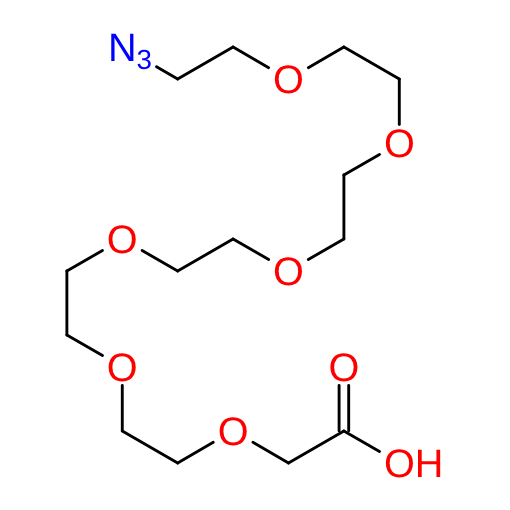
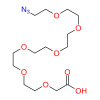
20-Azido-3,6,9,12,15,18-hexaoxaicosan-1-oic acid (96%)
Molecular Formula: C14H27N3O8
CAS#: 880129-82-8
SMILES: OC(COCCOCCOCCOCCOCCOCCN=[N+]=[N-])=O
MDL#: MFCD31656903
Catalog#: AMTGC1433-AC25
Molecular weight: 365.38 g/mol
Appearance: Pale Yellow Liquid
Purity: 96%
Storage: 2–8 °C storage
Solubility: Dichloromethane, Chloroform, Methanol
Other names:
- N3-PEG6-CH2CO2H
- Azido-PEG6-CH2COOH
- Azido-PEG6-CH2CO2H
- Azido-PEG6-acid
- Azido-PEG6-acetic acid
- N3-PEG6-CH2COOH
Fields of Interest
Functionalized PEGs, azido PEGs, acid PEGs, click chemistry, bioconjugation, medicinal chemistry, chemical biology, drug discovery, PROTAC linker synthesis, antibody-drug conjugates, molecular probe development, surface functionalization, glycan chemistry, custom linker synthesis
Background
20-Azido-3,6,9,12,15,18-hexaoxaicosanoic acid (CAS 880129-82-8) is a long-chain, heterobifunctional PEG linker containing a terminal azide and a terminal carboxylic acid separated by a defined PEG6-derived spacer. The compound has the molecular formula C14H27N3O8 and molecular weight 365.38 g/mol. Sigma-Aldrich identifies the material as a heterobifunctional PEGylated crosslinker with azide and carboxylic-acid functionality.
The terminal azide provides a compact bioorthogonal handle for copper-catalyzed azide–alkyne cycloaddition (CuAAC) with terminal alkynes and strain-promoted azide–alkyne cycloaddition (SPAAC) with strained cyclooctynes such as DBCO and BCN. The carboxylic acid provides complementary functionality for amide-bond formation after activation with standard peptide-coupling or carbodiimide reagents. This combination enables sequential or orthogonal attachment of two different molecular components.
The relatively long PEG6 spacer provides substantial flexibility and hydrophilic character compared with shorter azido-PEG acids. This additional spacing can be useful when researchers want to reduce steric crowding between conjugated groups or increase the hydrophilic contribution of the linker. Because the molecule is discrete rather than polydisperse, it also provides a reproducible molecular length and exact composition.
The compound can additionally serve as a precursor to 20-amino-3,6,9,12,15,18-hexaoxaicosanoic acid through reduction of the azide, providing another route to functionalized PEG derivatives. Direct synthetic records document conversion of CAS 880129-82-8 to the corresponding amino acid derivative.
Applications
Azido-PEG6-CH2COOH is particularly useful in bioconjugation and modular linker synthesis. The carboxylic acid can be coupled to amine-containing peptides, proteins, small molecules, fluorophores, affinity tags, or other scaffolds while leaving the distal azide available for a second conjugation step through click chemistry.
The long PEG6 spacer can be advantageous in medicinal chemistry and drug-conjugate development, where the distance between functional components can influence accessibility, flexibility, and the physicochemical behavior of the final construct. Sigma-Aldrich specifically identifies the compound as a building block for small molecules, biomolecular conjugates, chemical-biology tools, antibody-drug conjugates, and PROTACs.
In chemical biology, the compound can be used to introduce a latent click handle onto an amine-containing molecule through conventional amide coupling. The resulting azide-functionalized intermediate can then be reacted with alkyne- or cyclooctyne-functionalized reporters, probes, targeting ligands, or other biomolecules.
Azido-PEG6-acid is also relevant to surface and biomaterial functionalization. Azide-containing PEG architectures have been used in surface-bound cytomimetic assemblies and liposome immobilization strategies, illustrating the broader utility of azide-bearing PEG spacers in constructing chemically defined interfaces and biomimetic systems.
The extended oligoethylene glycol chain can also be useful in glycan and carbohydrate chemistry. Oligoethylene glycol-linked tags have been used successfully in glycan synthesis and purification workflows, demonstrating the value of defined PEG-like spacers for improving synthetic handling while retaining modular conjugation functionality.
Literature:
Peer-reviewed papers explicitly naming CAS 880129-82-8 are limited in indexed databases. The references below support the use of closely related azide-PEG architectures in bioconjugation, surface modification, and glycan chemistry.
- Ma, Y.; Zhang, H.; Sun, X.-L. “Surface-Bound Cytomimetic Assembly Based on Chemoselective and Biocompatible Immobilization and Further Modification of Intact Liposome.” Bioconjugate Chem. 2010, 21, 1994–1999. DOI: 10.1021/bc100220j.
- This study used azide-functionalized surfaces and PEG-containing liposomal components in chemoselective ligation strategies to create surface-bound biomimetic assemblies. The work supports the broader use of azide-bearing PEG architectures in surface functionalization and biomolecular assembly.
- Sato, R.; et al. “Intracellular Protein-Labeling Probes for Multicolor Single-Molecule Imaging of Immune Receptor–Adaptor Molecular Dynamics.” J. Am. Chem. Soc. 2017, 139, 17397–17404. DOI: 10.1021/jacs.7b08262.
- This work developed intracellular protein-labeling probes for multicolor single-molecule imaging. The study illustrates the broader value of defined, functionalized linker architectures in constructing compact molecular probes for chemical biology and live-cell imaging.
- Hwang, J.; Yu, H.; Malekan, H.; Sugiarto, G.; Li, Y.; Qu, J.; Nguyen, V.; Wu, D.; Chen, X. “Highly Efficient One-Pot Multienzyme (OPME) Synthesis of Glycans with Fluorous-Tag Assisted Purification.” Chem. Commun. 2014, 50, 3159–3162. DOI: 10.1039/C4CC00070F.
- This study used oligoethylene glycol-linked fluorous tags to facilitate both enzymatic glycan synthesis and purification. The work demonstrates how defined OEG/PEG spacers can improve modular handling and conjugation in carbohydrate chemistry.
- Agard, N. J.; Prescher, J. A.; Bertozzi, C. R. “A Strain-Promoted [3+2] Azide–Alkyne Cycloaddition for Covalent Modification of Biomolecules in Living Systems.” J. Am. Chem. Soc. 2004, 126, 15046–15047. DOI: 10.1021/ja044996f.
- This landmark study established SPAAC as a copper-free route for reacting azides with strained cyclooctynes, providing direct chemical support for use of the azide terminus in Azido-PEG6-acid for bioorthogonal conjugation.