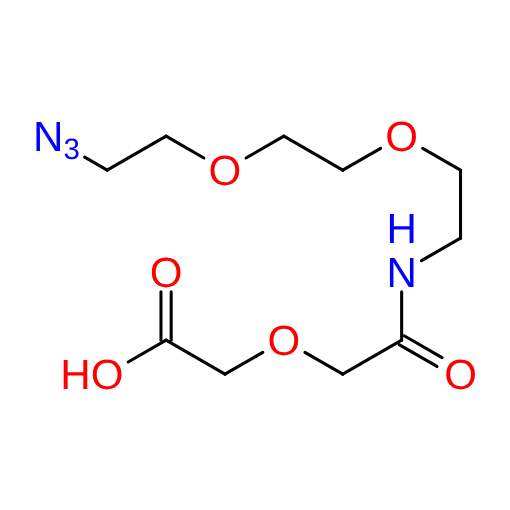
14-Azido-5-oxo-3,9,12-trioxa-6-azatetradecan-1-oic acid (98%)
Molecular Formula: C10H18N4O6
CAS#: None
SMILES: O=C(COCC(O)=O)NCCOCCOCCN=[N+]=[N-]
MDL#: None
Catalog#: AMTGC1268-AT24
Molecular weight: 290.27 g/mol
Appearance: Yellow Liquid
Purity: 98%
Storage: No Specific considerations
Solubility: Dichloromethane, Chloroform, Methanol
Other names:
- N3-PEG(9)-COOH
- Azido-PEG linker acid
- Azido-trioxa-aza carboxylic acid linker
Fields of Interest
Functionalized PEGs, azido PEGs, acid PEGs, click chemistry, bioconjugation, peptide chemistry, targeted drug delivery, liposome functionalization, medicinal chemistry, chemical biology, molecular probe development, custom linker synthesis
Background
14-Azido-5-oxo-3,9,12-trioxa-6-azatetradecan-1-oic acid is a defined heterobifunctional linker containing a terminal azide and a terminal carboxylic acid separated by an ether-rich spacer and an internal amide. The supplied SMILES, O=C(COCC(O)=O)NCCOCCOCCN=[N+]=[N-], corresponds to molecular formula C10H18N4O6 and molecular weight approximately 290.28 g/mol.
The molecule provides two complementary synthetic handles. The azide can participate in copper-catalyzed azide–alkyne cycloaddition (CuAAC) or strain-promoted azide–alkyne cycloaddition (SPAAC), while the carboxylic acid can be activated for amide coupling to amines. This makes the linker well suited for sequential molecular assembly in which one component is introduced through conventional coupling chemistry and another through click chemistry.
The internal amide distinguishes this linker from simpler azido-PEG acids in which the carboxylate is connected directly through the ether chain. That amide contributes additional polarity and hydrogen-bonding capacity while retaining the flexibility and hydrophilic character of the oligoethylene glycol portion.
Because the molecule is discrete rather than polydisperse, it provides a defined spacer length and exact composition. This can be useful in conjugate design where molecular spacing, linker flexibility, and reproducibility need to be tightly controlled.
Applications
This linker is particularly useful in bioconjugation and peptide-functionalization workflows. Its carboxylic acid can be coupled to amine-containing peptides, ligands, fluorophores, lipids, or other molecular components, leaving the distal azide available for subsequent click chemistry.
There is direct literature precedent for its use in targeted liposome construction. Ringhieri and co-workers used 14-azido-5-oxo-3,9,12-trioxa-6-azatetradecan-1-oic acid, identified in the paper as N3-Peg(9)-COOH, as a building block in the preparation of azide-functionalized surfactants incorporated into liposomes. Those azide groups were then reacted by click chemistry with alkyne-functionalized KCCYSL targeting peptides to generate HER-2-targeted liposomal systems.
This makes the compound relevant to drug-delivery systems, liposome functionalization, peptide conjugation, and targeted nanomaterials. Its azide allows modular introduction of targeting or reporter groups after the linker has already been incorporated into a larger construct.
The same architecture is also useful in chemical biology and molecular probe development, where a carboxylic-acid coupling step can install the linker onto an amine-bearing scaffold, followed by CuAAC or SPAAC to add a fluorophore, affinity tag, targeting ligand, or second biomolecule.
More broadly, the compound can serve as a custom linker intermediate in medicinal chemistry, allowing researchers to combine a defined hydrophilic spacer with two orthogonal reaction handles. This can be useful in multicomponent conjugates, surface modification, peptide assemblies, and other modular synthetic strategies.
Literature:
- Ringhieri, P.; Mannucci, S.; Conti, G.; Nicolato, E.; Fracasso, G.; Marzola, P.; Morelli, G.; Accardo, A. “Liposomes Derivatized with Multimeric Copies of KCCYSL Peptide as Targeting Agents for HER-2-Overexpressing Tumor Cells.” Int. J. Nanomedicine 2017, 12, 501–514. DOI: 10.2147/IJN.S113607.
- This study provides direct exact-compound precedent. The authors used 14-azido-5-oxo-3,9,12-trioxa-6-azatetradecan-1-oic acid (N3-Peg(9)-COOH) in the preparation of azide-functionalized liposomal components, which were subsequently clicked with alkyne-bearing KCCYSL peptides. The resulting multivalent liposomes showed enhanced binding and uptake in HER-2-overexpressing cells and were also evaluated as MRI contrast systems.
- Accardo, A.; Ringhieri, P.; Tesauro, D.; Morelli, G. “Liposomes Derivatized with Tetrabranched Neurotensin Peptides via Click Chemistry Reactions.” New J. Chem. 2013, 37, 3528–3534. DOI: 10.1039/C3NJ00596H.
- This related study demonstrates the use of azide-containing liposomal architectures and click chemistry to attach multibranched peptide ligands to liposome surfaces. It supports the broader use of azido-PEG linker chemistry in targeted nanocarrier functionalization.
- Agard, N. J.; Prescher, J. A.; Bertozzi, C. R. “A Strain-Promoted [3+2] Azide–Alkyne Cycloaddition for Covalent Modification of Biomolecules in Living Systems.” J. Am. Chem. Soc. 2004, 126, 15046–15047. DOI: 10.1021/ja044996f.
- This landmark study established strain-promoted azide–alkyne cycloaddition as a copper-free bioorthogonal reaction, supporting use of the terminal azide in this linker for SPAAC-based bioconjugation.