
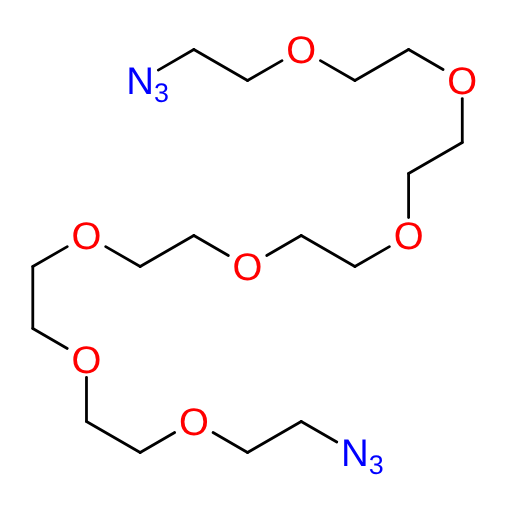
1,23-Diazido-3,6,9,12,15,18,21-heptaoxatricosane (98%)
Molecular Formula: C16H32N6O7
CAS#: 225523-86-4
SMILES: [N-]=[N+]=NCCOCCOCCOCCOCCOCCOCCOCCN=[N+]=[N-]
MDL#: MFCD29764341
Catalog#: AMTGC351-DA17
Molecular weight: 420.46 g/mol
Appearance: Yellow liquid
Purity: 98%
Storage: Room Temperature
Solubility: Dichloromethane, Chloroform, Methanol
Other names:
- N3-PEG7-CH2CH2N3
- Azido-PEG7-azide
- N3-PEG7-N3
Fields of Interest:
Click chemistry, bioconjugation, chemical biology, PEG linker synthesis, crosslinking, medicinal chemistry, drug discovery, PROTAC development, targeted protein degradation, polymer chemistry, hydrogel and biomaterial research, surface functionalization, nanomaterials, molecular probe development
Background
1,23-Diazido-3,6,9,12,15,18,21-heptaoxatricosane (CAS 225523-86-4) is a symmetrical, homobifunctional PEG linker commonly referred to as Azido-PEG7-azide. The molecule contains two terminal azide groups separated by a defined, flexible oligoethylene glycol chain. Unlike heterobifunctional PEG reagents that provide two different reaction handles, Azido-PEG7-azide presents the same click-reactive functionality at both termini, making it particularly useful for bridging, crosslinking, and constructing symmetrical or extended molecular architectures.
Both terminal azides can participate in copper-catalyzed azide–alkyne cycloaddition (CuAAC) with terminal alkynes or strain-promoted azide–alkyne cycloaddition (SPAAC) with strained cyclooctynes such as DBCO and BCN. These reactions generate stable triazole linkages and allow the PEG spacer to connect two appropriately functionalized molecular components.
The relatively long PEG7 spacer provides substantial molecular flexibility and hydrophilic character while retaining a discrete molecular structure. This distinguishes Azido-PEG7-azide from polydisperse polymeric PEG materials and allows researchers to incorporate a reproducible spacer length into molecular designs. Its longer spacer may be useful where additional separation between attached components is desired compared with shorter PEG diazides.
Applications
Azido-PEG7-azide is particularly useful as a homobifunctional click-chemistry crosslinker. One terminal azide can first react with an alkyne- or strained-alkyne-functionalized molecule while leaving the second azide available for subsequent conjugation. Alternatively, both termini can participate in coupling reactions to bridge two alkyne-functionalized molecules, surfaces, polymers, or other substrates. This enables the reagent to function as a defined molecular spacer in both stepwise and crosslinking strategies.
In bioconjugation and chemical biology, the PEG7 spacer can provide separation between biomolecules, affinity groups, fluorophores, targeting ligands, or other functional components. Because azide groups are relatively small and can participate in highly selective click reactions, diazido PEGs are useful intermediates for preparing more complex conjugation reagents and molecular probes.
The compound is also relevant to polymer, hydrogel, biomaterial, and surface chemistry. Multifunctional alkyne-bearing polymers or surfaces can be reacted with diazido PEG linkers to create crosslinked or PEG-containing architectures. Conversely, controlled reaction at one terminus can produce a mono-conjugated intermediate that retains an azide for subsequent surface attachment or molecular elaboration.
In medicinal chemistry and targeted protein degradation, discrete PEG chains are frequently incorporated into linkers to control the distance and flexibility between functional molecular components. Azido-PEG7-azide provides a relatively long PEG segment together with two synthetically accessible click handles, making it a useful precursor for assembling larger linker architectures. Commercial sources consequently classify it as a PEG-based PROTAC linker, although its utility extends well beyond PROTAC synthesis.
Another useful feature of the diazide architecture is its ability to act as a precursor to unsymmetrical heterobifunctional linkers. Selective functionalization of one azide followed by transformation or conjugation at the remaining terminus can provide access to more complex PEG-based building blocks. This makes Azido-PEG7-azide valuable not only as a final crosslinker but also as an intermediate for custom linker development.
Literature:
- Bioorganic and Medicinal Chemistry, 2010, vol. 18, # 15, p. 5732 – 5737
- European Journal of Medicinal Chemistry, 2026, vol. 305, art. no. 118566
- Angewandte Chemie – International Edition, 2016, vol. 55, # 11, p. 3642 – 3646
Exact-compound synthetic precedent: A doctoral research work from Charles University reports 1,23-diazido-3,6,9,12,15,18,21-heptaoxatricosane as a defined synthetic intermediate and provides its preparation from complementary azido-PEG alcohol and tosylate building blocks. The compound was prepared according to an earlier published procedure and characterized as part of the synthetic workflow. This provides direct evidence for the exact molecular structure and its use as a discrete PEG diazide building block.
- Kolb, H. C.; Finn, M. G.; Sharpless, K. B. “Click Chemistry: Diverse Chemical Function from a Few Good Reactions.” Angewandte Chemie International Edition 2001, 40, 2004–2021. DOI: 10.1002/1521-3773(20010601)40:11<2004::AID-ANIE2004>3.0.CO;2-5.
- This paper established the click-chemistry concept and provides the broader chemical rationale for using azide-functionalized building blocks in reliable, modular molecular assembly.
- Agard, N. J.; Prescher, J. A.; Bertozzi, C. R. “A Strain-Promoted [3+2] Azide–Alkyne Cycloaddition for Covalent Modification of Biomolecules in Living Systems.” Journal of the American Chemical Society 2004, 126, 15046–15047. DOI: 10.1021/ja044996f.
- This landmark study demonstrated strain-promoted azide–alkyne cycloaddition as a copper-free approach to biomolecular modification, supporting the use of terminal azides such as those in Azido-PEG7-azide for SPAAC-based conjugation.
- An, S.; Fu, L. “Small-Molecule PROTACs: An Emerging and Promising Approach for the Development of Targeted Therapy Drugs.” EBioMedicine 2018, 36, 553–562. DOI: 10.1016/j.ebiom.2018.09.005.
- This review discusses linker design in small-molecule PROTACs and is cited by suppliers specifically in connection with Azido-PEG7-azide. It provides class-level context for the use of defined PEG building blocks in targeted protein degradation rather than evidence that this exact CAS was evaluated in the paper.