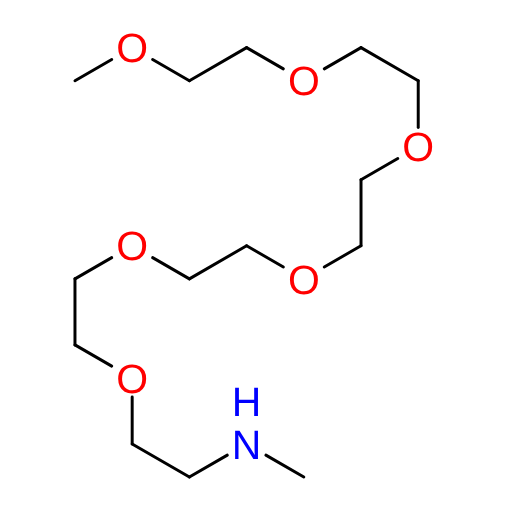
N-Methyl-2,5,8,11,14,17-hexaoxanonadecan-19-amine (98%)
Molecular Formula: C14H31CNO6
CAS#: 1059588-15-6
SMILES: COCCOCCOCCOCCOCCOCCNC
MDL#: MFCD35221303
Catalog#: AMTGC965-MA21
Molecular weight: 309.22 g/mol
Appearance: Yellow liquid
Purity: 98%
Storage: Room Temperature
Solubility: Dichloromethane, Chloroform, Methanol
Other names:
- mPEG6-NHMe
- N-Methyl-2,5,8,11,14,17-hexaoxanonadecan-19-amine
- N-Methyl-3,6,9,12,15,18-hexaoxanonadecan-1-amine
- Methylamino-PEG6-methyl ether
- N-Methyl-mPEG6-amine
- MeNH-PEG6-OMe
Fields of Interest:
Functionalized PEGs, methylamino PEGs, PEG linker synthesis, medicinal chemistry, drug discovery, bioconjugation, pharmaceutical research, amide synthesis, molecular probe development, photosensitizer modification, functional materials, specialty chemical synthesis
Background
N-Methyl-2,5,8,11,14,17-hexaoxanonadecan-19-amine (CAS 1059588-15-6) is a monofunctional, discrete PEG derivative containing a terminal secondary N-methylamine and a methoxy-capped PEG6 chain. Frontier’s AMT catalog identifies this exact compound and CAS number, while chemical databases also index the equivalent reverse-numbered name N-methyl-3,6,9,12,15,18-hexaoxanonadecan-1-amine.
The terminal N-methylamine provides the principal reactive functionality. As a secondary amine, it can participate in reactions with activated carboxylic acids, acid chlorides, activated esters, isocyanates, sulfonyl derivatives, and other suitable electrophiles. Acylation produces a tertiary N-methyl amide, providing a useful strategy for attaching a defined PEG6 chain to carboxylic-acid-containing molecular scaffolds.
The opposite terminus is capped with a methoxy group, making the molecule monofunctional under typical coupling conditions. The six-ether PEG segment provides a relatively long, flexible and hydrophilic spacer compared with shorter methylamino PEG derivatives, while retaining a defined molecular composition rather than the distribution of chain lengths found in polydisperse PEG materials.
An important distinction from conventional mPEG6-amine (CAS 184357-46-8) is the methyl substituent on nitrogen. mPEG6-amine contains a primary NH2 group, whereas CAS 1059588-15-6 contains a secondary NHCH3 terminus. This difference can be useful when a synthetic design specifically requires formation of an N-methylated tertiary amide or other N-methyl derivative.
Applications
N-Methyl-mPEG6-amine is useful as a synthetic building block for introducing a defined, methoxy-terminated PEG6 chain through secondary-amine coupling chemistry. Reaction of the N-methylamine with an activated carboxylic acid provides a direct route to N-methylated amides bearing a hydrophilic oligoethylene glycol substituent.
This chemistry is particularly relevant to medicinal chemistry and drug discovery, where discrete PEG chains can be incorporated into molecular structures to adjust spacer length, flexibility, and physicochemical characteristics. Because the PEG chain is methoxy-capped, the reagent introduces a single PEG substituent without leaving a second reactive PEG terminus. This can simplify the synthesis of compounds where further linker extension is not desired.
There is also direct precedent for using this exact compound to modify porphyrinoid photosensitizers. Patent literature describing phyllochlorin and purpurin derivatives uses N-methyl-2,5,8,11,14,17-hexaoxanonadecan-19-amine in amide-coupling reactions to install the N-methyl PEG chain onto photosensitizer scaffolds. For example, coupling with a reduced phyllochlorin using DMTMM produced the corresponding N-methyl-N-PEG-substituted propylamide. Related purpurin chemistry uses EDC/HOBt coupling with the same PEG reagent.
The compound can therefore serve as a useful building block for photosensitizers, molecular probes, drug-linker constructs, and other functional molecules where a defined hydrophilic PEG segment is desired. The relatively long PEG6 chain can provide separation between the parent scaffold and terminal methoxy group while increasing the ether content of the resulting conjugate.
More broadly, the secondary amine can be converted into amides, ureas, sulfonamides, carbamates, and related nitrogen-containing derivatives, depending on the reaction partner. This makes CAS 1059588-15-6 a versatile intermediate for custom synthesis beyond any single application area.
Literature:
Peer-reviewed literature explicitly identifying CAS 1059588-15-6 remains limited. However, direct exact-compound synthetic precedent is available in recent patent literature, while peer-reviewed research on discrete PEG and oligoethylene glycol chemistry supports the broader use of defined PEG spacers in molecular design.
- RSC Advances, 2015, vol. 5, # 26, p. 19989 – 20002
- WO 2024/246550 A1, “Purpurin Analogs for Use in Photodynamic Therapy,” 2024.
- This patent provides exact-compound application precedent for N-methyl-2,5,8,11,14,17-hexaoxanonadecan-19-amine. The reagent is coupled to purpurin 18 using EDC/HOBt chemistry to prepare an N-methyl-N-PEG-substituted amide. The work demonstrates the compound’s utility for installing a defined PEG6 segment onto a complex porphyrinoid photosensitizer scaffold.
- “Photodynamic Therapy and Diagnosis,” synthetic examples describing reduced phyllochlorin derivatives.
- N-Methyl-2,5,8,11,14,17-hexaoxanonadecan-19-amine is directly reacted with a reduced phyllochlorin using DMTMM-mediated coupling. The corresponding N-methyl-N-3,6,9,12,15,18-hexaoxanonadecyl propylamide is isolated as a PEG-modified photosensitizer derivative. This provides additional exact-compound evidence for its use in photosensitizer and medicinal-chemistry development.
- Knop, K.; Hoogenboom, R.; Fischer, D.; Schubert, U. S. “Poly(ethylene glycol) in Drug Delivery: Pros and Cons as Well as Potential Alternatives.” Angewandte Chemie International Edition 2010, 49, 6288–6308. DOI: 10.1002/anie.200902672.
- This class-level review discusses the physicochemical characteristics that make PEG useful in pharmaceutical and biomedical molecular design. It provides broader context for incorporating defined oligoethylene glycol chains into drug-related molecules but does not specifically evaluate CAS 1059588-15-6.