
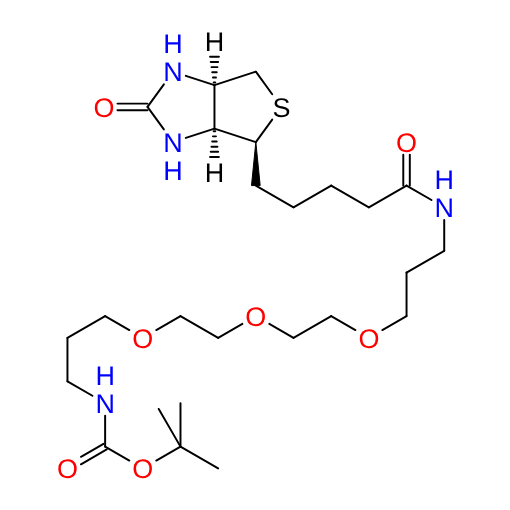
N-Boc-N′-biotinyl-4,7,10-trioxa-1,13-tridecanediamine (97%)
Molecular Formula: C25H46N4O7S
CAS#: 194920-63-3
SMILES: O=C(N1)N[C@]2([H])[C@@]1([H])[C@H](CCCCC(NCCCOCCOCCOCCCNC(OC(C)(C)C)=O)=O)SC2
MDL#: MFCD28386079
Catalog#: AMTGC276-BT17
Molecular weight: 546.72 g/mol
Appearance: orange solid
Purity: 97%
Storage: Room Temperature
Solubility: Solubility is poor in most organic solvents.
Other names:
- 6,9,12-Trioxa-2,16-diazaheneicosanoic acid, 21-[(3aS,4S,6aR)-hexahydro-2-oxo-1H-thieno[3,4-d]imidazol-4-yl]-17-oxo-, 1,1-dimethylethyl ester
- Biotin–TOTA–NHBoc
- Boc-protected biotin–TOTA linker
Fields of Interest:
Biotinylation, Bioconjugation, Functionalized PEGs, Affinity capture, Chemical biology, Molecular probe synthesis, Assay development
Background
N-Boc-N′-biotinyl-4,7,10-trioxa-1,13-tridecanediamine (CAS 194920-63-3) is a protected biotin linker for preparing biotin-bearing conjugates. Its structure combines biotin, an amide linkage, and a defined oligoether spacer derived from 4,7,10-trioxa-1,13-tridecanediamine (TOTA). One terminal nitrogen is attached to biotin, while the other carries a tert-butoxycarbonyl (Boc) protecting group. The spacer contains three ether oxygen atoms and propylene segments adjacent to the terminal nitrogens.
The Boc group temporarily masks the primary amine, allowing researchers to control when that attachment site becomes available. Appropriate acidic deprotection exposes an amine that can subsequently react with activated carboxylic acids or other compatible electrophiles. The oligoether chain provides a flexible connection between biotin and the attached molecular component. In the resulting conjugate, biotin supplies an affinity-recognition element for avidin or streptavidin, while the spacer separates that recognition element from the molecule being studied.
Applications
The compound’s structure supports the following synthesis and assay-development strategies after suitable deprotection and conjugation.
Preparation of biotinylated molecular probes: Removing the Boc group provides a terminal primary amine for coupling to suitably functionalized small molecules, dyes, or peptides. Reaction with an activated carboxylic acid, including an N-hydroxysuccinimide (NHS) ester, can form an amide-linked biotin conjugate. This gives researchers a defined attachment route when designing affinity probes.
Affinity capture and interaction studies: Biotin-bearing conjugates prepared from this building block can be evaluated for capture on streptavidin-coated beads or other affinity supports. An attached ligand may then serve as a probe for studying binding partners. Suitability depends on maintaining both the ligand’s activity and accessibility of the biotin group.
Assay and surface-immobilization reagent development: After coupling to the intended assay component, the biotin terminus offers a route to immobilization on avidin- or streptavidin-functionalized surfaces. The defined spacer makes this building block useful for comparing how attachment geometry influences molecular accessibility and assay behavior.
These applications draw on established protecting-group, amide-coupling, and biotin-affinity chemistry; they are not claims of demonstrated performance for this exact protected intermediate.
Literature:
- Chemical Communications, 2017, vol. 53, # 56, p. 7890 – 7893
- Angewandte Chemie – International Edition, 2013, vol. 52, # 1, p. 410 – 414
- Organic and Biomolecular Chemistry, 2013, vol. 11, # 2, p. 353 – 361
- Isidro-Llobet, A.; Álvarez, M.; Albericio, F. “Amino Acid-Protecting Groups.” Chemical Reviews 2009, 109, 2455–2504.
- Explains Boc protection and acid-mediated removal, providing a methodological foundation for exposing the linker’s terminal amine.
- Montalbetti, C. A. G. N.; Falque, V. “Amide bond formation and peptide coupling.” Tetrahedron 2005, 61, 10827–10852.
- Reviews carboxylic acid activation and amine coupling methods relevant to attaching the deprotected linker to molecular partners.
- Dundas, C. M.; Demonte, D.; Park, S. “Streptavidin–biotin technology: improvements and innovations in chemical and biological applications.” Applied Microbiology and Biotechnology 2013, 97, 9343–9353.
- Describes biotin-based recognition, labeling, and detection strategies, supplying broader application context for conjugates prepared from this linker.