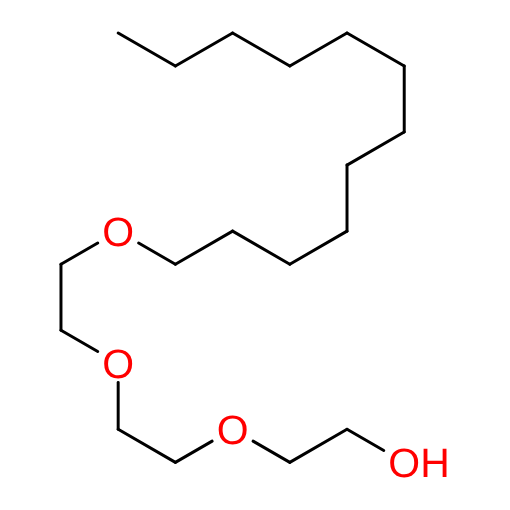
Triethylene glycol monododecyl ether (97%)
Molecular Formula: C18H38O4
CAS#: 3055-94-5
SMILES: CCCCCCCCCCCCOCCOCCOCCO
MDL#: MFCD00042659
Catalog#: AMTGC1210-TD23
Molecular weight: 318.49 g/mol
Appearance: Pale yellow solid
Purity: 97%
Storage: No special consideration
Solubility: Dichloromethane, Chloroform, Methanol
Other names:
- Triethylene glycol mono-n-dodecyl ether
- Dodecyl triethylene glycol ether
- Triethylene glycol lauryl ether
- Lauryl alcohol triglycol ether
Fields of Interest:
Functionalized PEGs, oligoethylene glycols, nonionic surfactants, amphiphilic molecules, self-assembly, colloid chemistry, surface chemistry, membrane research, nanomaterials, drug delivery, formulation science, biomaterials
Background
Triethylene glycol monododecyl ether (CAS 3055-94-5) is a discrete amphiphilic oligoethylene glycol containing a hydrophobic dodecyl (C12) alkyl chain connected to a hydrophilic triethylene glycol segment terminating in a primary alcohol. The compound has the molecular formula C18H38O4 and a molecular weight of 318.49 g/mol. C12E3, Laureth-3, and PEG-3 lauryl ether are commonly used names for the same defined molecular structure.
Unlike many commercial ethoxylated surfactants that are supplied as distributions of different ethoxylate chain lengths, CAS 3055-94-5 represents a defined C12E3 molecular species with three oxyethylene units. This well-defined structure makes it particularly useful for research in which the relationship between molecular architecture, hydrophilic-lipophilic balance, aggregation, and interfacial behavior needs to be studied precisely.
The molecule combines two distinct structural regions. Its linear C12 hydrocarbon chain provides a strongly hydrophobic domain, while the triethylene glycol chain and terminal hydroxyl group provide a comparatively hydrophilic domain. This amphiphilic architecture gives C12E3 pronounced surface-active and self-assembling behavior, including adsorption at interfaces and formation of organized structures in aqueous systems. Direct neutron-reflection studies have characterized the organization of C12E3 molecules at the air/water interface.
The terminal primary alcohol also distinguishes this compound from fully capped nonionic surfactants. The hydroxyl group provides a potential site for further chemical modification through transformations such as esterification, etherification, carbonate formation, or conversion into other functional groups. CAS 3055-94-5 can therefore serve both as a model nonionic surfactant and as an amphiphilic building block for more complex molecular architectures.
Applications
Triethylene glycol monododecyl ether has been extensively investigated in surfactant, colloid, interface, and self-assembly research. Its precisely defined C12 hydrophobic chain and triethylene glycol hydrophilic segment make it a useful model compound for examining how amphiphile structure influences adsorption, aggregation, phase behavior, and membrane organization.
At the air/water interface, neutron-reflection studies have directly characterized C12E3 monolayers and shown how the hydrocarbon and oligoethylene glycol portions of the molecule organize as surface concentration changes. These studies make CAS 3055-94-5 particularly relevant to fundamental research involving surface adsorption, interfacial films, and molecular organization.
C12E3 is also useful in self-assembled and mixed-surfactant systems. Research combining dodecyl triethylene glycol ether with cationic surfactants has demonstrated composition-dependent formation of bilamellar vesicles, multilamellar vesicles, and lamellar phases. This behavior illustrates how a discrete nonionic oligoethylene glycol surfactant can be used to tune the structure and physical properties of complex amphiphilic formulations.
The pure C12E3/water system itself exhibits rich concentration-, temperature-, and shear-dependent phase behavior. Rheological and neutron-scattering studies have examined transitions between planar lamellar structures and multilamellar vesicles, supporting applications of this compound as a model material for studying membrane mechanics, rheology, lyotropic liquid crystals, and stimulus-responsive self-assembly.
Beyond physical chemistry, Laureth-3 has been investigated in biological systems as a surface-active compound. A study of Staphylococcus aureus found that Laureth-3 reduced production of toxic shock syndrome toxin 1 under the experimental conditions evaluated, providing an example of how amphiphilic ether surfactants can influence biological membrane-associated processes.
Because of its combination of a long alkyl chain, defined oligoethylene glycol spacer, and terminal hydroxyl group, CAS 3055-94-5 may also serve as a starting material for custom amphiphile synthesis, surface modification, functional materials, and nanostructured systems where controlled hydrophobic/hydrophilic balance is important.
Literature:
- Lu, J. R.; Lee, E. M.; Thomas, R. K.; Penfold, J.; Flitsch, S. L. “Direct Determination by Neutron Reflection of the Structure of Triethylene Glycol Monododecyl Ether Layers at the Air/Water Interface.” Langmuir 1993, 9, 1352–1360. DOI: 10.1021/la00029a032.
- This study directly examines triethylene glycol monododecyl ether (C12E3) at the air/water interface using neutron reflection. The work provides molecular-level information about the arrangement of the hydrophobic dodecyl chains and hydrophilic triethylene glycol groups, making it particularly relevant to the compound’s use in surface and interfacial chemistry.
- Lu, J. R.; Hromadova, M.; Thomas, R. K.; Penfold, J. “Neutron Reflection from Triethylene Glycol Monododecyl Ether Adsorbed at the Air-Liquid Interface: The Variation of the Hydrocarbon Chain Distribution with Surface Concentration.” Langmuir 1993, 9, 2417–2425. DOI: 10.1021/la00033a026.
- This exact-compound study further investigates C12E3 monolayers, focusing on how the distribution and organization of the dodecyl chains change with surface concentration. The results provide direct experimental support for using CAS 3055-94-5 as a model surfactant in studies of molecular adsorption and interfacial organization.
- Tucker, I.; Penfold, J.; Thomas, R. K.; Grillo, I.; Mildner, D. F. R.; Barker, J. G. “Self-Assembly in Complex Mixed Surfactant Solutions: The Impact of Dodecyl Triethylene Glycol on Dihexadecyl Dimethyl Ammonium Bromide.” Langmuir 2008, 24, 10089–10098. DOI: 10.1021/la8012359.
- This study investigates C12E3 as the nonionic component of mixed surfactant systems. Small-angle neutron scattering and complementary techniques showed that changing C12E3 concentration produced substantial changes in aggregate morphology, including bilamellar vesicles, multilamellar vesicles, and lamellar structures. The work highlights the compound’s value for studying and controlling amphiphilic self-assembly.
- Gentile, L.; Oliviero Rossi, C.; Olsson, U.; Ranieri, G. A. “Dynamic Phase Diagram of a Nonionic Surfactant Lamellar Phase.” J. Phys. Chem. B 2014, 118. DOI: 10.1021/jp5009797.
- This study examines concentrated C12E3/D2O systems under shear at different temperatures and concentrations. Rheology and neutron/light-scattering measurements revealed transitions between planar lamellae and multilamellar vesicles, demonstrating the complex dynamic phase behavior of this defined nonionic surfactant.
- McNamara, P. J.; Syverson, R. E.; Milligan-Myhre, K.; Frolova, O.; Schroeder, S.; Kidder, J.; Hoang, T.; Proctor, R. A. “Surfactants, Aromatic and Isoprenoid Compounds, and Fatty Acid Biosynthesis Inhibitors Suppress Staphylococcus aureus Production of Toxic Shock Syndrome Toxin 1.” Antimicrob. Agents Chemother. 2009, 53, 1898–1906. DOI: 10.1128/AAC.01293-08.
- This study specifically evaluated Laureth-3 among a group of surfactants and other compounds for their effects on S. aureus. Laureth-3 was among the ether-linked surfactants found to suppress TSST-1 production under the experimental conditions, providing direct literature precedent for the compound in biological surfactant research.