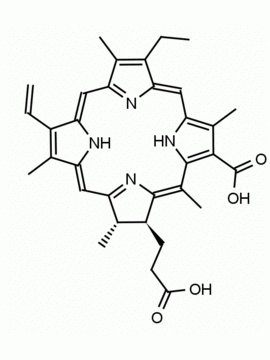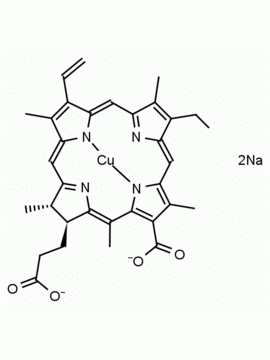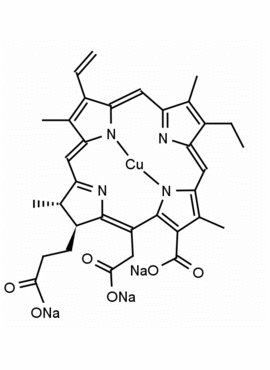
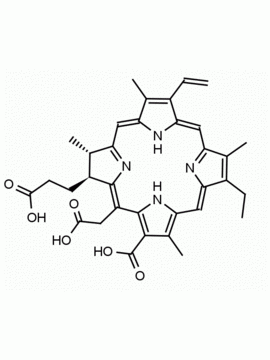
Cu(II) Chlorin e6 Trisodium Salt CAS: 11006-34-1 MDL: MFCD27981354
Molecular weight: 724.15 g/mol
Molecular Formula: C34H31CuN4Na3O6
CAS Number: 11006-34-1
Storage: Store at –20 °C, protect from light.
Uses: Photosynthesis, Photodynamic Therapy, Photovoltaics, Solar Cells, Antiinflammation/Antioxidant agent
Copper Chlorin e6, trisodium salt, is a natural product derived from plants and studied in photosynthesis, and has numerous uses in photodynamic therapy, as a food additive, interactions in the inflammasome, and has been used in solar cell construction. 1-5
Please note: Copper chlorophyllin is a complex mixture of chlorophyll derived compounds containing the sodium salts of Cu(II) Chlorin e4, Cu(II) chlorin e6, and many additional compounds. This product is sold as purified Cu (II) Chlorin e6 Trisodium Salt and is not a mixture of compounds.
References:
1.) Artificial photosynthesis. Photosensitization of titania solar cells with chlorophyll derivatives and related natural porphyrin, Kay, Andreas; Graetzel, Michael, Journal of Physical Chemistry (1993), 97(23), 6272-7, DOI:10.1021/j100125a02
2.) Primary mutagenicity screening of food additives currently used in Japan, Ishidate, M., Jr.; Sofuni, T.; Yoshikawa, K.; Hayashi, M.; Nohmi, T.; Sawada, M.; Matsuoka, A., Food and Chemical Toxicology (1984), 22(8), 623-36 DOI:10.1016/0278-6915(84)90271-0
3.) Antioxidant activity of chlorophylls and their derivatives, Lanfer-Marquez, Ursula M.; Barros, Rosa M. C.; Sinnecker, Patricia, Food Research International (2005), 38(8-9), 885-891DOI:10.1016/j.foodres.2005.02.012
4.) Copper chlorophyllin: A food colorant with bioactive properties?, Tumolo, Tathyana; Lanfer-Marquez, Ursula Maria, Food Research International (2012), 46(2), 451-459. Language: English, DOI:10.1016/j.foodres.2011.10.031
5.) Artificial Photosynthesis. 2. Investigations on the Mechanism of Photosensitization of Nanocrystalline TiO2 Solar Cells by Chlorophyll Derivatives, Kay, Andreas; Humphry-Baker, Robin; Graetzel, Michael, Journal of Physical Chemistry (1994), 98(3), 952-9. DOI:10.1021/j100054a035
 Powered by Bioz