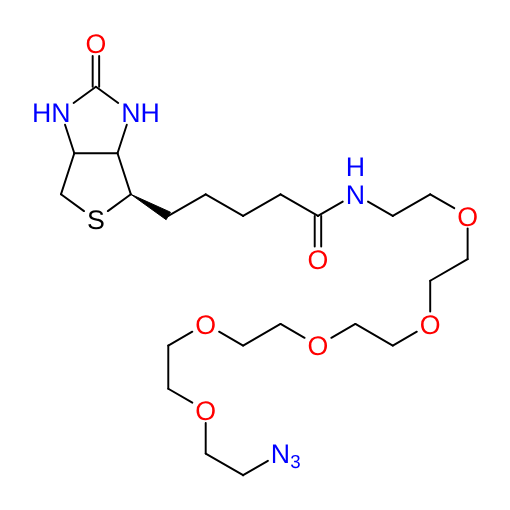
Biotin-PEG5-azide (99%)
Molecular Formula: C22H40N6O7S
CAS#: 1163732-89-5
SMILES: O=C(NCCOCCOCCOCCOCCOCCN=[N+]=[N-])CCCC[C@H]1SCC(C1N2)NC2=O
MDL#: MFCD22683275
Catalog#: AMTGC754-BZ21
Molecular weight: 532.65 g/mol
Appearance: Yellow Solid
Purity: 99%
Storage: Room Temperature
Solubility: Solubility is poor in most organic solvents.
Other names:
- Biotin-PEG5-CH2CH2N3
- Biotin-PEG5-azide
- Biotin-PEG5-N3
- (+)-Biotin-PEG5-azide
- (+)-Biotin-PEG5-CH2CH2N3
- N-(17-Azido-3,6,9,12,15-pentaoxaheptadecyl)-5-((3aS,4S,6aR)-2-oxohexahydro-1H-thieno[3,4-d]imidazol-4-yl)pentanamide
Fields of Interest:
Click chemistry, bioconjugation, biotinylation, chemical biology, affinity labeling, proteomics, biomolecule detection, molecular imaging, diagnostic research, fluorescent probe development, surface functionalization, nanoparticle modification, drug discovery
Background
Biotin-PEG5-azide (CAS 1163732-89-5) is a heterofunctional bioconjugation reagent that combines a biotin affinity tag, a defined hydrophilic PEG5 spacer, and a terminal azide group. The biotin moiety provides strong noncovalent recognition by avidin- and streptavidin-family proteins, while the PEG5 chain separates the affinity tag from the conjugated target and provides additional flexibility and hydrophilic character. Sigma-Aldrich identifies the material as Biotin-PEG5-azide with formula C₂₂H₄₀N₆O₇S and MW 532.66 g/mol.
The terminal azide provides a compact bioorthogonal handle for copper-catalyzed azide–alkyne cycloaddition (CuAAC) and strain-promoted azide–alkyne cycloaddition (SPAAC). This enables Biotin-PEG5-azide to be attached to alkyne- or strained-alkyne-functionalized molecules while preserving biotin for subsequent affinity capture or detection. The PEG5 spacer helps reduce steric interference between the biotin group and a conjugated target, making the reagent useful when access to streptavidin or avidin binding sites must be maintained.
Because the molecule is discrete rather than polymeric, it offers a reproducible spacer length and defined molecular composition. This makes it particularly useful in analytical and chemical-biology workflows where controlled spacing between the biotin affinity group and the labeled molecule is important.
Applications
Biotin-PEG5-azide is particularly useful for click-enabled biotinylation of alkyne-functionalized proteins, peptides, oligonucleotides, carbohydrates, small molecules, polymers, nanoparticles, and surfaces. After CuAAC or SPAAC conjugation, the resulting biotinylated construct can be captured or detected using streptavidin- or avidin-based reagents. This makes the compound useful in affinity enrichment, pull-down experiments, immobilization, purification, assay development, and molecular detection.
The reagent also has direct precedent in fluorescent-probe and molecular-imaging research. Biotin-PEG5-azide has been conjugated to cyanine-based near-infrared probes, where the PEG segment helped reduce dye aggregation while the biotin group provided a targeting element. The resulting probes showed specific cellular uptake and tumor-targeting behavior in imaging experiments.
In chemical biology and proteomics, Biotin-PEG5-azide can serve as an affinity-tagging reagent following metabolic or chemical installation of an alkyne handle. The clicked biotin tag then enables enrichment of modified biomolecules using streptavidin beads or related affinity matrices. This type of workflow is particularly valuable when the target species is present at low abundance or must be isolated from a complex biological sample.
The PEG5 spacer can also be advantageous in surface and nanoparticle functionalization. By separating biotin from the underlying material, the spacer can improve physical accessibility of the affinity tag while providing additional conformational freedom. Related PEG/biotin architectures are widely used in biomaterial and nanoparticle systems for streptavidin-mediated assembly or recognition.
Biotin-PEG5-azide can additionally be incorporated into multifunctional probes, where one molecular element provides targeting or sensing capability, the PEG chain provides spacing, the azide enables modular conjugation, and biotin provides a downstream purification or detection handle.
Literature:
- Nature Communications, 2019, vol. 10, # 1, art. no. 1387
- Journal of Organic Chemistry, 2014, vol. 79, # 8, p. 3709 – 3714
- Bioorganic and Medicinal Chemistry Letters, 2019, vol. 29, # 2, p. 234 – 237
- Zhang, et al. “Development of Biotin-Tagged Near-Infrared Fluorescence Probes for Tumor-Specific Imaging.” 2021.
- This study directly used Biotin-PEG5-Azide to prepare biotin-tagged cyanine NIR probes. Incorporation of the PEG/biotin unit reduced cyanine aggregation and enabled biotin-mediated targeting; the resulting probes demonstrated specific uptake by HeLa cells and tumor-selective fluorescence imaging in vivo. This is the strongest exact-compound application reference for CAS 1163732-89-5 located in the peer-reviewed literature.
- Agard, N. J.; Prescher, J. A.; Bertozzi, C. R. “A Strain-Promoted [3+2] Azide–Alkyne Cycloaddition for Covalent Modification of Biomolecules in Living Systems.” Journal of the American Chemical Society 2004, 126, 15046–15047. DOI: 10.1021/ja044996f.
- Establishes SPAAC as a copper-free route for reacting azides with strained cyclooctynes in biological environments, supporting the use of Biotin-PEG5-azide as a bioorthogonal labeling reagent.
- Kolb, H. C.; Finn, M. G.; Sharpless, K. B. “Click Chemistry: Diverse Chemical Function from a Few Good Reactions.” Angewandte Chemie International Edition 2001, 40, 2004–2021. DOI: 10.1002/1521-3773(20010601)40:11<2004::AID-ANIE2004>3.0.CO;2-5.
- This review defines click chemistry and provides the broader basis for using azide-functionalized building blocks in modular conjugation strategies.