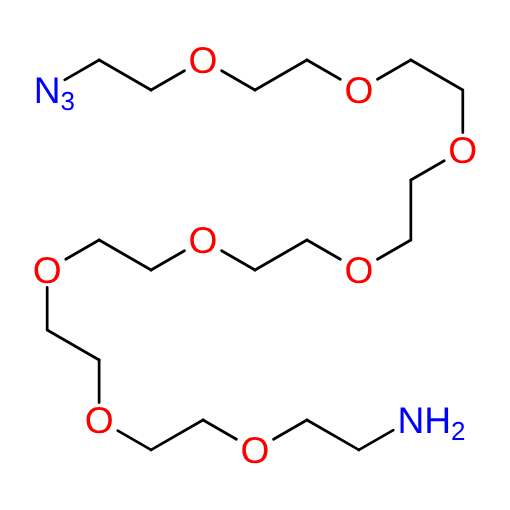
26-Azido-3,6,9,12,15,18,21,24-octaoxahexacosan-1-amine (98%)
Molecular Formula: C18H38N4O8
CAS#: 857891-82-8
SMILES: NCCOCCOCCOCCOCCOCCOCCOCCOCCN=[N+]=[N-]
MDL#: MFCD03453241
Catalog#: AMTGC1604-AO26
Molecular weight: 438.52 g/mol
Appearance: White Solid
Purity: 98%
Storage: Long-term storage in a freezer at -20°C
Solubility: Dichloromethane, Chloroform, Methanol
Other names:
- PEG9-Aminoazide
- Azido-PEG8-Amine
- N3-PEG8-CH2CH2NH2
- O-(2-Aminoethyl)-O′-(2-azidoethyl)heptaethylene glycol
Fields of Interest:
Click chemistry, Bioconjugation, PEG linkers, Chemical biology, Surface functionalization, Biomaterials, Molecular probe development
Background
Azido-PEG8-amine (CAS 857891-82-8) is a heterobifunctional polyethylene glycol (PEG) linker with a terminal azide and a primary amine. These two distinct reactive groups allow researchers to connect molecular components through complementary coupling reactions. The amine provides a site for attachment to activated carboxylic acids, while the azide serves as a handle for subsequent click chemistry.
The defined PEG8 spacer contains eight ether oxygen atoms, providing a flexible, polar connection between attached components. Its length makes it useful when designing conjugates that require separation between a label, targeting group, or functional surface and a second molecular component. The azide can participate in copper-catalyzed azide–alkyne cycloaddition (CuAAC) with terminal alkynes or strain-promoted azide–alkyne cycloaddition (SPAAC) with suitable strained cyclooctynes. This combination supports modular synthesis, allowing attachment chemistry and spacer length to be considered separately during conjugate design.
Applications
Azido-PEG8-amine provides a practical building block for sequential coupling, molecular labeling, and the modification of functional materials.
Amide-linked conjugates: The primary amine can react with activated carboxylic acids, including N-hydroxysuccinimide (NHS) esters, to form an amide bond. This offers a route to introduce a PEG8 spacer and terminal azide into suitably functionalized dyes, small molecules, peptides, or surfaces.
Click chemistry and probe assembly: Following attachment through the amine, the remaining azide can connect the conjugate to an alkyne-bearing partner by CuAAC. A compatible strained cyclooctyne provides an alternative through copper-free SPAAC, expanding the available strategies for assembling labeled or multifunctional constructs.
Polymer particle and fiber functionalization: Published work demonstrates azido-PEG-amine coupling to alkyne-functionalized poly(lactide-co-glycolide) (PLGA) materials, followed by fluorescent labeling through the remaining amine. This illustrates how the linker’s two reactive ends can support spatially selective surface modification and subsequent attachment of a reporter.
Spacer-length studies: The PEG8 chain offers a defined option for comparing how molecular separation affects accessibility in conjugates and surface-bound probes. Researchers can evaluate it alongside shorter PEG linkers while retaining the same azide and amine coupling chemistry.
Literature:
- European Journal of Medicinal Chemistry, 2022, vol. 242, art. no. 114697
- Angewandte Chemie – International Edition, 2026, vol. 65, # 31, art. no. E17800
- Bhaskar, S.; Roh, K.-H.; Jiang, X.; Baker, G. L.; Lahann, J. “Spatioselective Modification of Bicompartmental Polymer Particles and Fibers via Huisgen 1,3-Dipolar Cycloaddition.” Macromolecular Rapid Communications 2008, 29, 1655–1660. Publisher supporting information.
- Demonstrates azido-PEG-amine attachment to alkyne-functionalized polymer materials, followed by labeling of the available amine with fluorescein isothiocyanate. A relevant example of sequential surface modification.
- Hong, V.; Presolski, S. I.; Ma, C.; Finn, M. G. “Analysis and Optimization of Copper-Catalyzed Azide–Alkyne Cycloaddition for Bioconjugation.” Angewandte Chemie International Edition 2009, 48, 9879–9883. Read the paper.
- Examines conditions for effective CuAAC bioconjugation. Provides methodological guidance for using azide-bearing linkers with alkyne-functionalized partners.
- Baskin, J. M.; et al. “Copper-free click chemistry for dynamic in vivo imaging.” Proceedings of the National Academy of Sciences 2007, 104, 16793–16797. Read the paper.
- Establishes strained cyclooctynes as partners for copper-free labeling of azides. Supports the broader reaction strategy available to azido-PEG linkers rather than evaluating this specific compound.
- Montalbetti, C. A. G. N.; Falque, V. “Amide bond formation and peptide coupling.” Tetrahedron 2005, 61, 10827–10852. Read the review.
- Reviews carboxylic acid activation and amine coupling methods relevant to functionalizing the primary amine terminus.