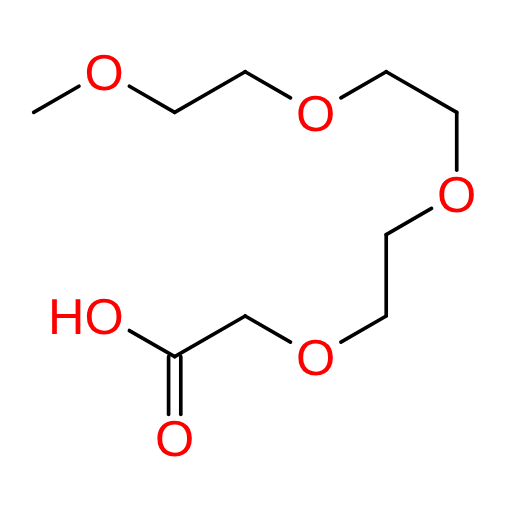
2,5,8,11-Tetraoxatridecan-13-oic acid (97%)
Molecular Formula: C9H18O6
CAS#: 16024-60-5
SMILES: OC(COCCOCCOCCOC)=O
MDL#: MFCD25959645
Catalog#: AMTGC1201-DA23
Molecular weight: 222.24 g/mol
Appearance: Colorless to yellow liquid
Purity: 97%
Storage: No special consideration
Solubility: Dichloromethane, Chloroform, Methanol
Other names:
- mPEG3-CH2CO2H
- mPEG3-CH2COOH
- mPEG3-acetic acid
- 3,6,9,12-Tetraoxatridecanoic acid
- m-PEG4-CH2COOH
Fields of Interest:
Functionalized PEGs, acid PEGs, methoxy PEGs, medicinal chemistry, bioconjugation, drug discovery, linker synthesis, oligoethylene glycol modification, nanoparticle functionalization, biomaterials, supramolecular chemistry, surface modification
Background
2-[2-[2-(2-Methoxyethoxy)ethoxy]ethoxy]acetic acid (CAS 16024-60-5) is a discrete, monofunctional oligoethylene glycol building block containing a terminal carboxylic acid and a methoxy-capped PEG chain. It has the molecular formula C9H18O6 and molecular weight 222.24 g/mol. PubChem identifies the systematic structure as 2-[2-[2-(2-methoxyethoxy)ethoxy]ethoxy]acetic acid, while mPEG3-CH2COOH is a widely used commercial shorthand.
The terminal carboxylic acid provides a versatile site for covalent attachment to amine-containing molecules. Following activation with standard peptide-coupling or carbodiimide reagents, CAS 16024-60-5 can be used to introduce a short, defined methoxy-terminated PEG segment through formation of an amide bond. Ester formation and conversion to other carboxylic-acid derivatives provide additional synthetic possibilities.
Unlike heterobifunctional PEG linkers carrying two independently reactive termini, this compound is monofunctional: the methoxy group caps one end of the oligoethylene glycol chain while the carboxylic acid provides the principal conjugation site. This architecture is useful when PEG modification is desired without introducing a second reactive group that could undergo unwanted crosslinking or further conjugation.
The defined oligoethylene glycol segment provides a reproducible molecular structure rather than the distribution of chain lengths associated with polydisperse PEG materials. Its ether-rich backbone can introduce flexible, hydrophilic molecular spacing between a parent molecule and the terminal methoxy group.
Applications
mPEG3-CH2COOH is useful for introducing a short methoxy-terminated oligoethylene glycol chain onto amines and other appropriately functionalized molecules. Activation of the carboxylic acid followed by amide coupling provides a straightforward route for modifying small molecules, ligands, peptides, biomolecular constructs, or functional materials with a discrete hydrophilic spacer.
In medicinal chemistry and drug discovery, short methoxy PEG acids can be incorporated into molecular designs to alter the distance, flexibility, and polarity around a pharmacophore. Because the methoxy terminus is nonreactive under many common coupling conditions, CAS 16024-60-5 is particularly useful when the goal is terminal PEG capping rather than subsequent attachment of an additional functional group.
The compound also has direct precedent in supramolecular and drug-delivery research. Methoxy-terminated oligoethylene glycol carboxylic-acid building blocks have been incorporated into nucleolipid systems designed to combine hydrophobic molecular components with hydrophilic oligoethylene glycol domains. Such structures have been investigated as self-assembling nanocarriers for biomolecule and drug transport.
CAS 16024-60-5 has additionally been used in organometallic and nanomaterials chemistry. A homologous series of methoxy-terminated oligoethylene glycol carboxylates was used to prepare gold(I) complexes that functioned as single-source precursors for gold nanoparticles. The ethylene glycol chains contributed to stabilization of the resulting colloidal particles, demonstrating the utility of this linker architecture beyond conventional biological conjugation.
The compound can therefore serve as a versatile building block for PEGylation, linker development, surface modification, nanoparticle chemistry, supramolecular systems, and functional materials, particularly where a compact and precisely defined methoxy-terminated PEG segment is preferred.
Literature:
- Tuchscherer, A.; Schaarschmidt, D.; Schulze, S.; Hietschold, M.; Lang, H. “Gold Nanoparticles Generated by Thermolysis of ‘All-in-One’ Gold(I) Carboxylate Complexes.” Dalton Trans. 2012, 41, 2738–2746. DOI: 10.1039/C2DT11748G.
- This study provides particularly relevant precedent for CAS 16024-60-5 chemistry. The researchers prepared a homologous series of gold(I) carboxylates containing methoxy-terminated oligoethylene glycol chains and subsequently used the complexes to generate gold nanoparticles by thermal decomposition. The work demonstrates how defined methoxy-PEG carboxylic-acid structures can be incorporated into metal complexes and used in nanomaterials research.
- Simeone, L.; Mangiapia, G.; Vitiello, G.; Irace, C.; Colonna, A.; Ortona, O.; Montesarchio, D.; Paduano, L. “Cholesterol-Based Nucleolipid-Ruthenium Complex Stabilized by Lipid Aggregates for Antineoplastic Therapy.” Bioconjugate Chem. 2012, 23, 758–770. DOI: 10.1021/bc200565v.
- This research developed a cholesterol-containing nucleolipid–ruthenium complex and incorporated it into lipid aggregates for antineoplastic applications. Synthetic records associate CAS 16024-60-5 with the preparation of the oligoethylene glycol-containing structures used in this work, providing relevant precedent for methoxy-terminated PEG acid chemistry in the construction of biologically active supramolecular systems.
- Simeone, L.; Mangiapia, G.; Irace, C.; Di Pascale, A.; Colonna, A.; Ortona, O.; De Napoli, L.; Montesarchio, D.; Paduano, L. “Nucleolipid Nanovectors as Molecular Carriers for Potential Applications in Drug Delivery.” Mol. BioSyst. 2011, 7, 3075–3086. DOI: 10.1039/C1MB05143A.
- This study describes thymidine- and uridine-derived nucleolipids containing hydrophilic oligoethylene glycol chains and hydrophobic lipid components. The resulting molecules self-assembled into stable vesicular structures and were evaluated as potential nanocarriers for biomolecules and drugs. Synthetic databases associate CAS 16024-60-5 with this work, supporting its relevance as a defined oligoethylene glycol building block for amphiphilic and drug-delivery systems.
- Hu, W.; Yan, Q.; Zhao, D. “Oligo(p-phenylene-ethynylene)s with Backbone Conformation Controlled by Competitive Intramolecular Hydrogen Bonds.” Chem. Eur. J. 2011, 17, 7087–7094. DOI: 10.1002/chem.201003603.
- This work investigates oligo(p-phenylene-ethynylene) systems in which oligoethylene glycol-containing side chains help control molecular conformation through competing intramolecular hydrogen-bonding interactions. Synthetic records identify CAS 16024-60-5 in connection with this chemistry, illustrating the broader value of defined methoxy oligoethylene glycol building blocks in functional organic and materials chemistry.