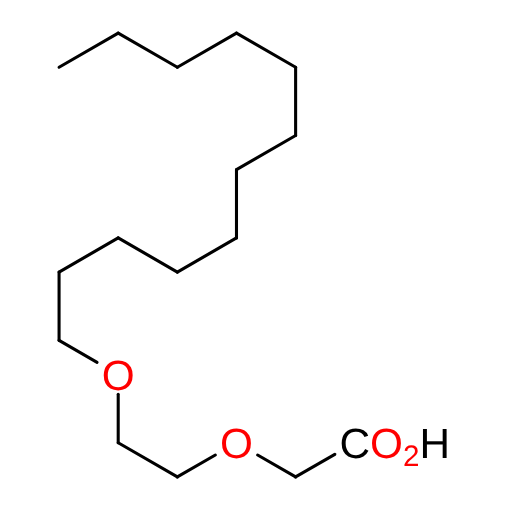
2-[2-(Dodecyloxy)ethoxy]acetic acid (>97%)
Molecular Formula: C16H32O4
CAS#: 20858-23-5 (Though often cited as 27306-90-7)
SMILES: CCCCCCCCCCCCOCCOCC(O)=O
MDL#: None
Catalog#: AMTGC1221-DD23
Molecular weight: 288.42 g/mol
Appearance: white solid
Purity: >97%
Storage: No special consideration
Solubility: Dichloromethane, Chloroform, Methanol
Other names:
- [2-(Dodecyloxy)ethoxy]acetic acid
- Dodecyl monoethylene glycol ether acetic acid
- C12 alkyl ether carboxylic acid
- Often mis-named as CAS 27306-90-7
Fields of Interest:
Alkyl ether carboxylic acids, functionalized oligoethylene glycols, amphiphilic molecules, anionic surfactants, surface chemistry, colloid chemistry, self-assembly, formulation science, materials science, organic synthesis, biodegradable surfactants
Background
2-[2-(Dodecyloxy)ethoxy]acetic acid is an amphiphilic ether carboxylic acid containing a hydrophobic dodecyl (C12) alkyl chain connected through an ether-linked ethylene glycol spacer to a terminal carboxylic acid. The structure provided by Frontier, CCCCCCCCCCCCOCCOCC(O)=O, corresponds to the canonical structure CCCCCCCCCCCCOCCOCC(=O)O, with molecular formula C16H32O4 and molecular weight 288.42 g/mol.
The molecule combines two chemically distinct regions: a long hydrocarbon chain that provides hydrophobic character and a short oxygen-containing segment terminating in a carboxylic acid. This architecture gives the compound amphiphilic and surface-active properties while retaining a chemically addressable acid functionality. In its deprotonated or salt form, the carboxylate provides an anionic hydrophilic headgroup, placing this structure within the broader family of alkyl ether carboxylate surfactants.
Compared with conventional nonionic alkyl ethoxylates, the terminal carboxylic acid introduces pH-dependent ionization and additional opportunities for chemical modification. The acid can be converted to salts or activated for ester and amide formation, while the C12 chain provides a persistent hydrophobic domain. This combination can be useful when designing molecules that interact with both aqueous and hydrophobic environments.
The defined structure is also distinct from commercial polyoxyethylene alkyl ether carboxylates that may contain distributions of ethoxylate chain lengths. For research applications requiring precise structure-property relationships, a discrete compound provides better control over alkyl-chain length and hydrophilic spacer architecture.
Applications
2-[2-(Dodecyloxy)ethoxy]acetic acid is primarily relevant to surfactant, interface, and colloid chemistry. Its C12 alkyl chain can associate with hydrophobic phases and interfaces, while the ether oxygen atoms and terminal carboxylic acid provide the hydrophilic portion of the molecule. Ionization of the carboxylic acid further changes the molecule’s interfacial behavior and aqueous interactions.
The compound belongs to the broader family of alkyl ether carboxylates (AECs), which combine the behavior of ether-containing surfactants with an anionic carboxylate headgroup. These materials are studied for their surface activity, aggregation behavior, formulation properties, and environmental fate. Research examining surfactant biodegradation in seawater has specifically included C12 alkyl ether carboxylates alongside nonionic ethoxylates, alkyl polyglucosides, and cationic surfactants.
The terminal carboxylic acid also provides a useful synthetic handle. Activation of the acid can enable esterification or amide formation with suitable alcohol- or amine-containing molecules. This creates opportunities to use the compound as an amphiphilic building block in custom molecular synthesis, surface modification, and materials development rather than solely as a surfactant.
In materials and formulation research, the combination of a long alkyl group with a compact oxygen-rich spacer can be useful for investigating adsorption, wetting, dispersion, emulsification, and self-assembly. Variation of either the hydrophobic chain or the number of ethylene oxide units within related compounds can provide a systematic approach for studying how molecular architecture influences amphiphilic behavior.
Literature:
- Brakstad, O. G.; Sarno, A.; Geerts, R.; Dawick, J.; Machado, A.; Hopp, P. “Ultimate and Primary Biodegradation of a Range of Nonpolymeric and Polymeric Surfactants in Seawater.” Environ. Toxicol. Chem. 2023, 42, 1454–1467. DOI: 10.1002/etc.5632.
- This study evaluated the biodegradation of a broad collection of surfactants in seawater, including C12 alkyl ether carboxylates alongside alcohol ethoxylates, alkyl polyglucosides, and cationic surfactants. The work provides particularly relevant class-level literature for understanding the environmental behavior and biodegradation of dodecyl ether carboxylate surfactants.