
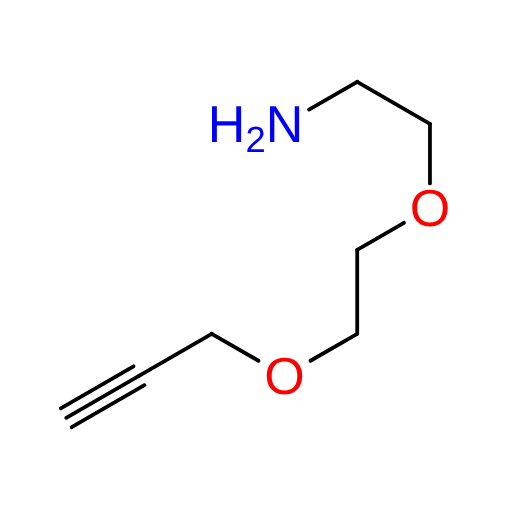
2-(2-(Prop-2-yn-1-yloxy)ethoxy)ethan-1-amine (99%)
Molecular Formula: C7H13NO2
CAS#: 944561-44-8
SMILES: NCCOCCOCC#C
MDL#: MFCD19160595
Catalog#: AMTGC1535-PP25
Molecular weight: 143.18 g/mol
Appearance: Orange Liquid
Purity: 99%
Storage: Room Temperature
Solubility: Dichloromethane, Chloroform, Methanol
Other names:
- Propargyl-PEG2-amine
- Alkynyl-PEG2-amine
Fields of Interest:
Bioconjugation, click chemistry, chemical biology, molecular probe development, target identification, medicinal chemistry, surface functionalization
Background
Propargyl-PEG2-amine (CAS 944561-44-8) is a heterobifunctional polyethylene glycol (PEG) linker containing a terminal alkyne and a primary amine. Its short, defined PEG2 spacer incorporates two ether oxygen atoms, providing a flexible, polar connection between the reactive termini. These complementary functional groups make the compound useful for assembling molecular probes, introducing alkyne functionality into larger molecules, and developing conjugates with controlled linker lengths.
The primary amine can react with activated carboxylic acids, including suitable N-hydroxysuccinimide (NHS) esters, to form an amide linkage. Under compatible conditions, the propargyl group remains available for subsequent copper(I)-catalyzed azide–alkyne cycloaddition (CuAAC), which joins the terminal alkyne to an azide-bearing partner through a triazole linkage. This staged chemistry allows researchers to attach a molecular component through the amine before introducing a second component through click conjugation. The compact spacer is particularly relevant when exploring how the distance between linked groups influences the behavior of a research probe.
Applications
Propargyl-PEG2-amine has a documented role in chemical probe synthesis and supports additional conjugation strategies through its amine and terminal alkyne.
Chemical probes for target identification: Published research uses this aminoalkyne building block to prepare triazole-containing chemical inducers of dimerization for yeast three-hybrid screening. These conjugates connect molecular binding elements and enable researchers to investigate small molecule–protein interactions, providing a specific application in chemical biology and target-identification research.
Click chemistry and bioconjugation: The terminal alkyne can undergo CuAAC with azide-functionalized labels, ligands, or biomolecular components. This provides a modular route for assembling conjugates through a defined PEG2 spacer. Catalyst and reaction conditions should be selected to accommodate the sensitivity of the conjugation partners.
Amide-linked reporters and ligands: Coupling the primary amine to an activated carboxyl-containing molecule introduces a short PEG spacer with an available alkyne. Subsequent click chemistry can attach an azide-bearing reporter or affinity tag, supporting the preparation of molecular probes and related research tools.
Surface and materials functionalization: The same attachment strategy can be considered for appropriately activated carboxyl-containing polymers or surfaces. Coupling through the amine leaves the alkyne available for subsequent modification with an azide-bearing component, offering a route to functional interfaces with a defined molecular spacer.
Literature:
- Journal of the American Chemical Society, 2020, vol. 142, # 42, p. 18022 – 18034
- MedChemComm, 2019, vol. 10, # 6, p. 1037 – 1041
- Drug Design, Development and Therapy, 2018, vol. 12, p. 987 – 995
The first of the following references uses this aminoalkyne building block directly; the remaining references provide supporting conjugation methodology.
- Tran, F.; Odell, A. V.; Ward, G. E.; Westwood, N. J. “A Modular Approach to Triazole-Containing Chemical Inducers of Dimerisation for Yeast Three-Hybrid Screening.” Molecules 2013, 18(9), 11639–11657. DOI: 10.3390/molecules180911639
- Describes the synthesis and use of the PEG2 aminoalkyne as building block 6a in a modular route to chemical probes for yeast three-hybrid screening.
- Hong, V.; Presolski, S. I.; Ma, C.; Finn, M. G. “Analysis and Optimization of Copper-Catalyzed Azide–Alkyne Cycloaddition for Bioconjugation.” Angewandte Chemie International Edition 2009, 48, 9879–9883. DOI: 10.1002/anie.200905087
- Examines CuAAC conditions for biomolecular conjugation, providing practical guidance relevant to coupling terminal-alkyne linkers with azide-bearing partners.
- Montalbetti, C. A. G. N.; Falque, V. “Amide bond formation and peptide coupling.” Tetrahedron 2005, 61, 10827–10852. DOI: 10.1016/j.tet.2005.08.031
- Reviews amide-forming methods relevant to attaching the linker’s primary amine to activated carboxylic acids and molecular building blocks.