
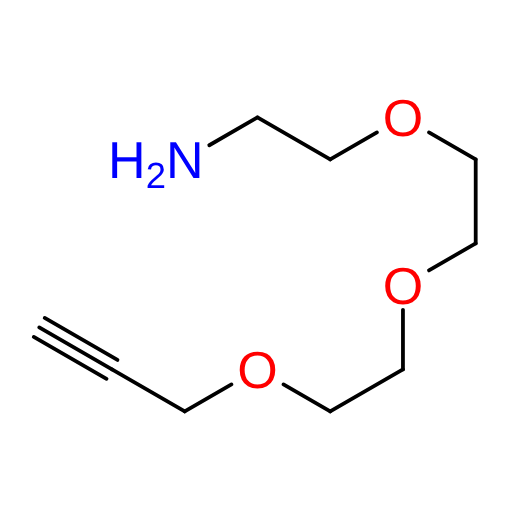
2-(2-(2-(Prop-2-yn-1-yloxy)ethoxy)ethoxy)ethan-1-amine (99%)
Molecular Formula: C9H17NO3
CAS#: 932741-19-0
SMILES: C#CCOCCOCCOCCN
MDL#: MFCD20720810
Catalog#: AMTGC1419-PE25
Molecular weight: 187.24 g/mol
Appearance: Pale Yellow liquid
Purity: 99%
Storage: Room Temperature
Solubility: Dichloromethane, Chloroform, Methanol
Other names:
- PROPARGYL-PEG3-AMINE
- 3-(2-(2-(2-Aminoethoxy)ethoxy)ethoxy)prop-1-yne; 2-{2-[2-(2-propynyloxy)ethoxy]ethoxy}ethanamine
Fields of Interest:
Bioconjugation, click chemistry, protein immobilization, biosensor development, molecular probe design, chemical biology, surface functionalization
Background
Propargyl-PEG3-amine (CAS 932741-19-0) is a heterobifunctional polyethylene glycol (PEG) linker containing a terminal alkyne and a primary amine. These complementary functional groups support sequential conjugation through amide formation and copper-catalyzed click chemistry. Its defined PEG3 spacer contains three ether oxygen atoms, providing a flexible, polar connection between the two attachment sites. This combination makes the compound useful for preparing molecular conjugates and introducing reactive alkyne groups onto functionalized surfaces.
The primary amine can react with activated carboxylic acids, including N-hydroxysuccinimide (NHS) esters, to form an amide linkage while retaining the terminal alkyne. The propargyl group can then undergo copper(I)-catalyzed azide–alkyne cycloaddition (CuAAC) with an azide-bearing partner, producing a triazole linkage. This staged approach allows researchers to install the linker first and attach a reporter, ligand, or biomolecular component afterward. A published application uses Propargyl-PEG3-amine to prepare alkyne-functionalized biosensor surfaces for protein immobilization, demonstrating its role at the interface between conjugation chemistry and analytical assay development.
Applications
Propargyl-PEG3-amine supports both documented biosensor applications and broader conjugation strategies based on its amine and terminal alkyne functionality.
Protein immobilization and biosensor development: Researchers have used this linker to functionalize activated carboxyl-containing sensor tips for biolayer interferometry (BLI). The resulting alkyne-bearing surfaces enabled immobilization of azide-modified SNAP-tag proteins. This provides a specific example of using the amine to anchor the linker and the exposed alkyne as a second attachment site for a biological component.
Molecular probes and bioconjugates: Coupling the primary amine to an activated carboxyl-containing molecule offers a route for introducing a PEG-spaced terminal alkyne into a probe or ligand. Subsequent CuAAC with an azide-functionalized reporter or affinity tag can complete the conjugate. This modular strategy allows different molecular components to be combined through a defined linker.
Surface and polymer functionalization: The same chemistry can be considered for other appropriately activated carboxyl-containing materials. Attachment through the amine leaves the propargyl group available for introducing azide-bearing labels or recognition groups. The PEG3 segment provides separation between the supporting material and the attached component, making the linker relevant to research on functional interfaces and assay surfaces.
Literature:
The first study uses Propargyl-PEG3-amine directly; the remaining references provide supporting conjugation methodology.
- Merlo, R.; Caprioglio, D.; Cillo, M.; et al. “The SNAP-tag technology revised: an effective chemo-enzymatic approach by using a universal azide-based substrate.” Journal of Enzyme Inhibition and Medicinal Chemistry 2021, 36(1), 85–97. DOI: 10.1080/14756366.2020.1841182
- Uses Propargyl-PEG3-amine to introduce alkyne groups onto BLI sensor surfaces, enabling immobilization of azide-modified proteins in a SNAP-tag-based workflow.
- Hong, V.; Presolski, S. I.; Ma, C.; Finn, M. G. “Analysis and Optimization of Copper-Catalyzed Azide–Alkyne Cycloaddition for Bioconjugation.” Angewandte Chemie International Edition 2009, 48, 9879–9883. DOI: 10.1002/anie.200905087
- Examines CuAAC conditions for biomolecular conjugation, providing practical guidance relevant to coupling terminal-alkyne linkers with azide-bearing partners.
- Montalbetti, C. A. G. N.; Falque, V. “Amide bond formation and peptide coupling.” Tetrahedron 2005, 61, 10827–10852. DOI: 10.1016/j.tet.2005.08.031
- Reviews amide-forming reactions relevant to attaching the linker’s primary amine to activated carboxylic acids and molecular building blocks.