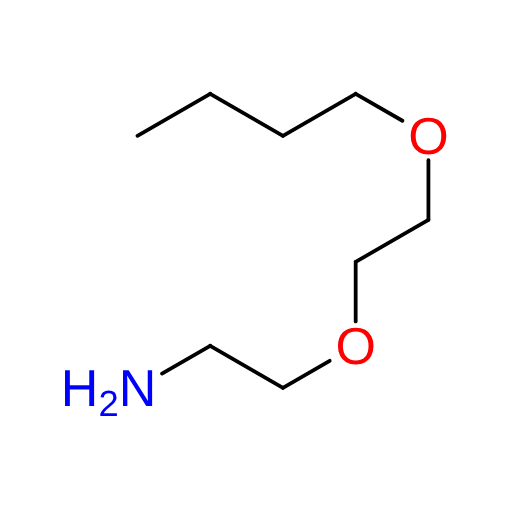
2-(2-Butoxyethoxy)ethanamine (99%)
Molecular Formula: C8H19NO2
CAS#: 6338-53-0
SMILES: NCCOCCOCCCC
MDL#: MFCD11196423
Catalog#: AMTGC386-BA17
Molecular weight: 161.24 g/mol
Appearance: Yellow liquid
Purity: 99%
Storage: Room Temperature
Solubility: Dichloromethane, Chloroform, Methanol
Other names:
- 3,6-dioxadecylamine
- 2-(2-Butoxyethoxy)ethanamine
- 2-(2-Butoxyethoxy)ethylamine
- 1-[2-(2-Aminoethoxy)ethoxy]butane
- 3,6-Dioxadecan-1-amine
- 2-(2-Butoxyethoxy)ethan-1-amine
Fields of Interest:
Functionalized PEGs, amino ethers, organic synthesis, medicinal chemistry, drug discovery, linker synthesis, pharmaceutical research, materials science, surfactant chemistry, polymer modification, specialty chemical synthesis
Background
2-(2-Butoxyethoxy)ethanamine (CAS 6338-53-0) is a primary amino ether containing a terminal primary amine, two ether oxygens, and a terminal n-butyl group. Its structure combines a short, flexible oligoether segment with a hydrophobic alkyl terminus, giving it a different balance of functionality and polarity than conventional PEG linkers terminated by azide, alkyne, acid, or a second amine. Frontier’s AMT catalog lists the compound as part of its PEG reagent and linker portfolio.
The primary amine provides the principal synthetic reaction handle. It can participate in common amine chemistry including amide formation with activated carboxylic acids, reactions with NHS esters, urea and carbamate formation with appropriate electrophiles, sulfonamide formation, and reductive amination. The two ether groups contribute conformational flexibility and increase polarity relative to a simple alkylamine, while the terminal n-butyl group introduces a modest hydrophobic component.
This amphiphilic structural character can be useful when a molecular design calls for an amine-bearing spacer that is less strongly hydrophilic than a methoxy-terminated PEG of comparable size. It should therefore be considered a short, defined aminoether building block rather than a conventional polymeric PEG material.
Applications
2-(2-Butoxyethoxy)ethanamine is useful primarily as a synthetic building block for introducing a butoxyethoxyethyl substituent through amine chemistry. Its primary amine can be coupled to carboxylic acids and activated esters to form amides or reacted with other suitable electrophiles to produce ureas, carbamates, sulfonamides, imines, and related nitrogen-containing derivatives.
There is direct literature precedent for using this exact compound in nitrogen-containing small-molecule synthesis. Harjani, Liang, and Jessop used 2-(2-butoxyethoxy)ethanamine in their study of primary-amine condensation with N,N-dimethylacetamide dimethyl acetal for the preparation of acetamidines. The work is useful evidence that the compound behaves as a conventional primary amine in synthetic transformations while retaining its ether-rich alkyl substituent.
The molecule can also be useful in medicinal chemistry and drug-discovery programs as a building block for installing a short ether-containing side chain. The combination of a butyl terminus and two ether oxygens provides a compact way to introduce both hydrophobic and polar character into a molecular scaffold. Depending on the parent structure, such a substituent can be explored when researchers are systematically varying linker composition, side-chain flexibility, or hydrophilic/lipophilic balance. These are reasonable structure-based applications rather than evidence that CAS 6338-53-0 itself possesses a particular pharmacological activity.
In materials, polymer, and specialty chemical synthesis, the primary amine offers a route for incorporating the butoxy-diethylene-glycol unit into amine-reactive polymers, surfaces, monomers, or other functional materials. It may also serve as an intermediate for preparing additional functionalized derivatives by modification of the primary amine.
Unlike azido-PEG amines, this compound does not contain a bioorthogonal click handle. Its value lies instead in straightforward primary-amine chemistry combined with a compact amphiphilic ether/alkyl chain.
Literature:
- European Journal of Medicinal Chemistry, 2020, vol. 202, art. no. 112624
- Harjani, J. R.; Liang, C.; Jessop, P. G. “A Synthesis of Acetamidines.” The Journal of Organic Chemistry 2011, 76, 1683–1691.
- The study investigates the reaction of primary amines with N,N-dimethylacetamide dimethyl acetal to synthesize acetamidines, and 2-(2-butoxyethoxy)ethanamine is specifically associated with the reported synthetic work. The paper demonstrates the compound’s utility as an amine building block for preparation of more complex nitrogen-containing products.