
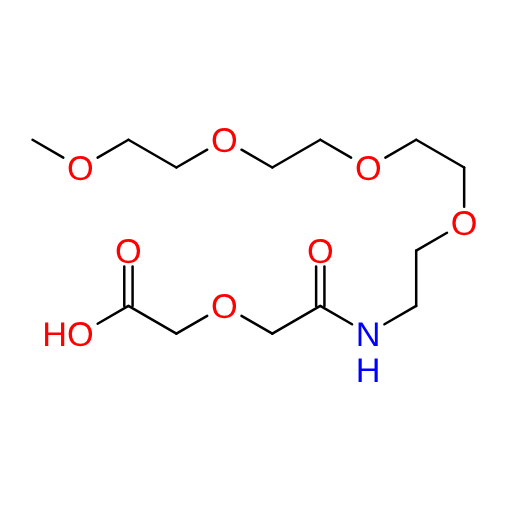
15-Oxo-2,5,8,11,17-pentaoxa-14-azanonadecan-19-oic acid (97%)
Molecular Formula: C13H25NO8
CAS#: None
SMILES: O=C(COCC(O)=O)NCCOCCOCCOCCOC
MDL#: None
Catalog#: AMTGC1271-PA24
Molecular weight: 323.34 g/mol
Appearance: Yellow Liquid
Purity: 97%
Storage: No special considerations
Solubility: Dichloromethane, Chloroform, Methanol
Other names:
- mPEG4 diglycolamic acid
- mPEG4-diglycolic acid monoamide
- Methoxy-PEG4 amide acid linker
- N-(2,5,8,11-tetraoxatridecan-13-yl)-2-(carboxymethoxy)acetamide
Fields of Interest
Functionalized PEGs, acid PEGs, methoxy PEGs, oligoethylene glycol linkers, amide linkers, medicinal chemistry, drug discovery, antibody-drug conjugates, bioconjugation, linker synthesis, pharmaceutical research, molecular modification, custom synthesis
Background
15-Oxo-2,5,8,11,17-pentaoxa-14-azanonadecan-19-oic acid is a discrete, monofunctional oligoethylene glycol linker containing a methoxy-terminated PEG-like chain, an internal amide, an additional ether within the acid-bearing segment, and a terminal carboxylic acid. Based on the supplied SMILES, O=C(COCC(O)=O)NCCOCCOCCOCCOC, the structure has molecular formula C13H25NO8 and molecular weight approximately 323.34 g/mol.
The molecule is structurally related to mPEG4-amine, but the amine has been converted into an amide attached to a diglycolic-acid-derived segment. The resulting structure can be represented as:
MeO-(CH2CH2O)4-CH2CH2-NH-C(O)-CH2-O-CH2-COOH
This architecture provides a relatively long, flexible, ether-rich spacer while retaining only one readily activated terminal group: the carboxylic acid. The opposite end is capped with a methoxy group, reducing the likelihood of uncontrolled bifunctional crosslinking.
The internal amide and additional ether distinguish this compound from simpler mPEG carboxylic acids. Together, these functionalities increase polarity and provide additional hydrogen-bonding capability while preserving the conformational flexibility associated with discrete oligoethylene glycol chains.
The terminal carboxylic acid can be converted into activated esters or coupled directly using standard peptide-coupling reagents, providing a route to amide-linked conjugates. Because the spacer is molecularly defined rather than polydisperse, it can provide reproducible linker length and composition in medicinal-chemistry and conjugation studies.
Applications
15-Oxo-2,5,8,11,17-pentaoxa-14-azanonadecan-19-oic acid is particularly useful as a monofunctional hydrophilic linker building block. Activation of its terminal carboxylic acid enables coupling to primary or secondary amines on drugs, ligands, peptides, fluorophores, or other molecular components.
The methoxy-capped oligoethylene glycol chain introduces a defined flexible spacer without leaving a second highly reactive terminus. This can be advantageous in medicinal chemistry, where a researcher may want to modify molecular polarity, spacing, or solubility while avoiding additional conjugation chemistry at the distal end of the linker.
Its architecture is also relevant to antibody-drug conjugate and drug-linker design. Patent literature on branched ADC linkers demonstrates the use of closely related mPEG4-amine-derived, amide-containing carboxylic-acid linker architectures in the construction of complex drug-linker systems. In those systems, mPEG4-derived segments provide defined hydrophilic spacing within larger conjugate structures.
The compound can also serve as a useful building block in peptide and bioconjugate chemistry. The terminal acid can be coupled to amine-containing biomolecules or synthetic intermediates, while the ether-rich chain separates the attached component from the terminal methoxy group and can reduce the hydrophobic character of a larger molecular construct.
More broadly, this linker is relevant to custom molecular modification, pharmaceutical intermediate synthesis, and functional materials where a discrete hydrophilic spacer containing both ether and amide functionality is desired.
Literature:
Peer-reviewed publications specifically identifying this exact discrete compound were not located in the indexed literature reviewed. The following references support the broader use of defined PEG linkers, amide-linked PEG conjugates, and hydrophilic PEG segments in drug- and biomolecule-conjugate design.
- Knop, K.; Hoogenboom, R.; Fischer, D.; Schubert, U. S. “Poly(ethylene glycol) in Drug Delivery: Pros and Cons as Well as Potential Alternatives.” Angew. Chem. Int. Ed. 2010, 49, 6288–6308. DOI: 10.1002/anie.200902672.
- This review examines how PEG and defined oligoethylene glycol segments can modify the solubility, flexibility, circulation behavior, and other physicochemical properties of conjugated molecules. It provides broad support for incorporating methoxy-terminated PEG spacers into pharmaceutical and biomolecular designs.
- Roberts, M. J.; Bentley, M. D.; Harris, J. M. “Chemistry for Peptide and Protein PEGylation.” Adv. Drug Deliv. Rev. 2002, 54, 459–476. DOI: 10.1016/S0169-409X(02)00022-4.
- This review covers the chemical strategies used to attach functionalized PEG derivatives to peptides and proteins. It provides relevant context for using carboxylic-acid-functionalized PEG linkers in amide-forming conjugation reactions.
- Tedeschini, T.; Campara, B.; Grigoletto, A.; Bellini, M.; Salvalaio, M.; Matsuno, Y.; Suzuki, A.; Yoshioka, H.; Pasut, G. “Polyethylene Glycol-Based Linkers as Hydrophilicity Reservoir for Antibody-Drug Conjugates.” J. Control. Release 2021, 337, 431–447. DOI: 10.1016/j.jconrel.2021.07.041.
- This study evaluates monodisperse PEG-containing drug-linker architectures in antibody-drug conjugates. The work demonstrates that PEG placement and linker design can strongly influence conjugate aggregation, stability, and pharmacokinetic behavior, providing particularly relevant class-level support for defined methoxy-PEG linker structures.