
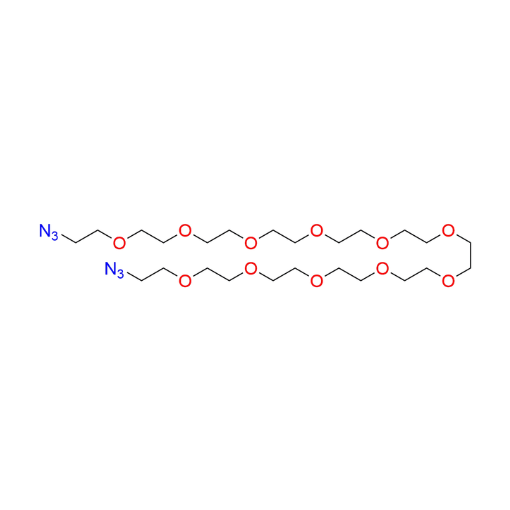
1,35-Diazido-3,6,9,12,15,18,21,24,27,30,33-undecaoxapentatriacontane
Molecular Formula: C24H48N6O11
CAS#: 1392284-57-9
SMILES: [N-]=[N+]=NCCOCCOCCOCCOCCOCCOCCOCCOCCOCCOCCOCCN=[N+]=[N-]
MDL#: MFCD28385475
Catalog#: AMTGC1250-DA24
Molecular weight: 596.67 g/mol
Appearance: Colorless liquid
Purity: 98.8%
Storage: Room temperature
Solubility: Dichloromethane, Chloroform, Methanol
Other names:
- Azido-PEG12-azide
- AZIDO-PEG11-AZIDE
- N3-PEG11-N3
- PEG11 diazide
- Bis-azido PEG11
Fields of Interest:
Click chemistry, bioconjugation, chemical biology, PROTAC development, drug delivery, biomaterials, polymer chemistry, surface functionalization, molecular crosslinking, specialty chemical synthesis.
Background
Azido-PEG11-azide (CAS 1392284-57-9) is a long-chain, homobifunctional PEG linker containing two terminal azide groups separated by a flexible, hydrophilic PEG11 spacer. The extended polyethylene glycol chain provides substantial molecular spacing and flexibility while increasing the hydrophilic character of molecules or materials into which the linker is incorporated.
Both terminal azides provide bioorthogonal handles for click chemistry, reacting with terminal alkynes through copper-catalyzed azide–alkyne cycloaddition (CuAAC) or with strained cyclooctynes such as DBCO and BCN through strain-promoted azide–alkyne cycloaddition (SPAAC). These reactions generate stable triazole linkages, making Azido-PEG11-azide particularly useful when two alkyne- or cyclooctyne-functionalized components need to be connected through a relatively long, hydrophilic spacer.
Applications
Azido-PEG11-azide is useful in bioconjugation, chemical biology, drug delivery research, PROTAC development, polymer modification, surface functionalization, biomaterials, and specialty chemical synthesis. Its two equivalent azide termini allow the linker to function as a molecular bridge or crosslinker, while the PEG11 spacer provides controlled separation between the connected components.
The linker can be used to connect alkyne-, DBCO-, or BCN-functionalized proteins, peptides, small molecules, polymers, nanoparticles, surfaces, or other molecular constructs. Its extended PEG spacer can be particularly advantageous when greater distance between conjugated components is desired or when a more hydrophilic linker is preferred. Commercial references also identify Azido-PEG11-azide as a PEG linker suitable for PROTAC synthesis.
Literature:
- ACS Chemical Biology, 2022, vol. 17, # 4, p. 957 – 968
- Chemistry – A European Journal, 2017, vol. 23, # 19, p. 4730 – 4735
- Bioorganic and Medicinal Chemistry, 2019, vol. 27, # 5, p. 700 – 707
- Organic Process Research and Development, 2024, vol. 28, # 10, p. 3913 – 3921
![Molecular structure for PEG 4,4,5,5-Tetramethyl-2-[4-(3,6,9,12-tetraoxatridec-1-yloxy)phenyl]-1,3,2-dioxaborolane, also known as Ethoxy-PEG4 phenyl boronic ester (CAS 1181210-11-6), from Frontier Specialty Chemicals.](https://frontierspecialtychemicals.com/wp-content/uploads/2026/03/AMTB1292-TE19-Square-510x510-1.png)