
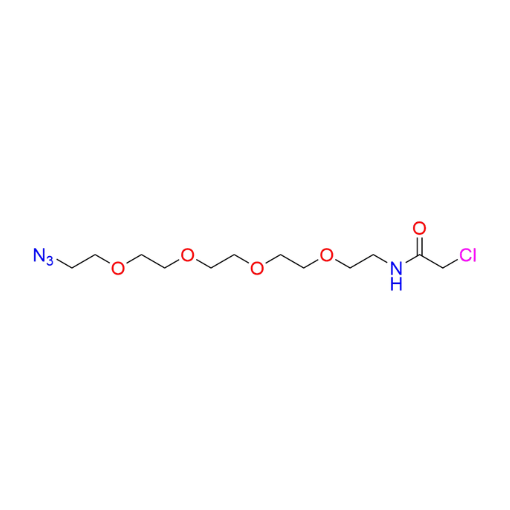
N-(14-azido-3,6,9,12-tetraoxatetradecyl)-2-chloroacetamide
Molecular Formula: C12H23ClN4O5
CAS#: None
SMILES: O=C(CCl)NCCOCCOCCOCCOCCN=[N+]=[N-]
MDL#: None
Catalog#: AMTH422-AA24
Molecular weight: 338.79 g/mol
Appearance: Pale yellow liquid
Purity: 98.3%
Storage: Room temperature
Solubility: Dichloromethane, Chloroform, Methanol
Other names:
- Azido-PEG4-chloroacetamide
- N3-PEG4-chloroacetamide
- Chloroacetamide-PEG4-azide
- ClAc-PEG4-N3
Fields of Interest
Click chemistry, bioconjugation, chemical biology, cysteine modification, protein labeling, peptide modification, covalent probe development, proteomics, medicinal chemistry, PROTAC research, molecular linker synthesis, biomaterials, specialty chemical synthesis
Background
N-(14-Azido-3,6,9,12-tetraoxatetradecyl)-2-chloroacetamide is a heterobifunctional PEG linker containing a terminal azide (N₃) and a chloroacetamide group separated by a flexible, hydrophilic oligoethylene glycol spacer. These two functionalities provide complementary reaction pathways, making the compound particularly useful for sequential and orthogonal molecular conjugation.
The terminal azide provides a bioorthogonal handle for copper-catalyzed azide–alkyne cycloaddition (CuAAC) and strain-promoted azide–alkyne cycloaddition (SPAAC). The chloroacetamide functionality acts as an electrophilic group capable of reacting with nucleophilic thiols, particularly cysteine residues, through displacement of chloride to form a stable thioether linkage. The PEG spacer provides molecular flexibility and separation between these reactive groups while increasing the hydrophilic character of the linker.
Applications
N-(14-Azido-3,6,9,12-tetraoxatetradecyl)-2-chloroacetamide is well suited for bioconjugation, chemical biology, protein modification, peptide modification, covalent probe development, and multifunctional linker synthesis. The chloroacetamide group provides a thiol-reactive handle for covalent modification of accessible cysteine residues, while the terminal azide can be retained for subsequent attachment of alkyne-, DBCO-, or BCN-functionalized molecules through click chemistry.
This combination is particularly useful for constructing multifunctional probes and conjugates in which cysteine-directed attachment is followed by bioorthogonal labeling, affinity-tag installation, fluorophore attachment, or incorporation of another molecular component. Chloroacetamide-containing reagents have been investigated for covalent protein and peptide modification, while azide functionality provides a complementary route for modular molecular assembly.
Literature:
There is strong literature for both chloroacetamide-mediated cysteine conjugation and closely related azido-PEG/chloroacetamide architectures.
- Dadová, J.; Orság, P.; Pohl, R.; Brázdová, M.; Fojta, M.; Hocek, M. “Chloroacetamide-Linked Nucleotides and DNA for Cross-Linking with Peptides and Proteins.” Bioconjugate Chemistry 2016, 27, 2089–2094. DOI: 10.1021/acs.bioconjchem.6b00342.
Synopsis: Demonstrated efficient reaction of chloroacetamide-functionalized biomolecules with cysteine, glutathione, cysteine-containing peptides, and proteins. The authors observed nearly quantitative cysteine/GSH conjugation in model reactions and successfully cross-linked modified DNA with p53 through cysteine alkylation. This provides particularly strong support for describing the chloroacetamide terminus of your PEG linker as a thiol/cysteine-reactive conjugation handle. - Brunderová, M.; et al. “Chloroacetamide-Modified Nucleotide and RNA for Bioconjugations and Cross-Linking with RNA-Binding Proteins.” Angewandte Chemie International Edition 2023. DOI: 10.1002/anie.202213764.
Synopsis: Developed chloroacetamide-functionalized RNA probes that formed stable covalent conjugates with thiol-containing molecules and cysteine-containing peptides and successfully cross-linked RNA-binding proteins. The study supports chloroacetamide functionality for bioconjugation, protein cross-linking, and proteomics-oriented probe development. - Müller, M.; et al. “Synthesis of Bifunctional Azobenzene Glycoconjugates for Cysteine-Based Photosensitive Cross-Linking with Bioactive Peptides.” Chemistry – A European Journal 2015. DOI: 10.1002/chem.201501571.
Synopsis: Prepared chloroacetamide-functionalized bifunctional crosslinkers and demonstrated ligation to cysteine side chains through nucleophilic substitution. This is relevant to your compound’s positioning as a heterobifunctional linker for cysteine-directed molecular assembly. - “Facile Rebridging Conjugation Approach to Attain Monoclonal Antibody-Targeted Nanoparticles with Enhanced Antigen Binding and Payload Delivery.” Bioconjugate Chemistry (2024). DOI: 10.1021/acs.bioconjchem.4c00275.
Synopsis: Particularly relevant structurally: the authors synthesized a conjugation reagent incorporating azido-PEG functionality together with chloroacetamide groups and used this chemistry in an antibody-conjugation strategy. Although it is not your exact compound, it provides direct precedent for combining azide/PEG and chloroacetamide functionality within the same linker system.