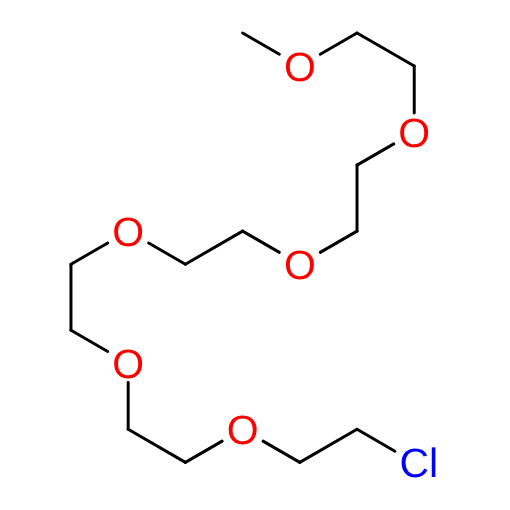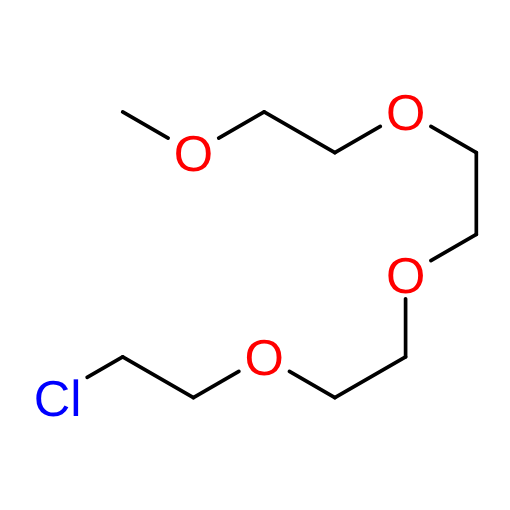
13-Chloro-2,5,8,11-tetraoxatridecane (98%)
Molecular Formula: C9H19ClO4
CAS#: 57722-04-0
SMILES: ClCCOCCOCCOCCOC
MDL#: MFCD26910593
Catalog#: AMTGC291-CT17
Molecular weight: 226.70 g/mol
Appearance: Yellow liquid
Purity: 98%
Storage: Room Temperature
Solubility: Dichloromethane, Chloroform, Methanol
Other names:
- Me-PEG3-CH2CH2Cl
- 1-Chloro-2-{2-[2-(2-methoxyethoxy)ethoxy]ethoxy}ethane
Fields of Interest:
Functionalized PEGs, Organic Synthesis, Nucleophilic Substitution, Oligoethylene Glycol Sorting Tags, Combinatorial Chemistry, Polymer and Materials Research
Background
13-Chloro-2,5,8,11-tetraoxatridecane (CAS 57722-04-0) is a methoxy-capped oligoethylene glycol building block used to introduce a defined ether-containing chain through nucleophilic substitution. Its structure contains four ether oxygen atoms and a terminal primary alkyl chloride. The chloride provides the reactive attachment site, while the methyl ether caps the opposite end, supporting the preparation of molecules bearing a single terminal oligoether substituent.
The compound combines a flexible, polar chain with an electrophilic carbon suitable for reaction with appropriately selected nucleophiles. Its use in preparing oligoethylene glycol sorting tags provides a documented example of this chemistry. The defined chain length is particularly useful when researchers need a specific molecular composition or want to compare derivatives containing different numbers of ethylene glycol units. Reaction conditions and the choice of nucleophile determine how the chloride terminus is converted into the desired linkage.
Applications
13-Chloro-2,5,8,11-tetraoxatridecane supports synthetic applications that connect its terminal chloride reactivity with its discrete oligoether structure.
Ether formation and oligoether attachment: The primary chloride can undergo substitution with oxygen nucleophiles, providing a route to compounds bearing a methoxy-capped oligoethylene glycol chain. Published sorting-tag chemistry uses this compound in constructing substituted aromatic derivatives, demonstrating its value for attaching a defined oligoether segment to a molecular scaffold.
Sorting tags for solution-phase synthesis: This exact compound has been prepared as an intermediate in a family of oligoethylene glycol tags used during the synthesis of hydroxybutenolide stereoisomers. Differences in tag length enable chromatographic separation of tagged products, supporting workflows in which compounds are reacted together and subsequently separated into individual components.
Building blocks for materials research: Its terminal chloride offers a potential attachment route for installing oligoether side chains on suitable molecular precursors. Related research on oligoethylene glycol-substituted polyisocyanates demonstrates that side-chain structure can influence aqueous phase-transition behavior. This provides materials-design context for the compound, although those polymer results do not establish equivalent behavior for this chloride or every derivative prepared from it.
Literature:
- Journal of Chemical Research – Part S, 2003, # 11, p. 698 – 699
- Journal of Medicinal Chemistry, 2014, vol. 57, # 22, p. 9480 – 9494
- Gudipati, V.; Curran, D. P.; Wilcox, C. S. “Solution-Phase Parallel Synthesis with Oligoethylene Glycol Sorting Tags. Preparation of All Four Stereoisomers of the Hydroxybutenolide Fragment of Murisolin and Related Acetogenins.” The Journal of Organic Chemistry 2006, 71, 3599–3607. DOI: 10.1021/jo060217x
- Reports oligoethylene glycol sorting tags for parallel synthesis; the supporting information identifies this exact compound as intermediate 5d.
- Sakai, N.; Jin, M.; Sato, S.; Satoh, T.; Kakuchi, T. “Synthesis of water-soluble polyisocyanates with the oligo(ethylene glycol) side-chain as new thermoresponsive polymers.” Polymer Chemistry 2014, 5, 1057–1062. DOI: 10.1039/C3PY00972F
- Examines how related oligoethylene glycol side chains affect polymer behavior in water, providing materials-research context rather than an exact-compound application.