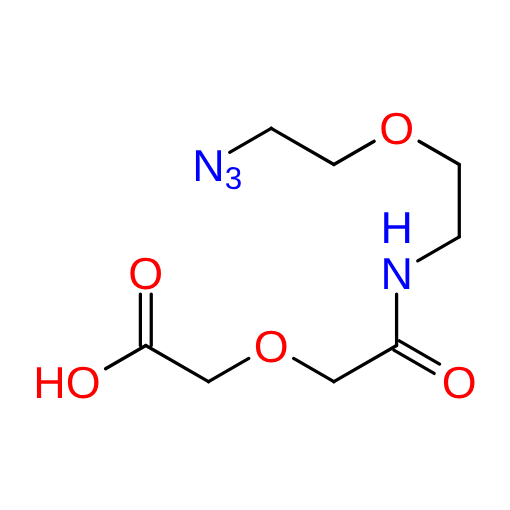
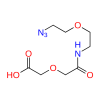
11-Azido-5-oxo-3,9-dioxa-6-azaundecan-1-oic acid (96%)
Molecular Formula: C8H14N4O5
CAS#: None
SMILES: O=C(COCC(O)=O)NCCOCCN=[N+]=[N-]
MDL#: None
Catalog#: AMTGC1272-OA24
Molecular weight: 246.22 g/mol
Appearance: Dark Liquid
Purity: 96%
Storage: No Special Considerations
Solubility: Dichloromethane, Chloroform, Methanol
Other names:
- Azidoethoxyethyl diglycolamic acid
- N-(2-(2-Azidoethoxy)ethyl)diglycolamic acid
- N3-EOE-diglycolamic acid
- Azidoether amide acid linker
Fields of Interest
Functionalized PEGs, azido PEGs, acid PEGs, click chemistry, bioconjugation, peptide chemistry, medicinal chemistry, chemical biology, drug discovery, PROTAC linker synthesis, molecular probe development, biomolecular labeling, custom linker synthesis
Background
11-Azido-5-oxo-3,9-dioxa-6-azaundecan-1-oic acid is a compact heterobifunctional linker containing a terminal azide and carboxylic acid, together with two ether oxygens and an internal amide. Based on the supplied SMILES, O=C(COCC(O)=O)NCCOCCN=[N+]=[N-], the compound has molecular formula C8H14N4O5 and molecular weight approximately 246.22 g/mol.
Structurally, the molecule can be represented as:
N3–CH2CH2–O–CH2CH2–NH–C(O)–CH2–O–CH2–COOH
This architecture combines two complementary reactive termini. The azide provides a compact bioorthogonal handle for copper-catalyzed azide–alkyne cycloaddition (CuAAC) and strain-promoted azide–alkyne cycloaddition (SPAAC), while the carboxylic acid can be activated for coupling with primary or secondary amines.
The acid-containing portion is derived conceptually from diglycolic acid, giving the characteristic –NH–C(O)–CH2–O–CH2–COOH motif. Related diglycolic anhydride chemistry has been used to prepare structurally defined amide/carboxylic-acid linkers for peptide and protein conjugation.
This distinction is important because the additional ether oxygen differentiates the molecule from a corresponding succinamic-acid linker. It provides additional polarity and flexibility while maintaining a short overall spacer. As a discrete molecular linker, the compound also offers precisely defined composition and spacing rather than the molecular-weight distribution associated with polydisperse PEG materials.
Applications
11-Azido-5-oxo-3,9-dioxa-6-azaundecan-1-oic acid is well suited to sequential and orthogonal conjugation chemistry. Its terminal carboxylic acid can first be activated and coupled to an amine-containing peptide, ligand, drug, fluorophore, or other scaffold while retaining the distal azide for subsequent click chemistry.
This architecture is particularly useful in bioconjugation and chemical biology. Following attachment through the carboxylic acid, the remaining azide can react with an alkyne- or cyclooctyne-functionalized reporter, affinity tag, targeting group, biomolecule, or other molecular component. The azidoethoxyethyl motif itself has established synthetic precedent as a compact handle for preparing azide-functionalized conjugates.
In medicinal chemistry and drug discovery, the compound provides a relatively short linker for situations where researchers want to introduce orthogonal functionality without substantially increasing molecular size. Its combination of ether and amide functionality provides polarity and conformational flexibility while maintaining a considerably smaller footprint than longer PEG linkers.
The compound may also be useful in PROTAC and other multicomponent conjugate synthesis, particularly during linker optimization. Its acid can be coupled to an amine-bearing ligand while the azide provides a second attachment strategy for an alkyne-functionalized component. Comparing this compact linker with longer analogues can help researchers investigate how linker length and polarity affect the properties of the resulting conjugate.
For peptide and protein modification, the combination of a coupling-ready acid and latent click handle offers a straightforward route to azide-functionalized constructs. Related defined ether/amide/carboxylic-acid architectures have been developed specifically as conjugating agents for peptides and therapeutic proteins.
Literature:
A peer-reviewed publication explicitly identifying this exact compound by its full systematic name was not located in the literature reviewed. The references below therefore support its azide chemistry and closely related linker architecture, rather than being presented as exact-compound precedent.
- Kolb, H. C.; Finn, M. G.; Sharpless, K. B. “Click Chemistry: Diverse Chemical Function from a Few Good Reactions.” Angew. Chem. Int. Ed. 2001, 40, 2004–2021. DOI: 10.1002/1521-3773(20010601)40:11<2004::AID-ANIE2004>3.0.CO;2-5.
- This foundational paper established the click-chemistry concept and highlighted azide–alkyne cycloaddition as a robust strategy for modular molecular construction. It provides the fundamental chemical basis for using the terminal azide of this linker in CuAAC reactions.
- Agard, N. J.; Prescher, J. A.; Bertozzi, C. R. “A Strain-Promoted [3+2] Azide–Alkyne Cycloaddition for Covalent Modification of Biomolecules in Living Systems.” J. Am. Chem. Soc. 2004, 126, 15046–15047. DOI: 10.1021/ja044996f.
- This landmark publication established SPAAC as a copper-free reaction between azides and strained cyclooctynes. The chemistry directly supports use of the terminal azide in this compound for bioorthogonal conjugation.
- Sletten, E. M.; Bertozzi, C. R. “Bioorthogonal Chemistry: Fishing for Selectivity in a Sea of Functionality.” Angew. Chem. Int. Ed. 2009, 48, 6974–6998. DOI: 10.1002/anie.200900942.
- This review examines the development of selective bioorthogonal reactions for biomolecular modification. It provides broader application context for incorporating compact azide-containing linkers into chemical biology and biomolecular labeling workflows.