
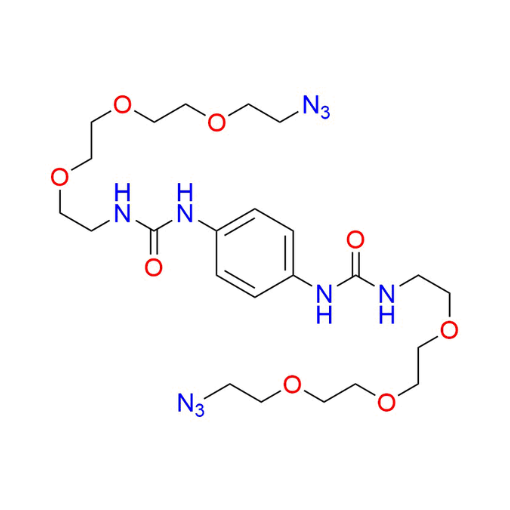
Name: 1,1′-(1,4-phenylene)bis(3-(2-(2-(2-(2-azidoethoxy)ethoxy)ethoxy)ethyl)urea)
Molecular Formula: C24H48N10O8
CAS#: None
SMILES: O=C(NC1=CC=C(NC(NCCOCCOCCOCCN=[N+]=[N-])=O)C=C1)NCCOCCOCCOCCN=[N+]=[N-]
MDL#: None
Catalog#: AMTGC1295-PU24
Molecular weight: 596.64 g/mol
Other names:
- 1,4-Phenylene bis[3-(2-(2-(2-(2-azidoethoxy)ethoxy)ethoxy)ethyl)urea]
- Bis(azido-PEG4-ethyl) para-phenylene diurea
- Bis-azido PEG4 phenylene urea linker
- PEG4 diazide bis-urea conjugate
- Aromatic bis-urea PEG4 diazide
Fields of Interest: click-chemistry, crosslinking, bioconjugation, and materials science
Background & Applications:
Background
1,1′-(1,4-phenylene)bis(3-(2-(2-(2-(2-azidoethoxy)ethoxy)ethoxy)ethyl)urea) is a symmetrical, multifunctional azide-functionalized PEG conjugate featuring two PEG4-linked azide groups connected through a central para-phenylene bis-urea core. The polyethylene glycol segments provide hydrophilicity, flexibility, and compatibility with aqueous and biological environments, while the aromatic bis-urea motif introduces structural rigidity and hydrogen-bonding capability. The terminal azide functionalities enable efficient bioorthogonal click chemistry, including CuAAC and strain-promoted azide–alkyne cycloaddition, allowing simultaneous or stepwise conjugation at both ends of the molecule. This bifunctional architecture makes the compound a versatile building block within a comprehensive portfolio of functionalized PEGs designed for modular molecular assembly and advanced materials applications.
Applications
This bis-azido PEG–urea conjugate is commonly used in crosslinking, bioconjugation, and materials science applications where dual click reactivity and a structured central linker are desired. Typical uses include preparation of PEG-based networks, incorporation into supramolecular or hydrogen-bonding systems, and click-based attachment to polymers, surfaces, nanoparticles, or biomolecules. The combination of dual azide functionality, PEG flexibility, and a rigid aromatic bis-urea core enables controlled assembly of multifunctional architectures and advanced materials. As part of a robust functionalized PEG product line, this compound supports modular design strategies in diagnostics, biomaterials development, and specialty chemical synthesis.
This bis-azido PEG–urea conjugate has click chemistry functionality with supramolecular urea interactions, making it more sophisticated than a standard PEG linker.
Appearance: Light-brown solid
Purity: 99%
Storage: Room Temp
Solubility: Dichloromethane, Chloroform, Methanol
Literature: None yet!