
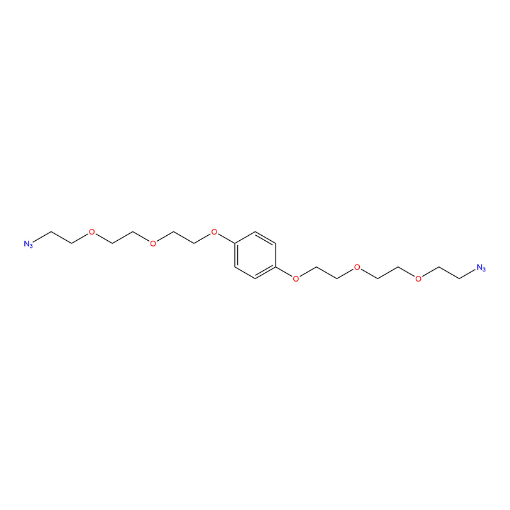
Name: 1,4-Bis(2-(2-(2-azidoethoxy)ethoxy)ethoxy)benzene
Molecular Formula: C18H28N6O6
CAS#: 2185880-97-9
SMILES: [N-]=[N+]=NCCOCCOCCOC1=CC=C(OCCOCCOCCN=[N+]=[N-])C=C1
MDL#: none
Catalog#: AMTGC1449-BA25
Molecular weight: 424.45 g/mol
Other names:
- Bis-azido PEG3 benzene linker
- PEG3 diazide aromatic linker
- Phenylene-bridged azido PEG linker
- 1,4-Phenylene bis(2-(2-(2-azidoethoxy)ethoxy)ethyl ether)
- p-Bis(PEG3-azide)benzene
Fields of Interest: click chemistry, crosslinking, bioconjugation, and materials science, PEG-based polymer networks, preparation of multifunctional intermediates, surface and nanoparticle modification, and assembly of supramolecular or rigidified architectures
Background & Applications:
Background
1,4-Bis(2-(2-(2-azidoethoxy)ethoxy)ethoxy)benzene is a symmetrical, bifunctional azide-functionalized PEG conjugate featuring two PEG3-linked azide groups attached to a central para-substituted phenylene core. The polyethylene glycol segments provide hydrophilicity, flexibility, and compatibility with aqueous and organic environments, while the aromatic core introduces structural rigidity and defined spatial orientation. The terminal azide functionalities enable highly efficient bioorthogonal click chemistry, including copper-catalyzed azide–alkyne cycloaddition (CuAAC) and strain-promoted azide–alkyne cycloaddition, allowing simultaneous or stepwise conjugation at both termini. This dual-functional architecture makes the compound a versatile intermediate within a comprehensive portfolio of functionalized PEGs designed for modular molecular assembly and advanced materials applications.
Applications
This aromatic bis-azido PEG linker is commonly used in crosslinking, bioconjugation, and materials science applications where dual click reactivity and controlled molecular spacing are required. Typical uses include construction of PEG-based polymer networks, preparation of multifunctional intermediates, surface and nanoparticle modification, and assembly of supramolecular or rigidified architectures through click chemistry. The combination of dual azide functionality, PEG flexibility, and a rigid aromatic core enables precise control over linker geometry and spacing in advanced materials and conjugate systems. As part of a robust functionalized PEG product line, this compound supports modular design strategies in diagnostics, biomaterials development, and specialty chemical synthesis.
Appearance: Colorless liquid
Purity: 99%
Storage: Room Temp
Solubility: Dichloromethane, Chloroform, Methanol
Literature:
- Journal of the American Chemical Society, 2017, vol. 139, # 42, p. 14825 – 14828
- Journal of the American Chemical Society, 2017, vol. 139, # 42, p. 14825 – 14828
- Chemical Society Reviews, 2023, vol. 52, # 21, p. 7333 – 7358