
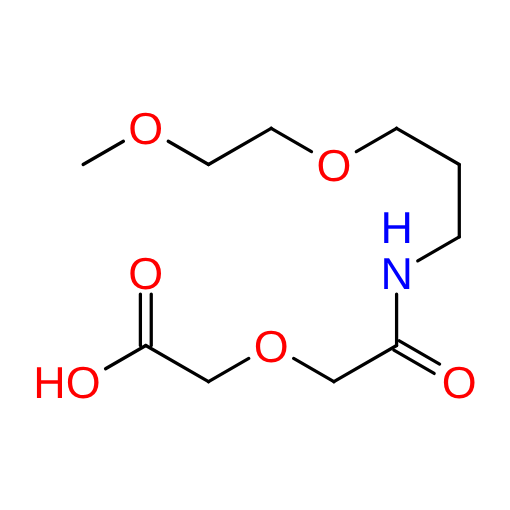
10-Oxo-2,5,12-trioxa-9-azatetradecan-14-oic acid (99%)
Molecular Formula: C10H19NO6
CAS#: 1292462-57-7
SMILES: COCCOCCCNC(COCC(O)=O)=O
MDL#: None
Catalog#: AMTGC1270-OT24
Molecular weight: 249.26 g/mol
Appearance: Pale Yellow Liquid
Purity: 99%
Storage: No special considerations
Solubility: Dichloromethane, Chloroform, Methanol
Other names:
- Methoxyether amide carboxylic acid
- Methoxy-oligoether acid linker
- mPEG-amide-acid linker
- Methoxy-PEG acid building block
Fields of Interest
Functionalized PEGs, acid PEGs, oligoethylene glycol linkers, carboxylic acid linkers, medicinal chemistry, bioconjugation, drug discovery, linker synthesis, peptide chemistry, molecular modification, materials chemistry, custom synthesis
Background
10-Oxo-2,5,12-trioxa-9-azatetradecan-14-oic acid (CAS 1292462-57-7) is a discrete ether-containing linker featuring a methoxy-terminated oligoether segment, an internal amide, and a terminal carboxylic acid. Based on the supplied structure, COCCOCCCNC(=O)COCC(=O)O, the compound has a molecular formula of C10H19NO6 and a molecular weight of approximately 249.26 g/mol.
Unlike heterobifunctional azido-PEG acids, this compound has only one readily activated terminal functional group: the carboxylic acid. The opposite end is capped with a chemically stable methoxy group. This makes the compound useful as a monofunctional linker or molecular modifier, rather than as a linker designed to connect two components through independently reactive termini.
The molecule also differs structurally from a conventional linear PEG acid. Its ether-containing chain is interrupted by an amide-containing segment, providing additional hydrogen-bonding capability and polarity. The terminal carboxylic acid can be activated using standard coupling chemistry for reaction with primary or secondary amines, while the methoxy terminus remains nonreactive under typical amide-coupling conditions.
As a discrete molecular species, CAS 1292462-57-7 provides a precisely defined spacer rather than the molecular-weight distribution associated with polydisperse PEG materials. This can be useful in medicinal chemistry and molecular design where researchers need reproducible control over linker composition and molecular spacing.
Applications
10-Oxo-2,5,12-trioxa-9-azatetradecan-14-oic acid can be used as a carboxylic acid building block for amide coupling. Activation of the terminal acid with reagents such as carbodiimides or uronium/phosphonium coupling agents provides a route to conjugation with amine-containing drugs, ligands, peptides, or other molecular scaffolds.
Because the opposite terminus is methoxy-capped, incorporation of the compound introduces a defined hydrophilic ether-containing segment without leaving a second highly reactive functional group. This can be advantageous when the objective is to modify the polarity, spacing, or physicochemical properties of a molecule while avoiding subsequent cross-reactivity at the distal end of the linker.
In medicinal chemistry, defined ether-containing acid linkers can be used to explore the effect of linker length and polarity on properties such as solubility, conformational flexibility, and molecular recognition. The terminal carboxylic acid makes this compound particularly convenient for derivatizing amine-containing pharmacophores through stable amide formation.
The compound may also serve as a building block in peptide and bioconjugate chemistry, where a short hydrophilic spacer is desired between an amine-bearing component and a methoxy-capped terminus. Its combination of ether and amide functionality provides a more polar alternative to simple hydrocarbon carboxylic-acid spacers.
More broadly, CAS 1292462-57-7 can be incorporated into custom linker synthesis and functional materials research when a precisely defined oligoether spacer with a single carboxylic-acid coupling handle is required.
Literature:
We could not identify a peer-reviewed publication that could be confidently assigned to CAS 1292462-57-7 or the exact supplied structure. The references below therefore provide class-level support for the use of discrete PEG/oligoether linkers in molecular modification and bioconjugation rather than exact-compound precedent.
- Knop, K.; Hoogenboom, R.; Fischer, D.; Schubert, U. S. “Poly(ethylene glycol) in Drug Delivery: Pros and Cons as Well as Potential Alternatives.” Angew. Chem. Int. Ed. 2010, 49, 6288–6308. DOI: 10.1002/anie.200902672.
- This review examines the physicochemical characteristics that make PEG and related ether-rich structures useful in drug-delivery and biomedical applications. It provides broader context for using defined oligoether spacers to introduce flexibility and hydrophilic character into molecular constructs.
- Roberts, M. J.; Bentley, M. D.; Harris, J. M. “Chemistry for Peptide and Protein PEGylation.” Adv. Drug Deliv. Rev. 2002, 54, 459–476. DOI: 10.1016/S0169-409X(02)00022-4.
- This review describes PEG functionalization and conjugation strategies for peptides and proteins, including the use of activated functional groups to form stable covalent linkages. The chemistry provides useful context for employing carboxylic-acid-functionalized oligoether building blocks in amide-forming conjugation reactions.