
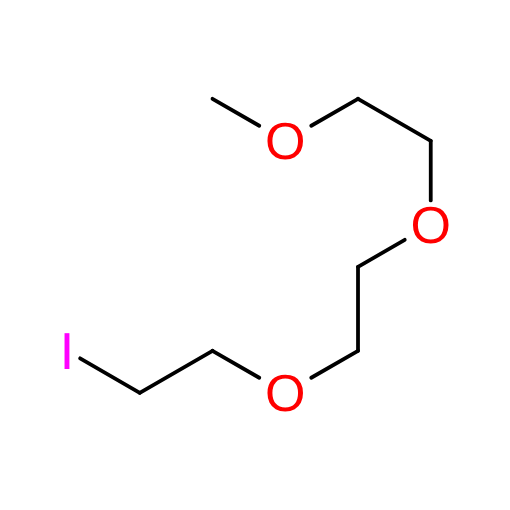
1-Iodo-3,6,9-trioxadecane (97%)
Molecular Formula: C7H15IO3
CAS#: 62999-96-6
SMILES: ICCOCCOCCOC
MDL#: MFCD26911322
Catalog#: AMTGC342-TO17
Molecular weight: 274.10 g/mol
Appearance: Yellow liquid
Purity: 97%
Storage: sealed, dry, protected from light at 2–8 °C
Solubility: Dichloromethane, Chloroform, Methanol
Other names:
- Me-PEG2-CH2CH2I
- 3,6,9-Trioxadecyl iodide
- 1-Iodo-2-[2-(2-methoxyethoxy)ethoxy]ethane
- mPEG3-I
- m-PEG3-I
- Methoxy-PEG3-iodide
Fields of Interest:
Functionalized PEGs, PEG linker synthesis, organic synthesis, medicinal chemistry, drug discovery, supramolecular chemistry, porphyrin and phthalocyanine chemistry, organic electronics, functional materials, polymer chemistry, surface functionalization, specialty chemical synthesis
Background
1-Iodo-3,6,9-trioxadecane (CAS 62999-96-6) is a monofunctional, discrete oligoethylene glycol derivative containing a methoxy-terminated triethylene glycol chain and a primary iodoethyl terminus. The molecule combines the flexibility and hydrophilic character of an oligoethylene glycol segment with the synthetic reactivity of a primary alkyl iodide. Frontier’s AMT catalog lists the compound under this exact name and CAS number.
The terminal iodide provides an effective leaving group for nucleophilic substitution and alkylation reactions, allowing the defined oligoethylene glycol chain to be introduced into a variety of molecular structures. In contrast, the methoxy group caps the opposite end of the molecule and is relatively unreactive under many common synthetic conditions. This makes 1-Iodo-3,6,9-trioxadecane particularly useful as a single-point PEG/OEG modification reagent rather than as a bifunctional crosslinker.
Because its oligoethylene glycol segment is discrete rather than polydisperse, the compound provides a defined molecular structure and spacer length. This can be valuable when researchers need reproducible control over molecular spacing, polarity, flexibility, or hydrophilic character. Compared with the longer 13-Iodo-2,5,8,11-tetraoxatridecane (CAS 143127-81-5), this compound offers the same general methoxy/iodide architecture with a shorter oligoethylene glycol segment.
Applications
1-Iodo-3,6,9-trioxadecane is primarily useful as a synthetic alkylating reagent for introducing a short methoxy-terminated oligoethylene glycol chain into other molecules. The primary iodide can undergo substitution with suitable nitrogen-, sulfur-, oxygen-, and other nucleophiles, enabling the preparation of PEG/OEG-modified small molecules, ligands, functional materials, polymers, and other specialty compounds.
The compound has particularly good precedent in porphyrin, phthalocyanine, and photosensitizer chemistry. Alkylation with 1-iodo-3,6,9-trioxadecane has been used to introduce oligoethylene glycol functionality into nitrogen-containing chromophores and ligands. For example, published work on BODIPY-substituted iridium(III) N-heterocyclic carbene complexes used 1-iodo-3,6,9-trioxadecane to alkylate NHC precursors, producing glycolated ligands for photophysical, photodynamic-therapy, and antimicrobial studies. This demonstrates the compound’s utility for incorporating hydrophilic OEG substituents into complex photoactive molecular architectures.
Related phthalocyanine research has used 1-iodo-3,6,9-trioxadecane in quaternization reactions to generate charged, oligoethylene-glycol-containing macrocycles. Such modification can substantially alter properties such as aqueous compatibility, aggregation behavior, and intermolecular interactions. These applications make the reagent relevant not only to PEG-linker synthesis but also to functional dye, photosensitizer, coordination, and materials chemistry.
The compound has also been used in polymer functionalization, including quaternization of tertiary-amine-containing polyglycidol materials with the oligoethylene glycol iodide. This illustrates another useful role for the molecule: simultaneously installing an ionic center through alkylation while introducing a short hydrophilic OEG substituent.
In medicinal and bioactive-molecule synthesis, the same chemistry can be used to incorporate a defined OEG segment into molecular scaffolds where researchers wish to modify spacing or physicochemical characteristics. The iodide should therefore be viewed primarily as a synthetically reactive precursor functionality, rather than as a bioorthogonal conjugation group like an azide or alkyne.
Literature:
- Journal of Medicinal Chemistry, 2008, vol. 51, # 3, p. 502 – 511
- Chemistry of Materials, 2012, vol. 24, # 9, p. 1583 – 1590
- Tetrahedron Letters, 1983, vol. 24, # 47, p. 5215 – 5218
- Descotes, G.; Praly, J.-P.; Bouchu, A. “Synthèse et applications de dérivés polyoxygénés du saccharose.” Carbohydrate Research 1986, 152, 137–142. DOI: 10.1016/0008-6215(86)80046-5.
- This early study is indexed specifically in connection with CAS 62999-96-6 and describes polyoxygenated synthetic chemistry involving the compound. It provides direct historical literature precedent for the use of this defined oligoethylene glycol iodide in carbohydrate-related synthetic chemistry.
- “Neutral Iridium(III) Complexes Bearing BODIPY-Substituted N-Heterocyclic Carbene (NHC) Ligands: Synthesis, Photophysics, In Vitro Theranostic Photodynamic Therapy, and Antimicrobial Activity.”
- The experimental procedures directly use 1-iodo-3,6,9-trioxadecane to alkylate NHC precursors used to prepare glycolated ligands. The resulting iridium/BODIPY systems were studied for their photophysical behavior and potential photodynamic and antimicrobial applications, providing strong exact-compound support for this reagent in advanced chromophore and coordination chemistry.
- “Negatively Charged and Water-Soluble Phthalocyanines: Synthesis, Photochemical Properties, and Structure–Activity Relationships.” Related phthalocyanine literature summarized in Dumoulin, F.; Durmuş, M.; Ahsen, V.; Nyokong, T. “Synthetic Pathways to Water-Soluble Phthalocyanines and Close Analogues.” Coordination Chemistry Reviews 2010, 254, 2792–2847.
- The reviewed work documents the use of 1-iodo-3,6,9-trioxadecane in quaternization of phthalocyanine derivatives, producing oligoethylene-glycol-containing ionic macrocycles. This supports the reagent’s relevance to phthalocyanine functionalization and modification of water compatibility and aggregation behavior.